2004 Toyota RAV4 Reliability & Problems
By Adrian V. LockhartUpdated All 154 NHTSA owner reports researched and classified
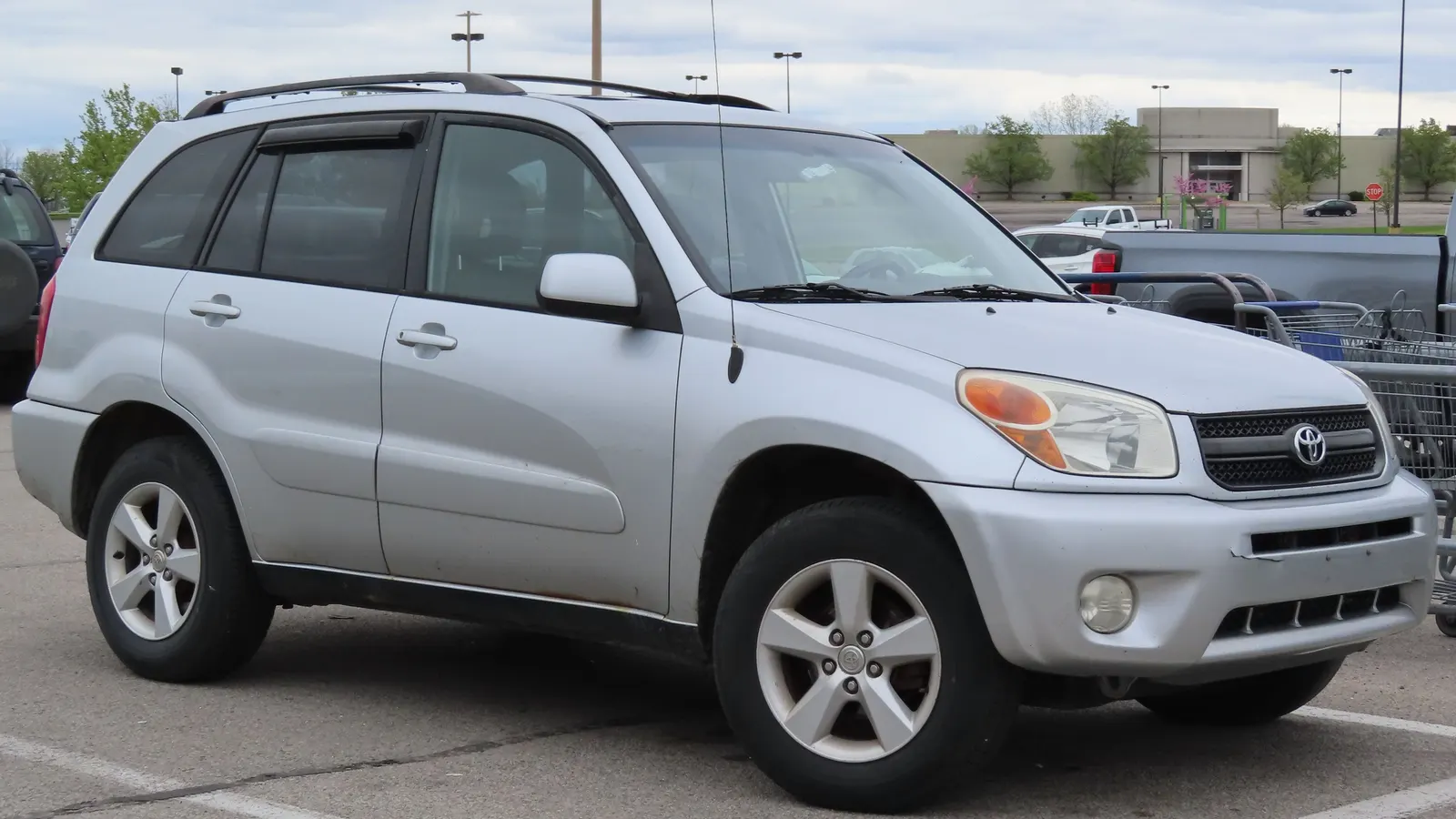
Pictured: 2004 or 2005 Toyota RAV4 4WD L. Photo: MercurySable99, CC BY-SA 4.0, cropped
Owner complaints
154
21 report a crash, fire, injury or death
Recalls
2
1 with a do-not-drive warning
Most common problem
14%
of complaints: head gasket or misfire problems
Complaints per year filed
2004–2024 · peak 34
In short
Some known problemsThe 2004 Toyota RAV4 has some known problems, mainly because of a do-not-drive recall (15V284000) for the driver air bag. NHTSA has 154 owner complaints, and 21 report a crash, fire, injury or death. The most common are misfires or head gasket failure and sudden or unintended acceleration. It has 2 recalls.
Reliability
How Reliable Is the 2004 Toyota RAV4?
The 2004 RAV4 has the verdict of some known problems, and the reason is an official one. The driver air bag recall 15V284000 tells owners not to drive the vehicle until the remedy is done. Beyond that, the owner complaints are split between engine trouble and a smaller group of frightening acceleration events. One serious engine problem and one critical safety problem lead the list, and most of the rest is minor.
Misfires or head gasket failure is the most common problem, at about 1 in 7 complaints. Owners describe coolant leaks, overheating, blown head gaskets and stripped bolts. Many mention being told the engine needed replacing, and 13 owners gave a repair cost, with a median of $5,000. Few of these reports describe an immediate safety risk, but the cost can be large. This model year has no recall for it.
Sudden or unintended acceleration is less common, at about 1 in 10 complaints, but it is the more serious problem. Owners describe the car surging forward while parking, accelerating while they pressed the brake, and a pedal that responded erratically. One owner mentions recall 11V113000, but this model year has no recall of its own for it. Only one owner described the result of a repair, and it did not fix the problem. Complaints lean toward repairs that failed, so a past dealer visit does not prove the problem is gone.
The air bag recalls matter here. Recall 15V284000 says the dual-stage driver air bag may be susceptible to moisture intrusion which, over time, could cause the inflator to rupture, and owners are advised not to drive until the remedy is completed. Recall 19V741000 covers vehicles whose driver or passenger inflators were previously replaced with the same design, and Toyota will notify owners. A car that had one recall done may still be covered by the other.
Mileage helps you read an odometer. Sudden acceleration is reported early, with a median of about 50,200 miles and half of reports between 35,000 and 66,500 miles. Head gasket and misfire problems come later, with a median of about 90,500 miles and half of reports between 77,800 and 121,000 miles. A 2004 RAV4 in the 80,000 to 120,000 mile range deserves a careful look at the cooling system. Complaint counts show what owners reported, not how many vehicles are affected, and they cannot show how a particular vehicle was maintained, so get a pre-purchase inspection and the service history.
Top problems
The 2 problems owners report most
Named from 154 NHTSA complaints. Open a problem for symptoms, the fix, cost and owners' accounts.
1.Misfires or head gasket failureSeriousAbout 1 in 7 complaints77,800–121,000 mi~$5,000 repair
Owners describe coolant leaks, overheating, blown head gaskets and stripped bolts, often noticed while driving. Half of the reports come from between about 77,800 and 121,000 miles, with a median of about 90,500 miles. Engine replacement is the repair owners are most often quoted, and this model year has no recall for it.
What owners describe
- Blown head gasket68%
- Coolant leak59%
- Engine overheating41%
- Stripped head bolts23%
Fix
Most common repair owners describe: engine replacement needed (3 reports).
Mileage
90,500 mi
Middle half 77,800–121,000 mi · 22 reports
Repair cost
$5,000
Middle half $1,950–$6,130 · 13 owner amounts
How common
14%
22 of 154 complaints
Crash, fire or injury
5%
of these complaints
In owners' words
“The head bolts pulled loose from the engine block and the engine leaked oil from the head gasket area.”
Owner in AZ2.4L 4-cylFiled 2011NHTSA 10437643 “The manufacturer was contacted and they offered to cover fifty percent of the repair costs.”
Owner in NEFiled 2011NHTSA 10400062 2.Sudden or unintended accelerationCriticalAbout 1 in 10 complaints35,000–66,500 mi
Owners describe the car surging while parking, accelerating after shifting into reverse, and not slowing when they pressed the brake. Reports have a median of about 50,200 miles, with half between 35,000 and 66,500 miles. One owner mentions recall 11V113000, and only one owner described a repair outcome, which did not fix it.
What owners describe
- Sudden rapid acceleration31%
- Brakes not slowing the car19%
- Surging while parking13%
- Erratic pedal response13%
Fix
Most common repair owners describe: reprogrammed (1 report).
Mileage
50,200 mi
Middle half 35,000–66,500 mi · 12 reports
Repair cost
—
Fewer than 10 owners report a repair cost
How common
10%
16 of 154 complaints
Crash, fire or injury
56%
of these complaints
In owners' words
“I lightly tapped the accelerator pedal and the car jerked forward and then started to go at a rapid speed.”
Owner in NY2.4L 4-cylFiled 2010NHTSA 10319312 “The engine revved loudly, lurched forward, jumped the curb and continued up a slope.”
Owner in NJ2.4L 4-cylFiled 2016NHTSA 10824130 “Sudden and rapid acceleration when auto was put in reverse. Brakes did not work.”
Owner in MDFiled 2004NHTSA 10062139
Buying one
Should you buy a used 2004 Toyota RAV4?
What to check before you buy, based on the complaint and recall data.
Before buying a 2004 RAV4, check that recall 15V284000 for the driver air bag was completed, because owners were advised not to drive affected vehicles until it was done. Ask whether the air bag inflator was replaced under a prior recall, since recall 19V741000 covers inflators replaced with the same design. Look for coolant leaks, overheating or low coolant, and ask for records of any head gasket work.
- 1Run the VIN for open recalls. NHTSA lists 2 recalls, and 1 carries a do-not-drive or park-outside warning (15V284000). Check at nhtsa.gov/recalls.
- 2Test-drive for sudden acceleration. It's the most common safety-critical complaint, in about 1 in 10 owner complaints, usually around 50,200 miles.
- 3Check for head gasket or misfire problems. The most common complaint, in about 1 in 7 owner complaints.
- 4Get a pre-purchase inspection. An independent mechanic can spot leaks, stored fault codes and accident repairs that a test drive misses.
Toyota RAV4 model years
Early complaints are those filed in a model year's first 3 years. They follow how many were sold, so they don't show which years are better.
Owning one
If you already own one
Find your symptom, see when problems tend to show up, and check which recalls apply.
If you own a 2004 RAV4, confirm that the driver air bag recall 15V284000 was completed, and do not drive the vehicle until it is. Also check whether recall 19V741000 applies to your air bags. Watch for coolant leaks, a hot temperature gauge or low coolant, and have them checked before the engine overheats. If the vehicle surges or does not slow when you press the brake, stop driving it and have it inspected.
Too few reports for a symptom finder
Only 2 symptoms reached 10 reports. If something is wrong with yours, report it at nhtsa.gov/report-a-safety-problem.
of complaints that list mileage (12 of 91) came in before 25,000 miles. A low odometer reading is no guarantee.
2 recalls, newest first
Open one for the risk, the remedy and what to do now.
Passenger side › Inflator moduleThese vehicles had their driver or passenger frontal air bag inflators previously replaced under a prior recall using…Oct 17, 2019928,220 vehicles19V741000
- Defect
- These vehicles had their driver or passenger frontal air bag inflators previously replaced under a prior recall using inflators of the same design.
- Risk
- An inflator explosion may result in sharp metal fragments striking the driver or other occupants resulting in serious injury or death.
- Remedy
- Toyota will notify owners.
Driver side › Inflator moduleDo not driveThe affected vehicles are equipped with a dual-stage driver frontal air bag that may be susceptible to moisture…May 13, 2015159,700 vehicles15V284000
- Defect
- The affected vehicles are equipped with a dual-stage driver frontal air bag that may be susceptible to moisture intrusion which, over time, could cause the inflator to rupture.
- Risk
- In the event of a crash necessitating deployment of the driver's frontal air bag, the inflator could rupture with metal fragments striking the driver or other occupants resulting in serious injury or death.
- Remedy
- Owners of these vehicles are advised not to drive their vehicles until the recall remedy has been completed.
- What to do
- Don't drive it until the recall repair is done. Call a dealer to arrange the fix.
What to do
Check the VIN at nhtsa.gov/recalls. If a recall is open, any dealer will fix it free. For NHTSA's full record of a campaign, search its number there (for example 19V741000).
Reliability history
Toyota RAV4 reliability by year
Complaints filed in each model year's first 3 years, by trouble spot. Darker cells have more complaints; counts aren't adjusted for how many were sold each year.
All problems
Every problem reported on the 2004 RAV4
Every problem found in the 154 owner complaints, by area of the vehicle.
Engine
34 22%- 22 14%typically at 90,500 mi · repair $5,00090,500$5,000–
- Engine control module failure5 3%–––
- Whistling or rattling engine noise2 1%–––
- Catalytic converter or charcoal canister failure1 0.6%–––
- Oil leaks or low oilSerious1 0.6%–––
- Oxygen sensor failure1 0.6%–––
Show 2 more engine problemsShow fewer engine problems
- Clanking noise and loss of power while driving1 0.6%–––
- Stalling or shutting off while drivingCritical1 0.6%–––
Acceleration & speed control
20 13%- 16 10%typically at 50,200 mi50,200––
- Throttle response delay or flat spotSerious3 2%–––
- Cruise control accelerates out of control2 1%–––
- Rolls backward while in park1 0.6%–––
- Accelerator pedal error with erratic throttle1 0.6%–––
Transmission & drivetrain
20 13%- Hesitation or slipping while drivingSerious8 5%typically at 101,500 mi101,500––
- Harsh, jerky shiftingSerious7 5%–––
- Transmission failure needing replacementSerious7 5%typically at 101,800 mi101,800––
- Delayed engagement pulling away from a stopSerious3 2%–––
- Drops into neutral or loses drive while movingCritical2 1%–––
- Automatic transmission shift cable broke1 0.6%–––
Show 2 more transmission & drivetrain problemsShow fewer transmission & drivetrain problems
- Rolls backward on a hill while idling1 0.6%–––
- Transmission warning messagesMinor1 0.6%–––
Body, lights & visibility
14 9%- Driver's sun visor won't stay upMinor7 5%typically at 50,000 mi50,000––
- Rear door window shatters on its ownSerious4 3%–––
- Cowl rattle in cold dry weather1 0.6%–––
- Windshield cracks on its own1 0.6%–––
- Front cross member rusted through1 0.6%–––
Brakes
8 5%- Brake pedal sinks or brakes failCritical5 3%–––
- Brake noise and early wearMinor1 0.6%–––
- ABS actuator not pumping properly1 0.6%–––
- Vehicle keeps rolling forward when braking1 0.6%–––
- Rear brake hoses rub against sway bar1 0.6%–––
Driver aids & stability
7 5%- Stability or traction control activates by itselfSerious7 5%typically at 89,500 mi89,500––
Airbags & seat belts
7 5%- Airbags did not deploy in a crashCritical5 3%–––
- Seat belts did not lock in a crash2 1%–––
- Airbags deployed without a crash1 0.6%–––
Electrical
6 4%- Many warning lights at onceMinor4 3%–––
- Battery drain or no-startSerious2 1%–––
- FM radio static with key in ON1 0.6%–––
Fire
3 2%- Vehicle catches fireCritical3 2%–––
Suspension
2 1%- Static shock when exiting1 0.6%–––
- Rear control arm rusting or breakingCritical1 0.6%–––
Wheels & tires
2 1%- Tire pressure light always on1 0.6%–––
- Tires dry rot early1 0.6%–––
Fuel system & stalling
1 0.6%- Air-fuel ratio sensor failure1 0.6%–––
Steering
1 0.6%- Worn steering rack mounting bushings1 0.6%–––
45 problems found in all 154 complaints. One complaint can describe more than one problem, so counts add up to more than the total. Not counted as a defect: 40 about recall paperwork or parts delays, 2 describing no vehicle defect. Typical miles, repair cost and fix rate show only when enough owners report them.
The data
Behind the numbers
Every figure comes from NHTSA's complaint file and APIs.
- Complaints
- 154
- Recalls
- 2
- Crashes
- 16
- Fires
- 4
- Injuries
- 15
- Deaths
- 0
Crashes and fires count complaints that report one; injuries and deaths count people.
Complaints by engine
Decoded from the partial VINs owners include. Not adjusted for how many of each engine were sold.
FAQ
2004 Toyota RAV4 questions
Is the 2004 Toyota RAV4 reliable?
The 2004 Toyota RAV4 has some known problems, mainly because of a do-not-drive recall (15V284000) for the driver air bag. NHTSA has 154 owner complaints, and 21 report a crash, fire, injury or death. The most common are misfires or head gasket failure and sudden or unintended acceleration.
What are the most common 2004 Toyota RAV4 problems?
Misfires or head gasket failure is the most common, at about 1 in 7 owner complaints, with owners describing coolant leaks, overheating, blown head gaskets and stripped bolts. Sudden or unintended acceleration follows at about 1 in 10 owner complaints, and it is the more serious problem. Most other complaints are minor.
How many recalls does the 2004 Toyota RAV4 have?
The 2004 Toyota RAV4 has 2 recalls. Recall 15V284000 is a do-not-drive warning: the driver air bag may be susceptible to moisture intrusion, the inflator could rupture, and owners are advised not to drive until the remedy is completed. Recall 19V741000 covers inflators previously replaced with the same design. Check your VIN at nhtsa.gov/recalls.
Does the 2004 Toyota RAV4 have head gasket problems?
Yes, misfires or head gasket failure is a serious problem, with 22 complaints. Half of the reports come from between about 77,800 and 121,000 miles, with a median of about 90,500 miles. Engine replacement is the repair owners are most often quoted, and 13 owners who gave a repair cost reported a median of $5,000.
Does the 2004 Toyota RAV4 have sudden acceleration problems?
Sudden or unintended acceleration is a critical problem, reported in 16 complaints, about 1 in 10. Owners describe surging while parking, accelerating after shifting into reverse, and not slowing when they pressed the brake. Reports have a median of about 50,200 miles, and only one owner described a repair outcome, which did not fix it.
What should I check before buying a 2004 Toyota RAV4?
First confirm that recall 15V284000 for the driver air bag was completed, and ask whether the inflator was replaced under a prior recall, since recall 19V741000 covers inflators replaced with the same design. Look for coolant leaks, overheating or low coolant, and ask for records of any head gasket work. Get a pre-purchase inspection.
Methodology
How we researched this
- Complaints. NHTSA's owner complaint file, counted as unique complaint numbers for make TOYOTA, model RAV4, model year 2004. Data through Oct 4, 2026.
- Verdict. Judged from this model year's own complaints, not against other models, using shares rather than counts. Serious known problems: one serious problem (transmission, engine or stalling, steering, brakes, airbags, fire, fuel leaks) is in a quarter or more of complaints; or a smaller but clear cluster comes with an unusual share of crash, fire, injury or loss-of-power reports or early failures; or an urgent recall or NHTSA investigation matches a top complaint. Some known problems: one of those signals on its own. No pattern of serious problems: none of them; this doesn't mean the vehicle is trouble-free. Too few complaints to judge: under 50 complaints. Why this verdict: A do-not-drive recall (15V284000) for the air bags.
- No grade or class ranking. Raw complaint counts favor models that sell fewer cars, so we don't score or rank this vehicle against other models until we can adjust for sales.
- Trouble spots and history. Complaints grouped by the part owners chose when filing. The history grid counts complaints filed in each model year's first 3 years so older and newer years compare fairly; years with fewer than 3 complete years are marked too new.
- Named problems. Every one of the 154 complaints was researched and classified by its problems, severity, symptoms, repairs and any cost the owner mentions; the counts, costs and fix rates on this page are tallies of those classifications. Quotes are verbatim excerpts, checked against the original text. Engines are decoded from partial VINs with NHTSA's vPIC service.
- Repair costs and fix rates. Shown only when at least 10 owners report a repair cost, or at least 10 complaints describe whether a repair worked.
- Not adjusted for sales. Not affiliated with NHTSA. Page updated Nov 23, 2026.