2016 Toyota RAV4 Reliability & Problems
By Adrian V. LockhartUpdated All 240 NHTSA owner reports researched and classified
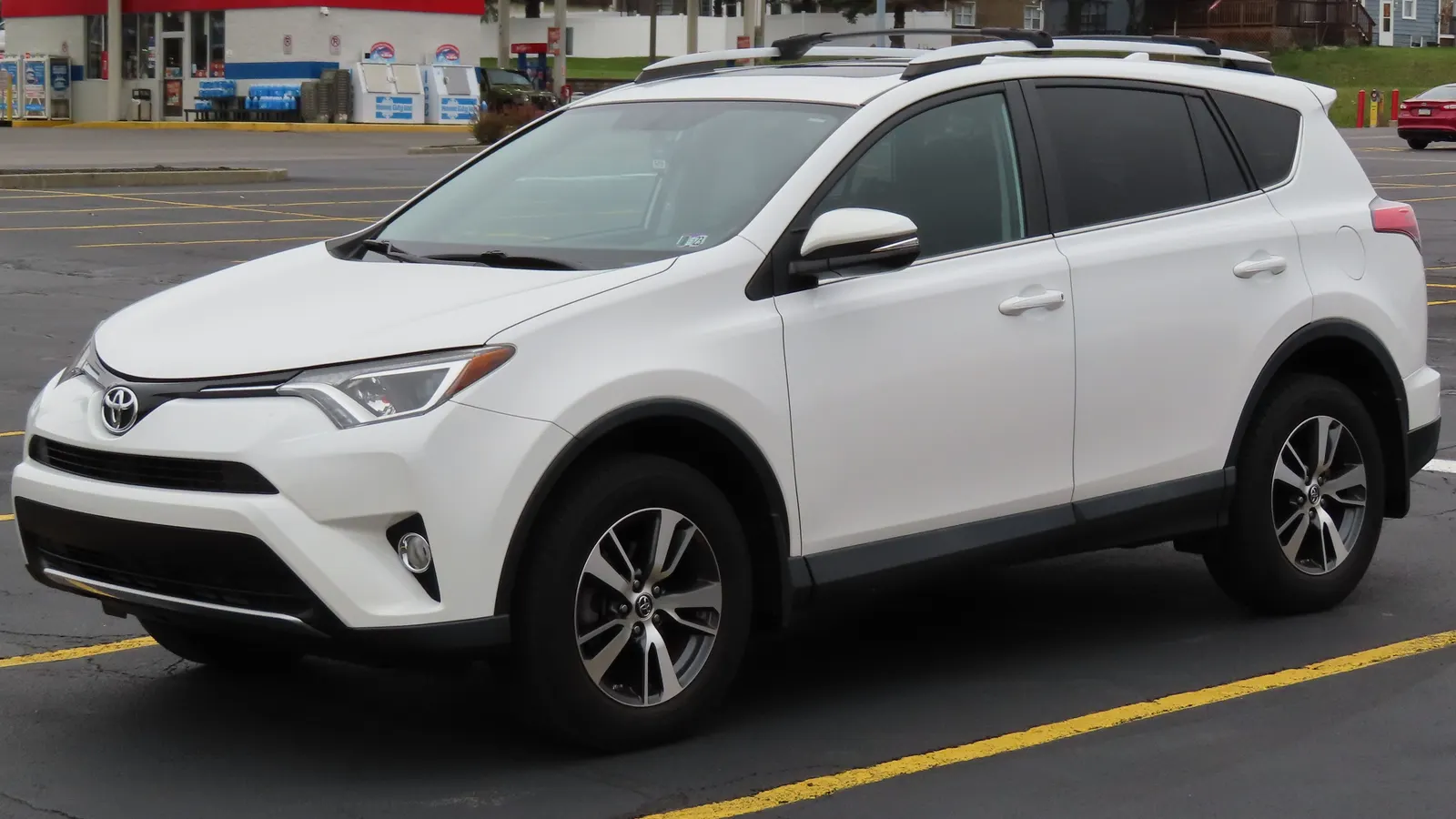
Pictured: 2016 Toyota RAV4 XLE. Photo: MercurySable99, CC BY-SA 4.0, cropped
Owner complaints
240
45 report a crash, fire, injury or death
Recalls
3
None urgent
Most common problem
9%
of complaints: brake failure
Complaints per year filed
2016–2025 · peak 34
In short
No pattern of serious problemsThe 2016 Toyota RAV4 shows no pattern of serious problems: its largest serious problem class, brake problems, makes up 9% of complaints. NHTSA has 240 owner complaints, and 45 report a crash, fire, injury or death. The most common are brake pedal or brake failures, stalling, and sunroof glass shattering. It has 3 recalls.
Reliability
How Reliable Is the 2016 Toyota RAV4?
The 2016 Toyota RAV4 has the verdict of no pattern of serious problems. Judged on its own complaints, no single serious problem class dominates: the largest, brake problems, accounts for 9% of them. This model year has no do-not-drive or park-outside recall and no open serious NHTSA investigation. That does not make the complaints trivial. Several of the most common problems are safety-related, and 45 complaints describe a crash, fire, injury or death. None report a death.
Four problems stand out, and none dwarfs the others. Brake complaints describe a pedal that goes to the floor, brakes that did not respond, and a car that did not stop, and about half of them were rated among the most severe. Stalling complaints describe the engine shutting off while driving, sometimes with a charging system message. Sunroof complaints describe the glass shattering or exploding, often on the highway, with glass falling into the cabin. Sudden acceleration complaints describe the car surging while braking, in park, or at a stop. Brake and acceleration complaints overlap: some owners describe the car accelerating while the brakes would not hold it.
Recalls cover only part of this. The ABS actuator recall (16V198000) says the actuator may have a damaged O-ring that could cause improper brake fluid pressure control during ABS, traction control or stability control activation. The fix is for dealers to inspect the actuator and replace it as necessary, free of charge. A couple of brake complaints mention it. The 2023 battery recall (23V734000) says certain replacement 12-volt batteries may not fit properly in the tray, allowing the battery to move and possibly cause a short circuit. A couple of stalling complaints mention it. The third recall (16V236000) concerns a tire load label. Sudden acceleration and sunroof glass breakage have no recall for this model year. Where owners describe repair results for stalling, they lean toward repairs that did not fix it, though few reported one.
Mileage helps when you look at a specific car. Sudden acceleration and sunroof complaints come early: the median is about 13,200 miles for sudden acceleration and about 11,800 for sunroof glass, with a quarter of sunroof reports at 7,500 miles or less. Brake complaints have a median of about 29,500 miles. Stalling reports are spread widest, with a median of about 35,000 miles and a quarter of them above 75,700 miles. Half of all complaints that give mileage are under 25,000 miles, so a low odometer does not rule these problems out, and a high one does not mean they have passed.
Before buying, confirm every recall was completed, test the brakes and check the sunroof glass. Remember the limits of this evidence. Complaint counts show what owners reported, not how many cars are affected, and they cannot show how a particular car was maintained or driven. A clean-looking history is not a guarantee, and a pre-purchase inspection is worth the cost.
Top problems
The 4 problems owners report most
Named from 240 NHTSA complaints. Open a problem for symptoms, the fix, cost and owners' accounts.
1.Brake pedal sinks or brakes failCriticalAbout 1 in 11 complaints6,900–43,900 mi
Owners describe a pedal that goes to the floor, brakes that did not respond and a car that did not stop, some at low speed such as about 10 mph. Reports have a median of about 29,500 miles, with a quarter at 6,900 miles or less. A couple of owners mention the ABS actuator recall (16V198000).
What owners describe
- Pedal goes to the floor19%
- Brakes do not respond19%
- Car does not slow or stop19%
- Spongy or slow pedal14%
Fix
Most common repair owners describe: pads and discs may need replacing (1 report).
Mileage
29,500 mi
Middle half 6,900–43,900 mi · 16 reports
Repair cost
—
Fewer than 10 owners report a repair cost
How common
9%
21 of 240 complaints
By engine
- 2.5L 4-cyl85%
- 2.5L 4-cyl hybrid15%
In owners' words
“Sometimes the brake pedal slips part way or all the way to the floor allowing the car to roll into the intersection before stopping.”
Owner in TX2.5L 4-cylFiled 2017NHTSA 11001782 “The brake petal will go all the way to the floor with no slowing or stopping of the vehicle.”
Owner in FL2.5L 4-cylFiled 2016NHTSA 10885169 “The pedal pushed all the way to the floor with zero resistance and the car did not slow.”
Owner in OH2.5L 4-cylFiled 2017NHTSA 10995701 2.Stalling or shutting off while drivingCriticalAbout 1 in 13 complaints9,700–75,700 mi
Owners describe the engine shutting down, sometimes with a charging system message, at stops, on hills or when shifting from reverse to drive. Reports have a median of about 35,000 miles, with a quarter at 9,700 miles or less and a quarter above 75,700. A couple of owners mention the 12-volt battery recall (23V734000).
What owners describe
- Engine shuts down21%
- Charging system message21%
- Stalls when stopping or shifting21%
- Loss of power16%
Fix
Most common repair owners describe: replaced batteries and air sensor fuel tank replacement quoted (1 report).
Mileage
35,000 mi
Middle half 9,700–75,700 mi · 11 reports
Repair cost
—
Fewer than 10 owners report a repair cost
How common
8%
19 of 240 complaints
Crash, fire or injury
21%
of these complaints
In owners' words
“Dashboard lit up and car completed turned off without warning for approximately 30 seconds before power came back on it's own”
Owner in CA2.5L 4-cylFiled 2024NHTSA 11620925 “Intermittent stalling in various conditions including idling, highway driving and city driving.”
Owner in TXFiled 2026NHTSA 11750762 3.Sunroof glass shattersSeriousAbout 1 in 14 complaints7,500–25,000 mi
Owners describe a loud bang followed by shattered glass, often while driving on the highway with the sunroof closed. Glass slivers fell into the cabin in some reports. Reports have a median of about 11,800 miles, with a quarter at 7,500 miles or less. No recall for this problem is mentioned.
What owners describe
- Happens at highway speed65%
- Glass shatters59%
- Loud bang or explosion53%
- Glass falls into cabin24%
Fix
Most common repair owners describe: sunroof replacement needed (1 report).
Mileage
11,800 mi
Middle half 7,500–25,000 mi · 15 reports
Repair cost
—
Fewer than 10 owners report a repair cost
How common
7%
17 of 240 complaints
By engine
- 2.5L 4-cyl80%
- 2.5L 4-cyl hybrid20%
4.Sudden or unintended accelerationCriticalAbout 1 in 16 complaints3,300–36,100 mi
Owners describe the car accelerating while braking, at a stop or in park, and some report hitting a gate, a house or another vehicle. Reports have a median of about 13,200 miles, with a quarter at 3,300 miles or less. No recall for this problem is mentioned.
What owners describe
- Accelerates while braking27%
- Lunges forward from a stop20%
- Accelerator seems stuck13%
- Accelerates in park7%
Fix
Most common repair owners describe: timing belt replaced and reprogrammed (1 report).
Mileage
13,200 mi
Middle half 3,300–36,100 mi · 9 reports
Repair cost
—
Fewer than 10 owners report a repair cost
How common
6%
15 of 240 complaints
By engine
- 2.5L 4-cyl86%
- 2.5L 4-cyl hybrid14%
In owners' words
“When I applied brake to slow down and stop the car at the highway intersections, it accelerated uncontrollably.”
Owner in MD2.5L 4-cylFiled 2017NHTSA 11022407 “While stopped at a red light the vehicle jumped forward and struck the vehicle in front of me.”
Owner in MA2.5L 4-cylFiled 2016NHTSA 10876251
Buying one
Should you buy a used 2016 Toyota RAV4?
What to check before you buy, based on the complaint and recall data.
Test the brakes on a drive and ask whether the ABS actuator recall (16V198000) was done. Check whether the 12-volt battery recall (23V734000) applies and whether the battery was replaced. Look closely at the sunroof glass, and ask the seller about any stalling, hesitation or sudden surges. Run the VIN on NHTSA's recall lookup before you buy.
- 1Run the VIN for open recalls. NHTSA lists 3 recalls. Check at nhtsa.gov/recalls.
- 2Test-drive for brake failure. It's the most common safety-critical complaint, in about 1 in 11 owner complaints, usually around 29,500 miles.
- 3Get a pre-purchase inspection. An independent mechanic can spot leaks, stored fault codes and accident repairs that a test drive misses.
Toyota RAV4 model years
Early complaints are those filed in a model year's first 3 years. They follow how many were sold, so they don't show which years are better.
Crash test ratings
NHTSA 5-Star Safety Ratings.
| SUV AWD | SUV FWD | |
|---|---|---|
| Overall | ★★★★★ | ★★★★★ |
| Frontal crash | ★★★★ | ★★★★ |
| Side crash | ★★★★★ | ★★★★★ |
| Rollover | ★★★★ | ★★★★ |
| Rollover risk | 17% | 17% |
Owning one
If you already own one
Find your symptom, see when problems tend to show up, and check which recalls apply.
Stop driving and get the car inspected if the brake pedal sinks, feels spongy or does not slow the car. Also stop if the engine shuts off while driving or the car accelerates on its own. Confirm that all three recalls have been completed by running your VIN on NHTSA's site. If the sunroof shatters, report it to NHTSA and keep any repair paperwork.
- Brake pedal sinks or brakes failCriticalAbout 1 in 11 owner complaints21 of 240Median 29,500 mi
Most common repair owners describe: pads and discs may need replacing (1 report).
- Stalling or shutting off while drivingCriticalAbout 1 in 13 owner complaints19 of 240Median 35,000 mi
Most common repair owners describe: replaced batteries and air sensor fuel tank replacement quoted (1 report).
- Sunroof glass shattersSeriousAbout 1 in 14 owner complaints17 of 240Median 11,800 mi
Most common repair owners describe: sunroof replacement needed (1 report).
- Sudden or unintended accelerationCriticalAbout 1 in 16 owner complaints15 of 240Median 13,200 mi
Most common repair owners describe: timing belt replaced and reprogrammed (1 report).
- Dim low-beam headlightsSeriousAbout 1 in 17 owner complaints14 of 240Median 4,000 mi
- Vehicle catches fireCriticalAbout 1 in 17 owner complaints14 of 240Median 85,000 mi
- Airbags did not deploy in a crashCriticalAbout 1 in 22 owner complaints11 of 240Median 25,000 mi
- Brake noise and early wearMinorAbout 1 in 24 owner complaints10 of 240Median 16,300 mi
Show all 9 problemsShow fewer problems
- Battery drain or no-startSeriousAbout 1 in 24 owner complaints10 of 240Median 91,500 mi
of complaints that list mileage (81 of 151) came in before 25,000 miles. A low odometer reading is no guarantee.
3 recalls, newest first
Open one for the risk, the remedy and what to do now.
Electrical system › 12v/24v/48v batteryCertain replacement 12-volt batteries may not fit properly in the battery tray, allowing the battery to move and…Nov 1, 20231,853,568 vehicles23V734000
- Defect
- Certain replacement 12-volt batteries may not fit properly in the battery tray, allowing the battery to move and contact the hold-down bracket, possibly causing a short circuit.
- Risk
- A battery short circuit increases the risk of a fire.
- Remedy
- Dealers will replace the battery clamp sub-assembly, battery tray, and positive terminal cover, free of charge.
TiresThe Load Carrying Capacity Modification Label may not reflect the correct added weight of the installed accessories.…Apr 22, 201694 vehicles16V236000
- Defect
- The Load Carrying Capacity Modification Label may not reflect the correct added weight of the installed accessories. As a result, these vehicles fail to comply with the requirements of Federal Motor Vehicle Safety Standard number 110, "Tire Selection and Rims for Passenger Cars."
- Risk
- An incorrect label may result in the vehicle being overloaded, increasing the risk of a crash.
- Remedy
- SET will notify owners, and provide them a corrected label to be installed over the inaccurate label, free of charge.
Service brakes, hydraulic › Antilock/traction control/electronic limited slipThese vehicles are equipped with an ABS actuator that may have a damaged O-ring which could result in improper brake…Apr 7, 201616,656 vehicles16V198000
- Defect
- These vehicles are equipped with an ABS actuator that may have a damaged O-ring which could result in improper brake fluid pressure control during ABS, Traction Control, or Stability Control activation.
- Risk
- Insufficient brake fluid pressure may cause a loss of vehicle control, increasing the risk of a crash.
- Remedy
- Dealers will inspect the brake actuator, replacing it as necessary, free of charge.
What to do
Check the VIN at nhtsa.gov/recalls. If a recall is open, any dealer will fix it free. For NHTSA's full record of a campaign, search its number there (for example 23V734000).
Reliability history
Toyota RAV4 reliability by year
Complaints filed in each model year's first 3 years, by trouble spot. Darker cells have more complaints; counts aren't adjusted for how many were sold each year.
All problems
Every problem reported on the 2016 RAV4
Every problem found in the 240 owner complaints, by area of the vehicle.
Body, lights & visibility
65 27%- Sunroof glass shattersSerious17 7%typically at 11,800 mi11,800––
- Dim low-beam headlightsSerious14 6%typically at 4,000 mi4,000––
- Tail lights fog with condensationMinor9 4%–––
- Liftgate or tailgate failureMinor7 3%typically at 75,000 mi75,000––
- Headlights fail2 0.8%–––
- Windshield cracking2 0.8%–––
Show 13 more body, lights & visibility problemsShow fewer body, lights & visibility problems
- High beam failure2 0.8%–––
- Factory paint peeling2 0.8%–––
- Dashboard trim causes sun glare1 0.4%–––
- Seat fabric fraying1 0.4%–––
- Flickering headlights1 0.4%–––
- Headlights too bright for other drivers1 0.4%–––
- Driver seat locks and will not move forward1 0.4%–––
- Wiper failure1 0.4%–––
- Door locks fail1 0.4%–––
- Water condensation in headlights1 0.4%–––
- Rear door unlatches while driving1 0.4%–––
- Headlights cut out while driving1 0.4%–––
- Door lock actuator failure1 0.4%–––
Electrical
40 17%- Battery drain or no-startSerious10 4%typically at 91,500 mi91,500––
- Screen or infotainment glitchesMinor7 3%typically at 55,300 mi55,300––
- Water leaks damaging electronicsSerious7 3%–––
- Many warning lights at onceMinor6 3%–––
- Wiring harness damageSerious3 1%–––
- Bluetooth will not pair with phoneMinor3 1%–––
Show 7 more electrical problemsShow fewer electrical problems
- Charging system failure message2 0.8%–––
- Park assist warning message1 0.4%–––
- Speedometer hard to read in daylight1 0.4%–––
- Instrument cluster blank1 0.4%–––
- Key fob fails to start vehicle1 0.4%–––
- Electrical settings reset and devices drop out1 0.4%–––
- Battery terminal corrosion1 0.4%–––
Brakes
37 15%- Brake pedal sinks or brakes failCritical21 9%typically at 29,500 mi29,500––
- Brake noise and early wearMinor10 4%typically at 16,300 mi16,300––
- ABS warning light2 0.8%–––
- ABS actuator failure1 0.4%–––
- Front-end vibration when braking1 0.4%–––
- Brake pedal sticks down1 0.4%–––
Show 1 more brakes problemsShow fewer brakes problems
- ABS stays engaged and will not release1 0.4%–––
Engine
24 10%- 19 8%typically at 35,000 mi35,000––
- Engine failure1 0.4%–––
- Exhaust fumes or carbon monoxide in the cabinCritical1 0.4%–––
- Engine rpm surges while driving1 0.4%–––
- Oil consumption1 0.4%–––
- Check engine light on1 0.4%–––
Acceleration & speed control
18 8%- 15 6%typically at 13,200 mi13,200––
- Aggressive creep when stopped2 0.8%–––
- No acceleration after shifting from reverse to drive1 0.4%–––
Airbags & seat belts
18 8%- Airbags did not deploy in a crashCritical11 5%typically at 25,000 mi25,000––
- Airbag warning light stays onSerious5 2%–––
- Airbags deploy without warning1 0.4%–––
- Airbags deployed violently and injured passenger1 0.4%–––
- Seat belt chime and light come on while belted1 0.4%–––
- Seat belt will not unlatch1 0.4%–––
Fire
14 6%- Vehicle catches fireCritical14 6%typically at 85,000 mi85,000––
Transmission & drivetrain
12 5%- CV joint wear or noise2 0.8%–––
- Transmission shudder or judderSerious2 0.8%–––
- Hesitation or slipping while drivingSerious2 0.8%–––
- Harsh, jerky shiftingSerious1 0.4%–––
- Vehicle moves on its own in Park1 0.4%–––
- Whining or whistling noise from drivetrain1 0.4%–––
Show 5 more transmission & drivetrain problemsShow fewer transmission & drivetrain problems
- Delayed engagement pulling away from a stopSerious1 0.4%–––
- Clicking noise when shifting into drive1 0.4%–––
- Torque converter failure1 0.4%–––
- Transmission failure needing replacementSerious1 0.4%–––
- Transmission warning messagesMinor1 0.4%–––
Steering
7 3%- Loss of power steeringCritical4 2%–––
- Pulls to one side while driving2 0.8%–––
- Sticky or notchy steeringSerious1 0.4%–––
Driver aids & stability
5 2%- Built-in blind spot mirror shows the wrong area2 0.8%–––
- Automatic emergency braking activates for no reasonCritical1 0.4%–––
- Pre-collision system gives no warning1 0.4%–––
- Rearview camera screen goes dark in sunlight1 0.4%–––
Wheels & tires
2 0.8%- Tire blowout1 0.4%–––
- Steering wheel lock problem1 0.4%–––
Fuel system & stalling
2 0.8%- Fuel leaksCritical1 0.4%–––
- Charcoal canister or evaporative system failure1 0.4%–––
Other
1 0.4%- Rear glass shatters1 0.4%–––
Suspension
1 0.4%- Rear control arm rusting or breakingCritical1 0.4%–––
- Clunks or knocks from the suspensionMinor1 0.4%–––
80 problems found in all 240 complaints. One complaint can describe more than one problem, so counts add up to more than the total. Not counted as a defect: 19 about recall paperwork or parts delays, 3 describing no vehicle defect. Typical miles, repair cost and fix rate show only when enough owners report them.
The data
Behind the numbers
Every figure comes from NHTSA's complaint file and APIs.
- Complaints
- 240
- Recalls
- 3
- Crashes
- 33
- Fires
- 12
- Injuries
- 27
- Deaths
- 0
Crashes and fires count complaints that report one; injuries and deaths count people.
Complaints by engine
Decoded from the partial VINs owners include. Not adjusted for how many of each engine were sold.
FAQ
2016 Toyota RAV4 questions
Is the 2016 Toyota RAV4 reliable?
The 2016 Toyota RAV4 shows no pattern of serious problems. Its largest serious problem class, brake problems, makes up 9% of its 240 NHTSA complaints, and it has no do-not-drive or park-outside recall and no open serious NHTSA investigation. That does not make the complaints trivial: 45 describe a crash, fire, injury or death.
What are the most common 2016 Toyota RAV4 problems?
Four problems stand out, and none dwarfs the others. Brake pedal sinks or brakes fail has 21 complaints (about 1 in 11), stalling or shutting off while driving has 19 (about 1 in 13), sunroof glass shattering has 17 (about 1 in 14), and sudden or unintended acceleration has 15 (about 1 in 16).
How many recalls does the 2016 Toyota RAV4 have?
The 2016 Toyota RAV4 has 3 recalls, and none is a do-not-drive or park-outside recall. They cover the ABS actuator (16V198000), certain replacement 12-volt batteries that may not fit the tray (23V734000), and the tire load label (16V236000). Check your VIN at nhtsa.gov/recalls.
Does the 2016 Toyota RAV4 have brake problems?
Yes, brake pedal or brake failure is the most common complaint, with 21 complaints rated Critical. Owners describe a pedal that goes to the floor and brakes that did not respond. Reports have a median of about 29,500 miles, and a couple of owners mention the ABS actuator recall (16V198000).
Does the 2016 Toyota RAV4 have sunroof problems?
Owners report sunroof glass shattering, with 17 complaints, about 1 in 14. They describe a loud bang, often on the highway with the sunroof closed, and glass falling into the cabin. Reports come early, with a median of about 11,800 miles. No recall for this problem is mentioned.
How safe is the 2016 Toyota RAV4?
NHTSA gives the 2016 Toyota RAV4 an overall rating of 5 out of 5 stars, with 4 out of 5 stars for frontal crash, 5 out of 5 stars for side crash and 4 out of 5 stars for rollover. The ratings are the same for the AWD and FWD versions.
Methodology
How we researched this
- Complaints. NHTSA's owner complaint file, counted as unique complaint numbers for make TOYOTA, model RAV4, model year 2016. Data through Oct 4, 2026.
- Verdict. Judged from this model year's own complaints, not against other models, using shares rather than counts. Serious known problems: one serious problem (transmission, engine or stalling, steering, brakes, airbags, fire, fuel leaks) is in a quarter or more of complaints; or a smaller but clear cluster comes with an unusual share of crash, fire, injury or loss-of-power reports or early failures; or an urgent recall or NHTSA investigation matches a top complaint. Some known problems: one of those signals on its own. No pattern of serious problems: none of them; this doesn't mean the vehicle is trouble-free. Too few complaints to judge: under 50 complaints. Why this verdict: Checked: the largest serious problem class is brake problems (brake failure, phantom automatic braking), 9% of complaints; safety-related complaints are 20% (typical: 17%), and there's no do-not-drive or park-outside recall or open serious NHTSA investigation..
- No grade or class ranking. Raw complaint counts favor models that sell fewer cars, so we don't score or rank this vehicle against other models until we can adjust for sales.
- Trouble spots and history. Complaints grouped by the part owners chose when filing. The history grid counts complaints filed in each model year's first 3 years so older and newer years compare fairly; years with fewer than 3 complete years are marked too new.
- Named problems. Every one of the 240 complaints was researched and classified by its problems, severity, symptoms, repairs and any cost the owner mentions; the counts, costs and fix rates on this page are tallies of those classifications. Quotes are verbatim excerpts, checked against the original text. Engines are decoded from partial VINs with NHTSA's vPIC service.
- Repair costs and fix rates. Shown only when at least 10 owners report a repair cost, or at least 10 complaints describe whether a repair worked.
- Not adjusted for sales. Not affiliated with NHTSA. Page updated Nov 23, 2026.