2019 Toyota RAV4 Reliability & Problems
By Adrian V. LockhartUpdated All 879 NHTSA owner reports researched and classified
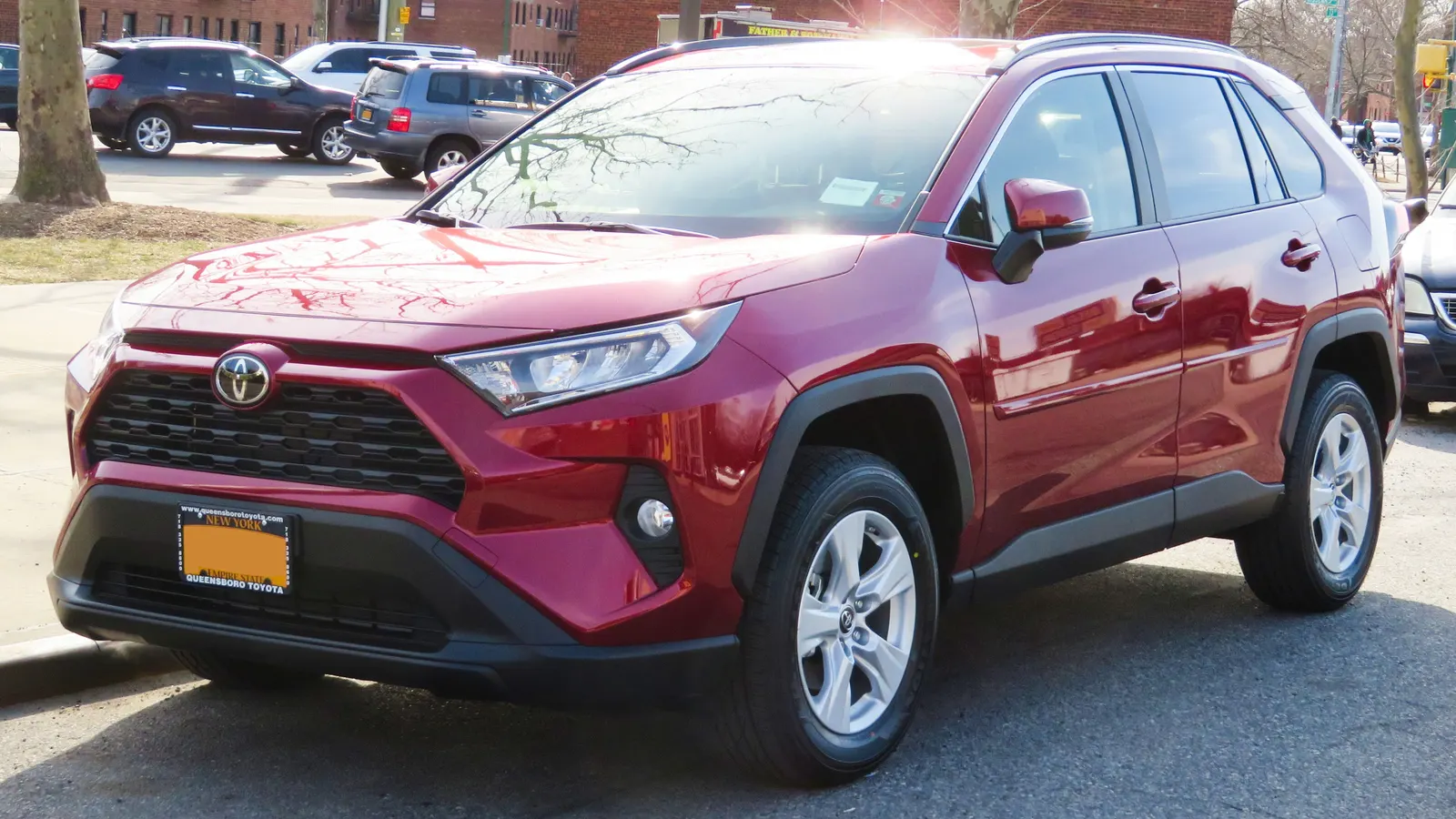
Pictured: 2019 Toyota RAV4 XLE. Photo: Kevauto, CC BY-SA 4.0, cropped
Owner complaints
879
30 report a crash, fire, injury or death
Recalls
7
None urgent
Most common problem
24%
of complaints: fuel tank that won't fill completely
Complaints per year filed
2019–2025 · peak 193
In short
No pattern of serious problemsThe 2019 Toyota RAV4 shows no pattern of serious problems: its largest serious problem class, transmission problems, makes up 7% of complaints. NHTSA has 879 owner complaints, and 30 report a crash, fire, injury or death. The most common are a fuel tank that won't fill fully, coolant bypass valve failures and water leaks. It has 7 recalls.
Reliability
How Reliable Is the 2019 Toyota RAV4?
This model year has no pattern of serious problems. The largest serious problem class is transmission problems, such as harsh shifting and delayed engagement, and it is a small share of complaints. Safety-related complaints are also a small share, and no recall tells owners to park the vehicle or park it outside. Most complaints describe problems that are annoying or costly rather than dangerous, and NHTSA has 879 of them, with 30 reporting a crash, fire, injury or death.
Two problems dominate. The most common is a fuel tank that won't fill completely, which about 1 in 4 owner complaints describe. Owners say the pump shuts off early, the tank takes only about 8 to 10 gallons, or range drops well below what they expected. This is almost entirely reported on hybrids, so it matters most if you are shopping for one. The second is coolant bypass valve failure, reported mostly on gas models. Owners typically see an engine maintenance required message that won't clear, and some report overheating or a coolant leak. These two problems are mostly separate, because they appear on different versions of the RAV4.
Neither of these top problems has a recall for this model year. Where owners describe their repairs, the coolant bypass valve is usually reported as fixed by replacing the valve, and owners who gave a cost most often reported about $800. Some owners also say the part was on back order. Complaints lean toward repairs that failed, though, so treat a successful fix as likely but not certain. Water leaks, mostly around the roof racks and headliner, had no successful repairs among the owners who described one. Other issues, such as liftgate hinge cracks and sunroof glass that shatters while driving, are reported far less often and have no recall for this model year either.
The recalls that do exist cover other things. One says the low-pressure fuel pump inside the tank may fail, and dealers replace the fuel pump assembly with an improved one. Another says porosity in the engine castings may result in cracks that can allow coolant to leak, and dealers inspect and replace the engine, including the block, as necessary. A third says the front lower suspension arms may have cracks, and dealers replace both arms. A few stalling complaints mention the fuel pump and engine recalls. All of these repairs are free of charge.
Mileage matters when you look at an odometer. The fuel fill problem is reported very early, at a median of about 500 miles, so a car that has passed that point without it is a good sign. Harsh shifting and sunroof glass breakage are also reported fairly early, around 9,900 and 10,300 miles. Coolant bypass valve complaints cluster later, around 50,000 miles, with most between 40,400 and 69,300 miles. Water leaks center near 34,500 miles. Complaint counts show what owners reported, not how many vehicles are affected, and they can't show how a particular vehicle was maintained, so a pre-purchase inspection still matters.
Top problems
The 9 problems owners report most
Named from 879 NHTSA complaints. Open a problem for symptoms, the fix, cost and owners' accounts.
1.Fuel tank won't fill completelyMinorAbout 1 in 4 complaints354–2,500 mi
Owners say the pump shuts off with many gallons still to go, so the tank takes only about 8 to 10 gallons and range drops well below what they expected. It happens at refueling and often at every fill-up, and some say it has been that way since purchase. Reports put it early, at a median of about 500 miles. This model year has no recall for it, and nearly all reports are from hybrids.
What owners describe
- Pump shuts off early11%
- Tank takes only 8-10 gallons7%
- Reduced driving range6%
Fix
Most common repair owners describe: fuel tank replaced (4 reports).
Mileage
500 mi
Middle half 354–2,500 mi · 136 reports
Repair cost
—
Fewer than 10 owners report a repair cost
How common
24%
207 of 879 complaints
By engine
- 2.5L 4-cyl hybrid97%
- 2.5L 4-cyl3%
In owners' words
“They also claim no more repair attempts will be made as they do not know what the issue is or how to fix it.”
Owner in CA2.5L 4-cyl hybridFiled 2019NHTSA 11255325 “I have given Toyota 4 visits to fix the issue. They have replaced fuel system but issue persist.”
Owner in VA2.5L 4-cyl hybridFiled 2019NHTSA 11253943 “Fuel tank does not properly fill, and often results in gas spilling out of the vehicle”
Owner in IN2.5L 4-cyl hybridFiled 2019NHTSA 11242443 2.Coolant bypass valve failureSeriousAbout 1 in 5 complaints40,400–69,300 mi~$800 repair
Owners most often describe an engine maintenance required message that won't clear, and some report overheating or a coolant leak. Reports put it around 50,000 miles, with most between 40,400 and 69,300 miles. The usual repair is replacing the valve, and some owners say the part was on back order. This problem is reported mostly on the gas engine.
What owners describe
- Engine maintenance required message62%
- Overheating or coolant leak8%
- Check engine light6%
Fix
Most common repair owners describe: coolant bypass valve replacement (14 reports).
Repair worked in 92% of complaints that describe one (complaints lean toward repairs that failed)
Mileage
50,000 mi
Middle half 40,400–69,300 mi · 40 reports
Repair cost
$800
Middle half $700–$910 · 44 owner amounts
How common
18%
160 of 879 complaints
Crash, fire or injury
0.6%
of these complaints
In owners' words
“The Toyota dealership maintenance told me that the engine repair required alert was for normal maintenance and directed me to continue driving with it until my scheduled service”
Owner in NC2.5L 4-cylFiled 2024NHTSA 11612290 “The Coolant Bypass Valve on my vehicle failed, leading to a risk of sudden engine overheating and potential coolant leaks into the electrical harness.”
Owner in FL2.5L 4-cylFiled 2026NHTSA 11738596 “Engine maintenance required sign pops up and cannot remove which does not allow driver to see speedometer leading to unsafe driving speeds.”
Owner in NY2.5L 4-cylFiled 2024NHTSA 11601321 3.Water leaks damaging electronicsSeriousAbout 1 in 12 complaints17,400–48,200 mi
Owners describe leaks around the roof racks that wet the headliner, cause mold or a mildew smell, and in some cases reach wiring and airbags. It happens mostly when it rains or after a car wash. Reports put it around 34,500 miles, with most between 17,400 and 48,200 miles. This model year has no recall for it, and the owners who described their repairs said they did not fix it.
What owners describe
- Roof rack leak41%
- Wet or stained headliner24%
- Leaks after rain or washing23%
- Mold or mildew smell9%
Fix
Most common repair owners describe: roof rack assembly replaced (1 report).
Repair worked in 0% of complaints that describe one (complaints lean toward repairs that failed)
Mileage
34,500 mi
Middle half 17,400–48,200 mi · 16 reports
Repair cost
—
Fewer than 10 owners report a repair cost
How common
8%
74 of 879 complaints
By engine
- 2.5L 4-cyl93%
- 2.5L 4-cyl hybrid7%
In owners' words
“The remodeled 2019 Toyota rav4 has a common water leak where the headliner meets the safety airbags.”
Owner in MO2.5L 4-cylFiled 2020NHTSA 11373621 “Because my vehicle is no longer under warranty, I have to pay to have the roof racks replaced”
Owner in AL2.5L 4-cylFiled 2021NHTSA 11442037 “I was dismissed at the dealer when I questioned my concern on the airbag functioning properly”
Owner in PA2.5L 4-cylFiled 2022NHTSA 11463715 4.Stalling or shutting off while drivingCriticalAbout 1 in 25 complaints15,000–69,000 mi
Owners describe the car stalling while driving, sometimes without warning and sometimes with a power steering low message or all warning lights on. Reports put it around 43,000 miles. A few owners mention the fuel pump recall (20V682000) and the engine recall (20V064000).
What owners describe
- Stalls while driving26%
- Power steering low message9%
- Engine shuts off6%
Fix
Most common repair owners describe: vapor lock repair quoted (1 report). Recalls 20V064000, 20V682000.
Mileage
43,000 mi
Middle half 15,000–69,000 mi · 17 reports
Repair cost
—
Fewer than 10 owners report a repair cost
How common
4%
35 of 879 complaints
By engine
- 2.5L 4-cyl88%
- 2.5L 4-cyl hybrid13%
In owners' words
“The engine abruptly shut off. I suddenly had no engine power, power brakes or power steering.”
Owner in TX2.5L 4-cylFiled 2019NHTSA 11231792 “Car stalls when acceliator is depressed while going foward before coming to a complete stop”
Owner in NM2.5L 4-cylFiled 2021NHTSA 11400330 5.Liftgate hinge failureSeriousAbout 1 in 28 complaints37,000–68,000 mi
Owners describe cracked hinges and brackets, a hatch that leans to one side or won't latch, and a door that doesn't seal. A few say it is worse in winter. This model year has no recall for it.
What owners describe
- Cracked hinges or brackets16%
- Hatch won't latch or close10%
- Hatch leans or pulls to one side6%
- Door doesn't seal6%
Fix
Most common repair owners describe: hatch repair with goodwill adjustment (1 report).
Mileage
60,000 mi
Middle half 37,000–68,000 mi · 5 reports
Repair cost
—
Fewer than 10 owners report a repair cost
How common
4%
31 of 879 complaints
By engine
- 2.5L 4-cyl72%
- 2.5L 4-cyl hybrid28%
In owners' words
“The Toyota dealership where the vehicle was purchased stated that the vehicle is out of warranty and there is no recall for the hinges”
Owner in NY2.5L 4-cylFiled 2026NHTSA 11737542 “My liftgate doesn't close properly and is out of alignment to stay safely latched closed and has become 100% unusable.”
Owner in TN2.5L 4-cylFiled 2024NHTSA 11604355 “The dealer stated the issue could not be replicated and advised me to manually push the hatch upward.”
Owner in CT2.5L 4-cylFiled 2026NHTSA 11708446
Show 4 more problemsShow fewer problems
6.Harsh, jerky shiftingSeriousAbout 1 in 34 complaints1,400–22,800 mi
Owners describe hard shifting, lurching and sudden jerking, often when slowing down and then accelerating again or when pulling away from a stop. Reports put it fairly early, around 9,900 miles. This model year has no recall for it.
What owners describe
- Hard or jerky shifting54%
- Car lurches forward38%
- Jerks when slowing or pulling away12%
Fix
Most common repair owners describe: pcm reflash (1 report).
Mileage
9,900 mi
Middle half 1,400–22,800 mi · 18 reports
Repair cost
—
Fewer than 10 owners report a repair cost
How common
3%
26 of 879 complaints
Crash, fire or injury
0%
of these complaints
In owners' words
“If I have to speed up in an intersection, it downshifts violently and causes a lot of jerking while driving.”
Owner in GA2.5L 4-cylFiled 2019NHTSA 11277130 “When time to accelerate, the vehicle started lurching forward in a hard jerking motion.”
Owner in FL2.5L 4-cylFiled 2020NHTSA 11311751 “Transmission sudden jerking/shifting when slowing down in city at traffic lights”
Owner in LA2.5L 4-cylFiled 2019NHTSA 11244389 7.Fuel gauge or range reading inaccurateMinorAbout 1 in 37 complaints400–1,000 mi
Owners say the gauge reads nearly full after a fill that only took 8 to 9 gallons, or that the range estimate is far above the real range. It shows up at refueling and was reported early, around 500 miles. This model year has no recall for it, and nearly all reports are from hybrids.
What owners describe
- Tank takes only 8-9 gallons8%
Fix
Most common repair owners describe: fuel tank replaced (2 reports).
Mileage
500 mi
Middle half 400–1,000 mi · 17 reports
Repair cost
—
Fewer than 10 owners report a repair cost
How common
3%
24 of 879 complaints
Crash, fire or injury
0%
of these complaints
In owners' words
“The service employee said that Toyota is aware of the problem and there is no fix.”
Owner in WAFiled 2019NHTSA 11269446 8.Sudden or unintended accelerationCriticalAbout 1 in 40 complaints4,800–31,500 mi
Owners describe the vehicle accelerating in reverse, surging, or lurching from a stop, often while parking, and a few say braking did not stop it. Two report crashing into a wall. Reports put it fairly early, around 8,500 miles. One owner mentions the fuel pump recall (20V682000).
What owners describe
- Braking doesn't stop it18%
- Lurches or surges forward18%
- Accelerates while parking14%
- Accelerates in reverse14%
Fix
Most common repair owners describe: engine transmission tcm transfer clutch and brakes replaced (1 report).
Mileage
8,500 mi
Middle half 4,800–31,500 mi · 12 reports
Repair cost
—
Fewer than 10 owners report a repair cost
How common
3%
22 of 879 complaints
By engine
- 2.5L 4-cyl68%
- 2.5L 4-cyl hybrid32%
In owners' words
“Depressing on the brake pedal but the vehicle began to accelerate independently causing the vehicle to crash into a tree trunk”
Owner in IL2.5L 4-cylFiled 2021NHTSA 11443034 “Toyota service person showed concern and drove the rav around for about 10 minutes and could not get it to repeat this.”
Owner in WA2.5L 4-cylFiled 2020NHTSA 11329780 “The vehicle attempts to accelerate to approximately 1500 RPM for approximately 1 second and lurch forward”
Owner in ID2.5L 4-cylFiled 2020NHTSA 11328424 9.Sunroof glass shattersSeriousAbout 1 in 46 complaints8,300–18,200 mi
Owners describe a loud bang or pop overhead, then shattered glass and shards in the cabin, usually on the highway with nothing hitting the glass. Some say the glass exploded outward. This model year has no recall for it.
What owners describe
- Loud bang or pop overhead63%
- Happens on the highway58%
- Sunroof glass shatters53%
- Glass shards in cabin5%
Fix
Most common repair owners describe: taking to dealer for repair (1 report).
Mileage
10,300 mi
Middle half 8,300–18,200 mi · 7 reports
Repair cost
—
Fewer than 10 owners report a repair cost
How common
2%
19 of 879 complaints
By engine
- 2.5L 4-cyl63%
- 2.5L 4-cyl hybrid37%
In owners' words
“We were showered with shards of glass in the front seats and some in the back seat floor as well.”
Owner in OH2.5L 4-cylFiled 2019NHTSA 11229457
Buying one
Should you buy a used 2019 Toyota RAV4?
What to check before you buy, based on the complaint and recall data.
Ask for proof that the fuel pump, engine casting and front suspension arm recalls were done. On a hybrid, fill the tank at a pump and see whether it shuts off early. On a gas model, ask whether the coolant bypass valve has been replaced and check for an engine maintenance message. Look at the headliner and roof rack area for stains or a mildew smell.
- 1Run the VIN for open recalls. NHTSA lists 7 recalls. Check at nhtsa.gov/recalls.
- 2Test-drive for stalling while driving. It's the most common safety-critical complaint, in about 1 in 25 owner complaints, usually around 43,000 miles.
- 3Check for fuel tank that won't fill completely. The most common complaint, in about 1 in 4 owner complaints.
- 4Get a pre-purchase inspection. An independent mechanic can spot leaks, stored fault codes and accident repairs that a test drive misses.
Toyota RAV4 model years
Early complaints are those filed in a model year's first 3 years. They follow how many were sold, so they don't show which years are better.
Crash test ratings
NHTSA 5-Star Safety Ratings.
| SUV AWD | SUV FWD | |
|---|---|---|
| Overall | ★★★★★ | ★★★★★ |
| Frontal crash | ★★★★ | ★★★★ |
| Side crash | ★★★★★ | ★★★★★ |
| Rollover | ★★★★ | ★★★★ |
| Rollover risk | 16% | 16% |
Owning one
If you already own one
Find your symptom, see when problems tend to show up, and check which recalls apply.
If the engine maintenance required message appears and won't clear, have the coolant bypass valve checked, and stop driving if the engine overheats or you see a coolant leak. If the car stalls while driving, get it inspected before relying on it. Confirm with a dealer that every recall for your VIN is complete, especially the fuel pump, engine casting and suspension arm recalls. Look for damp headliner or carpet after rain.
- Fuel tank won't fill completelyMinorAbout 1 in 4 owner complaints207 of 879Median 500 mi
Most common repair owners describe: fuel tank replaced (4 reports).
- Coolant bypass valve failureSeriousAbout 1 in 5 owner complaints160 of 879Median 50,000 mi
Most common repair owners describe: coolant bypass valve replacement (14 reports).
- Water leaks damaging electronicsSeriousAbout 1 in 12 owner complaints74 of 879Median 34,500 mi
Most common repair owners describe: roof rack assembly replaced (1 report).
- Stalling or shutting off while drivingCriticalAbout 1 in 25 owner complaints35 of 879Median 43,000 mi
Most common repair owners describe: vapor lock repair quoted (1 report).
- Liftgate hinge failureSeriousAbout 1 in 28 owner complaints31 of 879Median 60,000 mi
Most common repair owners describe: hatch repair with goodwill adjustment (1 report).
- Harsh, jerky shiftingSeriousAbout 1 in 34 owner complaints26 of 879Median 9,900 mi
Most common repair owners describe: pcm reflash (1 report).
- Fuel gauge or range reading inaccurateMinorAbout 1 in 37 owner complaints24 of 879Median 500 mi
Most common repair owners describe: fuel tank replaced (2 reports).
- Sudden or unintended accelerationCriticalAbout 1 in 40 owner complaints22 of 879Median 8,500 mi
Most common repair owners describe: engine transmission tcm transfer clutch and brakes replaced (1 report).
Show all 13 problemsShow fewer problems
- Sunroof glass shattersSeriousAbout 1 in 46 owner complaints19 of 879Median 10,300 mi
Most common repair owners describe: taking to dealer for repair (1 report).
- Power transfer unit (PTU) or 4WD failureCriticalAbout 1 in 59 owner complaints15 of 879Median 7,500 mi
- Many warning lights at onceMinorAbout 1 in 68 owner complaints13 of 879Median 4,900 mi
- Delayed engagement pulling away from a stopSeriousAbout 1 in 73 owner complaints12 of 879Median 4,200 mi
- Mud and sand mode engages on its ownSeriousAbout 1 in 73 owner complaints12 of 879Median 52,000 mi
of complaints that list mileage (257 of 309) came in before 25,000 miles. A low odometer reading is no guarantee.
7 recalls, newest first
Open one for the risk, the remedy and what to do now.
Delivery › Fuel pumpThe low-pressure fuel pump inside the fuel tank may fail.Nov 4, 20201,525,742 vehicles20V682000
- Defect
- The low-pressure fuel pump inside the fuel tank may fail.
- Risk
- If the fuel pump fails, the engine can stall while driving, increasing the risk of a crash.
- Remedy
- Dealers will replace the fuel pump assembly with an improved one, free of charge.
Steering › Electric power assist systemWater may enter through the steering gear box cover and cause a loss of electric power steering assist.Jun 24, 202046 vehicles20V373000
- Defect
- Water may enter through the steering gear box cover and cause a loss of electric power steering assist.
- Risk
- A loss of power steering assist could increase steering effort at low vehicle speeds, increasing the risk of a crash.
- Remedy
- Dealers will replace the power steering gear box, free of charge.
Control arm › Lower armThe front lower suspension arms may have cracks, which may result in the suspension arm separating from the front…May 20, 20209,502 vehicles20V286000
- Defect
- The front lower suspension arms may have cracks, which may result in the suspension arm separating from the front wheel assembly.
- Risk
- If a suspension control arm breaks, it can result in a loss of vehicle control, increasing the risk of a crash.
- Remedy
- Dealers will replace both front lower suspension arms, free of charge.
Engine and engine coolingPorosity in the engine castings may result in cracks than can allow coolant to leak internally and/or externally.Feb 6, 202044,191 vehicles20V064000
- Defect
- Porosity in the engine castings may result in cracks than can allow coolant to leak internally and/or externally.
- Risk
- A coolant leak can cause the engine to overheat and cause a vehicle stall in conventional gasoline vehicles, increasing the risk of a crash.
- Remedy
- Dealers will inspect and replace the engine including the engine block, as necessary, free of charge.
Sensing system › CameraDue to a damaged electrical connector, the back-up camera may not activate when the vehicle is in reverse. As such,…Aug 6, 201914,215 vehicles19V576000
- Defect
- Due to a damaged electrical connector, the back-up camera may not activate when the vehicle is in reverse. As such, these vehicles fail to comply to Federal Motor Safety Standard (FMVSS) number 111, "Rearview Mirrors."
- Risk
- If the backup camera system does not activate and the driver does not check his/her surroundings while reversing, there is an increased risk of a crash.
- Remedy
- Dealers will inspect the back-up camera system and replace the audio display unit, if necessary, free of charge.
Show all 7 recallsShow fewer recalls
Other › LabelsThe load carrying capacity modification label may be incorrect. As such, these vehicles fail to comply with the…Jun 28, 20191,325 vehicles19V503000
- Defect
- The load carrying capacity modification label may be incorrect. As such, these vehicles fail to comply with the requirements of Federal Motor Vehicle Safety Standard (FMVSS) number 110, "Tire Selection and Rims."
- Risk
- An incorrect label may lead to unintentionally overloading the vehicle, increasing the risk of a crash.
- Remedy
- SET will notify owners and provide a corrected label for placement over the inaccurate label, free of charge.
Other › LabelsThe text on the load capacity label may become illegible. As such, these vehicles fail to comply with the…Mar 27, 20193,634 vehicles19V244000
- Defect
- The text on the load capacity label may become illegible. As such, these vehicles fail to comply with the requirements of Federal Motor Vehicle Safety Standard (FMVSS) number 110, "Tire Selection and Rims."
- Risk
- If the driver cannot read the label, they may unknowingly overload the vehicle, increasing the risk of a crash.
- Remedy
- Dealers will provide corrected load carrying capacity modification labels, free of charge.
What to do
Check the VIN at nhtsa.gov/recalls. If a recall is open, any dealer will fix it free. For NHTSA's full record of a campaign, search its number there (for example 20V682000).
Reliability history
Toyota RAV4 reliability by year
Complaints filed in each model year's first 3 years, by trouble spot. Darker cells have more complaints; counts aren't adjusted for how many were sold each year.
All problems
Every problem reported on the 2019 RAV4
Every problem found in the 879 owner complaints, by area of the vehicle.
Engine
234 27%- Coolant bypass valve failureSerious160 18%typically at 50,000 mi · repair $800 · 92% fixed50,000$80092%
- 35 4%typically at 43,000 mi43,000––
- Coolant leakSerious7 0.8%–––
- Loss of engine power while drivingCritical5 0.6%–––
- Fuel pump or fuel injector failureCritical5 0.6%–––
- Stalling right after refuelingCritical5 0.6%–––
Show 19 more engine problemsShow fewer engine problems
- Misfires or head gasket failureSerious3 0.3%–––
- Oil level rises above the full mark2 0.2%–––
- Oil leaks or low oilSerious2 0.2%–––
- Engine maintenance light stays on2 0.2%–––
- Engine coolant pump failure2 0.2%–––
- Engine overheating or over-temperature warning2 0.2%–––
- Engine failure2 0.2%–––
- Engine can be shut off in drive and the vehicle rolls away1 0.1%–––
- Strange mooing noise from the engine1 0.1%–––
- Engine keeps running when driver walks away1 0.1%–––
- Engine knocking1 0.1%–––
- Engine shudders at takeoff1 0.1%–––
- Shaking at idle1 0.1%–––
- Vehicle slows down on its own while driving1 0.1%–––
- Engine malfunction warning (P0128)1 0.1%–––
- Engine control malfunction with overheating and jerking1 0.1%–––
- Engine maintenance required message1 0.1%–––
- Check engine light disables driver features1 0.1%–––
- Engine maintenance required warning1 0.1%–––
Fuel system & stalling
213 24%- 207 24%typically at 500 mi500––
- 24 3%typically at 500 mi500––
- Fuel range dropped after recall repair1 0.1%–––
- Surging idle and lean fuel codes1 0.1%–––
- Strong gas smell in cabin1 0.1%–––
- Fuel gauge and sensor failure1 0.1%–––
Electrical
138 16%- 74 8%typically at 34,500 mi · 0% fixed34,500–0%
- Many warning lights at onceMinor13 1%typically at 4,900 mi4,900––
- Mud and sand mode engages on its ownSerious12 1%–––
- Data communication module (DCM) failureMinor9 1%–––
- Screen or infotainment glitchesMinor8 0.9%–––
- Wiring harness damageSerious6 0.7%–––
Show 15 more electrical problemsShow fewer electrical problems
- Hybrid system failureSerious5 0.6%–––
- Battery drain or no-startSerious4 0.5%–––
- Electric coolant water pump failureSerious4 0.5%–––
- Electronic parking brake engages on its ownCritical3 0.3%–––
- Hybrid battery does not fully charge2 0.2%–––
- Instrument cluster goes blank1 0.1%–––
- Key will not come out of the ignition1 0.1%–––
- Burning electrical smell1 0.1%–––
- Engine keeps running when the driver leaves with the smart key1 0.1%–––
- Key will not come out of ignition1 0.1%–––
- Speed limit sign display reads wrong1 0.1%–––
- Outside temperature reading inaccurate1 0.1%–––
- Hybrid high-voltage cable corrosion1 0.1%–––
- Cracked cylinder head1 0.1%–––
- Loss of motive power while driving1 0.1%–––
Body, lights & visibility
102 12%- Liftgate hinge failureSerious31 4%typically at 60,000 mi60,000––
- Sunroof glass shattersSerious19 2%typically at 10,300 mi10,300––
- Water collects in doorsMinor9 1%–––
- Side mirrors vibrate or show a blurred imageMinor8 0.9%typically at 1,200 mi1,200––
- Dim low-beam headlightsSerious3 0.3%–––
- Windshield cracks on its ownMinor3 0.3%–––
Show 21 more body, lights & visibility problemsShow fewer body, lights & visibility problems
- Seat heater turns on by itself and overheats3 0.3%–––
- Fuel door won't openMinor3 0.3%–––
- Seat broke2 0.2%–––
- Dash trim reflects in the driver's mirror2 0.2%–––
- Wiper failure2 0.2%–––
- Rust and paint loss on the roof2 0.2%–––
- Seat heater overheating2 0.2%–––
- Seat heater not working1 0.1%–––
- Driver door will not lock1 0.1%–––
- Rattle or squeak from doors, dash and fenders1 0.1%–––
- Doors lock on their own1 0.1%–––
- Driver seat frame detached and seat stuck1 0.1%–––
- No towing eye or recovery point1 0.1%–––
- Drive mode switches on its own1 0.1%–––
- Power seat adjuster failure1 0.1%–––
- Window regulator failure1 0.1%–––
- Door lock actuator failure1 0.1%–––
- Power seat grinding noise1 0.1%–––
- Driver seat causes back pain1 0.1%–––
- Door locks fail via key fob1 0.1%–––
- Exterior door handles detach1 0.1%–––
Transmission & drivetrain
68 8%- Harsh, jerky shiftingSerious26 3%typically at 9,900 mi9,900––
- Power transfer unit (PTU) or 4WD failureCritical15 2%typically at 7,500 mi7,500––
- Delayed engagement pulling away from a stopSerious12 1%–––
- Hesitation or slipping while drivingSerious8 0.9%typically at 4,800 mi4,800––
- Transmission failure needing replacementSerious8 0.9%typically at 109,200 mi109,200––
- Grinding or whining noise from the drivetrainMinor3 0.3%–––
Show 6 more transmission & drivetrain problemsShow fewer transmission & drivetrain problems
- Drops into neutral or loses drive while movingCritical2 0.2%–––
- Gear shifter came out of its housing1 0.1%–––
- Thump or lurch from the rear driveline1 0.1%–––
- Transmission shudder or judderSerious1 0.1%–––
- Defective differential clunks1 0.1%–––
- Check engine light disables AWD (EVAP)1 0.1%–––
Acceleration & speed control
26 3%- 22 3%typically at 8,500 mi8,500––
- Engine slow to respond to the gas pedal1 0.1%–––
- Cruise speed on multifunction display hard to read1 0.1%–––
- Hesitation when accelerating1 0.1%–––
- Shaking and jerking while accelerating1 0.1%–––
Brakes
23 3%- Brake noise and early wearMinor9 1%typically at 5,000 mi5,000––
- Brake pedal sinks or brakes failCritical9 1%–––
- Brake light works intermittently1 0.1%–––
- Stability control deactivates over bumps1 0.1%–––
- Red brake warning light comes on without braking1 0.1%–––
- Parking brake switch easy to hit by accident1 0.1%–––
Show 3 more brakes problemsShow fewer brakes problems
- Vehicle does not slow when braking1 0.1%–––
- Brake caliper stuck1 0.1%–––
- Brake booster failure1 0.1%–––
Airbags & seat belts
17 2%- Airbags did not deploy in a crashCritical7 0.8%–––
- Seat belt malfunction4 0.5%–––
- Airbag warning light stays onSerious3 0.3%–––
- Seat belts not locking1 0.1%–––
- Driver seat belt wedges in seat mechanism1 0.1%–––
- Seatbelt unlatching1 0.1%–––
Show 1 more airbags & seat belts problemsShow fewer airbags & seat belts problems
- Seat belt did not lock in a crash1 0.1%–––
Driver aids & stability
16 2%- Automatic emergency braking activates for no reasonCritical3 0.3%–––
- Pre-collision warning system not workingSerious3 0.3%–––
- Backup camera stops working2 0.2%–––
- Lane keep assist pulls steering2 0.2%–––
- Lane assist steers vehicle wrongly2 0.2%–––
- Lane-centering steers the vehicle out of its lane1 0.1%–––
Show 4 more driver aids & stability problemsShow fewer driver aids & stability problems
- Blind spot monitor misses vehicles1 0.1%–––
- Vehicle drifts in lane and is hard to steer1 0.1%–––
- Automatic high beams act randomly1 0.1%–––
- Pre-collision system did not brake1 0.1%–––
Steering
14 2%- Loss of power steeringCritical8 0.9%–––
- Vehicle swerves on its own1 0.1%–––
- Clicking noise from steering1 0.1%–––
- Sticky or notchy steeringSerious1 0.1%–––
- Steering locks up suddenly1 0.1%–––
- Electric power steering light comes on1 0.1%–––
Show 1 more steering problemsShow fewer steering problems
- Steering angle sensor fault1 0.1%–––
Suspension
11 1%- Clunks or knocks from the suspensionMinor6 0.7%–––
- Front camber out of spec2 0.2%–––
- Car lurches and tilts while driving1 0.1%–––
- Vibration at certain speeds1 0.1%–––
- Rear suspension bolt loose1 0.1%–––
Wheels & tires
8 0.9%- Steering wheel covering wears off2 0.2%–––
- Noise from steering wheel2 0.2%–––
- Premature tire wear1 0.1%–––
- Steering wheel and transmission seize1 0.1%–––
- Rear tires wear fast, no camber adjustment1 0.1%–––
- Heated steering wheel overheating1 0.1%–––
Other
6 0.7%- Wind noise in the cabin1 0.1%–––
- Dashboard cracking1 0.1%–––
- Speaker not working1 0.1%–––
- Alternator failure1 0.1%–––
- Hands-free microphone not working1 0.1%–––
- A/C condenser damaged by road debris through grille1 0.1%–––
Fire
3 0.3%- Vehicle catches fireCritical3 0.3%–––
147 problems found in all 879 complaints. One complaint can describe more than one problem, so counts add up to more than the total. Not counted as a defect: 27 about recall paperwork or parts delays, 12 describing no vehicle defect. Typical miles, repair cost and fix rate show only when enough owners report them.
The data
Behind the numbers
Every figure comes from NHTSA's complaint file and APIs.
- Complaints
- 879
- Recalls
- 7
- Crashes
- 25
- Fires
- 2
- Injuries
- 21
- Deaths
- 0
Crashes and fires count complaints that report one; injuries and deaths count people.
Complaints by engine
Decoded from the partial VINs owners include. Not adjusted for how many of each engine were sold.
FAQ
2019 Toyota RAV4 questions
Is the 2019 Toyota RAV4 reliable?
The 2019 Toyota RAV4 shows no pattern of serious problems. Its largest serious problem class is transmission problems, 7% of complaints, and safety-related complaints are also 7%. No recall tells owners to park the vehicle or park it outside. NHTSA has 879 owner complaints, and 30 report a crash, fire, injury or death.
What are the most common 2019 Toyota RAV4 problems?
The most common is a fuel tank that won't fill completely, about 1 in 4 owner complaints (207 complaints), mostly on hybrids. Next is coolant bypass valve failure, about 1 in 5 (160 complaints), reported mostly on gas models. Water leaks into the cabin, around the roof racks and headliner, are about 1 in 12 (74 complaints).
Does the 2019 Toyota RAV4 have any recalls?
It has 7 recalls, and none is a do-not-drive or park-outside recall. They cover the fuel pump (20V682000), water entering the steering gear box cover (20V373000), cracked front lower suspension arms (20V286000), engine casting porosity (20V064000), the back-up camera (19V576000) and two load capacity labels (19V503000, 19V244000). Check your VIN at nhtsa.gov/recalls.
Why won't my 2019 Toyota RAV4 fuel tank fill all the way?
A fuel tank that won't fill completely is the most common complaint, with 207 complaints. Owners say the pump shuts off early, the tank takes only about 8 to 10 gallons, and range drops well below what they expected. Nearly all reports are from hybrids, appear early at a median of about 500 miles, and this model year has no recall for it.
Does the 2019 Toyota RAV4 have stalling problems?
Stalling while driving is reported in 35 complaints, about 1 in 25, and is rated critical. Owners describe the engine shutting off, sometimes without warning and sometimes with a power steering low message, at around 43,000 miles. A few mention the fuel pump recall (20V682000) and the engine recall (20V064000), which covers engine casting porosity that can allow a coolant leak.
At what mileage do 2019 Toyota RAV4 coolant bypass valve problems start?
Coolant bypass valve complaints cluster around 50,000 miles. Owners typically see an engine maintenance required message that won't clear, and some report overheating or a coolant leak. The usual repair is replacing the valve, and owners who gave a cost most often reported about $800. Some say the part was on back order.
What should I check before buying a used 2019 Toyota RAV4?
Ask for proof that the fuel pump (20V682000), engine casting (20V064000) and front suspension arm (20V286000) recalls were done. On a hybrid, fill the tank and see whether the pump shuts off early. On a gas model, ask whether the coolant bypass valve has been replaced. Check the headliner and roof rack area for stains or a mildew smell.
Methodology
How we researched this
- Complaints. NHTSA's owner complaint file, counted as unique complaint numbers for make TOYOTA, model RAV4, model year 2019. Data through Oct 4, 2026.
- Verdict. Judged from this model year's own complaints, not against other models, using shares rather than counts. Serious known problems: one serious problem (transmission, engine or stalling, steering, brakes, airbags, fire, fuel leaks) is in a quarter or more of complaints; or a smaller but clear cluster comes with an unusual share of crash, fire, injury or loss-of-power reports or early failures; or an urgent recall or NHTSA investigation matches a top complaint. Some known problems: one of those signals on its own. No pattern of serious problems: none of them; this doesn't mean the vehicle is trouble-free. Too few complaints to judge: under 50 complaints. Why this verdict: Checked: the largest serious problem class is transmission problems (harsh or jerky shifting, power transfer unit failures, delayed engagement pulling away), 7% of complaints; safety-related complaints are 7% (typical: 17%), and there's no do-not-drive or park-outside recall or open serious NHTSA investigation..
- No grade or class ranking. Raw complaint counts favor models that sell fewer cars, so we don't score or rank this vehicle against other models until we can adjust for sales.
- Trouble spots and history. Complaints grouped by the part owners chose when filing. The history grid counts complaints filed in each model year's first 3 years so older and newer years compare fairly; years with fewer than 3 complete years are marked too new.
- Named problems. Every one of the 879 complaints was researched and classified by its problems, severity, symptoms, repairs and any cost the owner mentions; the counts, costs and fix rates on this page are tallies of those classifications. Quotes are verbatim excerpts, checked against the original text. Engines are decoded from partial VINs with NHTSA's vPIC service.
- Repair costs and fix rates. Shown only when at least 10 owners report a repair cost, or at least 10 complaints describe whether a repair worked.
- Not adjusted for sales. Not affiliated with NHTSA. Page updated Nov 23, 2026.