2002 Toyota RAV4 Reliability & Problems
By Adrian V. LockhartUpdated All 527 NHTSA owner reports researched and classified
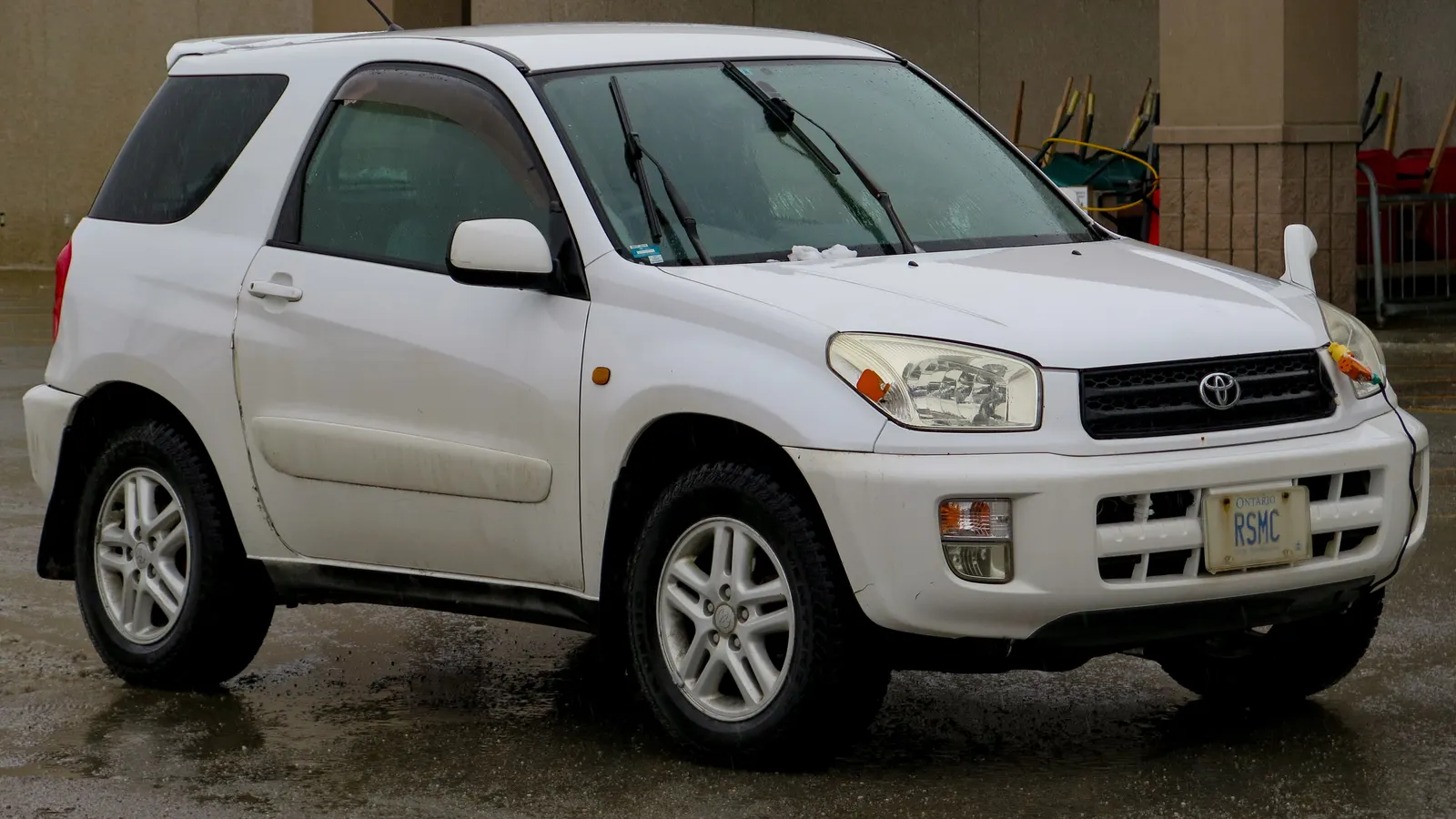
Pictured: 2002 Toyota RAV4 L 2-door (Japanese model). Photo: Elise240SX, CC BY-SA 4.0, cropped
NHTSA lists no safety recalls for this model year.
Owner complaints
527
43 report a crash, fire, injury or death
Recalls
0
None listed by NHTSA
Most common problem
50%
of complaints: engine control module failure
Complaints per year filed
2002–2024 · peak 146
In short
Serious known problemsThe 2002 Toyota RAV4 has serious known problems: 324 owner complaints (61%) describe transmission trouble such as harsh shifting, slipping or outright failure. NHTSA has 527 owner complaints, and 43 report a crash, fire, injury or death. Engine control module failure and hesitation are also common. This model year has no recalls.
Reliability
How Reliable Is the 2002 Toyota RAV4?
The 2002 RAV4 has serious known problems because most of its complaints are about the transmission. 61% of owner complaints describe harsh or jerky shifting, slipping, delayed engagement or outright transmission failure. These are not cosmetic issues. They affect whether the car moves when you press the pedal, and some owners describe it happening while pulling into traffic.
The biggest group of complaints is engine control module failure, reported in about half of all complaints. It overlaps heavily with the transmission problems. Owners with this complaint often describe the same shifting symptoms, a check engine light, and repairs that ranged from replacing the module to rebuilding the transmission. Hesitation or slipping while driving and harsh shifting each show up in about 1 in 3 complaints, and transmission failure needing replacement in about 1 in 4. Because the same cars often appear under several of these headings, treat them as one cluster rather than separate, independent faults.
A smaller group of complaints describes more dangerous events. Some owners report stalling while driving, or the car dropping into neutral or losing drive while moving. A few describe sudden acceleration, and about 1 in 25 complaints say the airbags did not deploy in a crash. Those airbag reports come at a much lower mileage than the rest, with a median of about 35,500 miles. This model year has no recall for any of these problems.
The transmission and engine control module problems are reported at similar mileage. Their medians sit between about 94,500 and 96,200 miles, and the middle half of reports fall between roughly 73,800 and 125,000 miles. Stalling is reported a little earlier, around 88,100 miles. A low-mileage car is not clear of these problems, but one past 70,000 miles is in the range where owners most often report them. Where owners say what happened after repair, more say it did not fix the problem than say it did, for both engine control module failure and transmission failure. Complaints lean toward repairs that failed.
If you are buying, look for proof of transmission and engine control module work, and check how the car shifts when cold and when pulling away from a stop. Complaint counts show what owners reported, not how many vehicles are affected, and they cannot show how a particular car was maintained or driven. A clean test drive does not rule these problems out, but a car that already hesitates or shows a check engine light is a poor bet.
Top problems
The 9 problems owners report most
Named from 527 NHTSA complaints. Open a problem for symptoms, the fix, cost and owners' accounts.
1.Engine control module failureSeriousNearly half of complaints82,000–117,500 mi~$1,500 repair
Owners most often describe a check engine light, jerking, transmission slipping and erratic or harsh shifting, usually while driving or in traffic. Reports typically come at around 95,600 miles, with the middle half between 82,000 and 117,500 miles. Replacing the ECM is the most common repair mentioned, and no recalls are mentioned.
What owners describe
- Jerking or hesitation20%
- Check engine light17%
- Erratic or harsh shifting11%
- Transmission slipping11%
Fix
Most common repair owners describe: replaced ecm (7 reports).
Repair worked in 36% of complaints that describe one (complaints lean toward repairs that failed)
Mileage
95,600 mi
Middle half 82,000–117,500 mi · 249 reports
Repair cost
$1,543
Middle half $1,300–$4,000 · 52 owner amounts
How common
50%
262 of 527 complaints
Crash, fire or injury
2%
of these complaints
In owners' words
“The ecm is defective, which is causing the car to stall out when accelerating and then shift very hard.”
Owner in KY2.0L 4-cylFiled 2008NHTSA 10226513 “It constantly looses tension on its clutch pack, resulting in loss of power to the road.”
Owner in FL2.0L 4-cylFiled 2008NHTSA 10244728 “The vehicle shifted completely out of gear and then went shifted back on its own.”
Owner in WA2.0L 4-cylFiled 2007NHTSA 10207995 2.Hesitation or slipping while drivingSeriousAbout 1 in 3 complaints79,100–118,300 mi~$3,500 repair
Owners describe transmission slipping, hesitation, jerking and erratic shifting, mostly while driving, accelerating or pulling out into traffic. Reports typically come at around 95,800 miles, with the middle half between 79,100 and 118,300 miles. No recalls are mentioned.
What owners describe
- Transmission slipping28%
- Jerking or bucking24%
- Hesitating on acceleration18%
- Check engine light9%
Fix
Most common repair owners describe: transmission replacement quoted (4 reports).
Repair worked in 29% of complaints that describe one (complaints lean toward repairs that failed)
Mileage
95,800 mi
Middle half 79,100–118,300 mi · 192 reports
Repair cost
$3,500
Middle half $1,400–$4,000 · 25 owner amounts
How common
38%
198 of 527 complaints
Crash, fire or injury
2%
of these complaints
In owners' words
“My tranny slips and hesitates so bad that as I pulled into the intersection in the way of oncoming cars my car couldn't get through the intersection safely.”
Owner in OH2.0L 4-cylFiled 2009NHTSA 10262209 “The car does not respond for a while when shifting from first to second gear, then it jumps making a loud noise”
Owner in VA2.0L 4-cylFiled 2008NHTSA 10229850 “My car started to rev without any forward gain in distance when I depressed the accelerator.”
Owner in CO2.0L 4-cylFiled 2009NHTSA 10257071 3.Harsh, jerky shiftingSeriousAbout 1 in 3 complaints83,300–115,000 mi~$1,400 repair
Owners describe harsh, hard or erratic shifts, jerking and slipping, often in traffic or when accelerating from a stop. Reports typically come at around 96,000 miles, with the middle half between 83,300 and 115,000 miles. No recalls are mentioned.
What owners describe
- Jerking or shaking28%
- Harsh or hard shifts21%
- Check engine light14%
- Erratic shifting6%
Fix
Most common repair owners describe: ecm replaced (4 reports).
Repair worked in 36% of complaints that describe one (complaints lean toward repairs that failed)
Mileage
96,000 mi
Middle half 83,300–115,000 mi · 154 reports
Repair cost
$1,350
Middle half $1,050–$2,320 · 19 owner amounts
How common
31%
163 of 527 complaints
Crash, fire or injury
4%
of these complaints
In owners' words
“Auto transmission suddenly shifting hard from 2/3 gears, hard into reverse, slow to engage after full stops, jerks abruptly.”
Owner in WIFiled 2008NHTSA 10249543 “It jerks and hesitates and is extremely dangerous to drive as you never know if it is going to proceed forward or not.”
Owner in COFiled 2008NHTSA 10237451 “As the car was shifting into 2nd gear it would stall & then suddenly shift really hard into 3rd gear.”
Owner in CA2.0L 4-cylFiled 2008NHTSA 10233982 4.Transmission failure needing replacementSeriousAbout 1 in 4 complaints73,800–116,000 mi~$3,500 repair
Owners describe transmission failure, slipping, erratic shifting and a check engine light, often when accelerating or pulling into traffic. Some say the problem came back after a rebuild. Reports typically come at around 94,500 miles, with the middle half between 73,800 and 116,000 miles. No recalls are mentioned.
What owners describe
- Transmission failure15%
- Erratic shifting10%
- Slipping10%
Fix
Most common repair owners describe: transmission rebuilt (7 reports).
Repair worked in 34% of complaints that describe one (complaints lean toward repairs that failed)
Mileage
94,500 mi
Middle half 73,800–116,000 mi · 114 reports
Repair cost
$3,500
Middle half $3,073–$4,275 · 38 owner amounts
How common
23%
121 of 527 complaints
Crash, fire or injury
2%
of these complaints
In owners' words
“Car slowed without cause in heavy traffic, and I had to pull off road in adverse conditions.”
Owner in CO2.0L 4-cylFiled 2009NHTSA 10276090 “I am currently unemployed and had to use all of my student loan money to pay for my car.”
Owner in CA2.0L 4-cylFiled 2009NHTSA 10287023 “Transmission was rebuilt for the 3rd time and not completed and was never fixed.”
Owner in IL2.0L 4-cylFiled 2008NHTSA 10233092 5.Delayed engagement pulling awaySeriousAbout 1 in 12 complaints85,000–125,000 mi~$1,600 repair
Owners describe the car hesitating or not moving after a stop, such as when turning across oncoming traffic or accelerating from a standstill. Reports typically come at around 96,200 miles, with the middle half between 85,000 and 125,000 miles. No recalls are mentioned.
What owners describe
- Hesitates from a stop11%
- Check engine light9%
- Will not move or go into gear7%
- Erratic shifting7%
Fix
Most common repair owners describe: new transmission quoted (2 reports).
Repair worked in 35% of complaints that describe one (complaints lean toward repairs that failed)
Mileage
96,200 mi
Middle half 85,000–125,000 mi · 43 reports
Repair cost
$1,599
Middle half $1,300–$3,375 · 10 owner amounts
How common
9%
45 of 527 complaints
Crash, fire or injury
0%
of these complaints
In owners' words
“At stop signs and traffic lights the vehicle begins jerking and hesitating when you push on the acceleration peddle.”
Owner in KY2.0L 4-cylFiled 2008NHTSA 10239809 “Attempting to turn across oncoming traffic and vehicle would not move and almost hit by oncoming traffic.”
Owner in CO2.0L 4-cylFiled 2008NHTSA 10229462 “When I would come to a complete stop, it would take a while for the car to accelerate and pick up speed”
Owner in FL2.0L 4-cylFiled 2009NHTSA 10282747
Show 4 more problemsShow fewer problems
6.Stalling or shutting off while drivingCriticalAbout 1 in 12 complaints75,500–117,500 mi
Owners describe the car stalling without warning, including when pulling into traffic, going uphill or in an intersection. Reports typically come at around 88,100 miles, with the middle half between 75,500 and 117,500 miles. No recalls are mentioned.
What owners describe
- Stalls while driving67%
- Rough or hard shifting14%
- Check engine light9%
Fix
Most common repair owners describe: transmission and ecm repairs (1 report).
Repair worked in 22% of complaints that describe one (complaints lean toward repairs that failed)
Mileage
88,100 mi
Middle half 75,500–117,500 mi · 38 reports
Repair cost
—
Fewer than 10 owners report a repair cost
How common
8%
43 of 527 complaints
Crash, fire or injury
2%
of these complaints
In owners' words
“She pulled away from a stop sign and our 2002 rav4 started jerking and then slowed to a sudden stop right in the middle of the intersection”
Owner in CAFiled 2010NHTSA 10315956 “At 84,000 miles the car started surging for no reason, stalling while moving on the highway, and stalling while approaching intersections.”
Owner in NJ2.0L 4-cylFiled 2009NHTSA 10269861 “The engine would start, but engaging any drive position (d, 2, 1, r) would cause the engine to shut down”
Owner in NY2.0L 4-cylFiled 2009NHTSA 10297229 7.Sudden or unintended accelerationCriticalAbout 1 in 23 complaints59,600–106,200 mi
Owners describe the car accelerating on its own, surging forward with the brake applied, or not stopping, including in reverse and on the highway. Some report collisions. Reports typically come at around 84,000 miles. No recalls are mentioned.
What owners describe
- Accelerates on its own17%
- Surges with brake applied13%
- Check engine light9%
Fix
Most common repair owners describe: speed sensor replaced (1 report).
Mileage
84,000 mi
Middle half 59,600–106,200 mi · 18 reports
Repair cost
—
Fewer than 10 owners report a repair cost
How common
4%
23 of 527 complaints
Crash, fire or injury
30%
of these complaints
In owners' words
“Suddenly accelerated (even though I quickly put my foot on the brake) and crashed through the bottom half of the garage door”
Owner in MS2.0L 4-cylFiled 2010NHTSA 10339915 “I was going 65 and all of a sudden the RPMS went up to 6000 from 3000 and the car sped up to 85 and then went into neutral”
Owner in AZ2.0L 4-cylFiled 2009NHTSA 10274064 “The vehicle then attempted to stall without warning, however suddenly the vehicle shifted gears and abnormally accelerated”
Owner in MA2.0L 4-cylFiled 2010NHTSA 10318926 8.Airbags did not deploy in a crashCriticalAbout 1 in 25 complaints33,000–44,500 mi
Owners describe front, side or rear airbags not deploying in head-on, broadside and chain collisions, some with fire, jammed doors or injury. Reports come at lower mileage than other problems, typically around 35,500 miles. No recalls are mentioned.
What owners describe
- Vehicle fire after crash19%
- Jammed or blocked doors19%
Fix
Owners don't describe a consistent repair yet.
Mileage
35,500 mi
Middle half 33,000–44,500 mi · 18 reports
Repair cost
—
Fewer than 10 owners report a repair cost
How common
4%
21 of 527 complaints
By engine
- 2.0L 4-cyl94%
- 2.5L 4-cyl6%
In owners' words
“The air bags on my 2002 Toyota rav4 SUV failed to deploy and I suffered injuries to my head, neck, chest, stomach and left hand”
Owner in WV2.0L 4-cylFiled 2017NHTSA 10969094 9.Drops into neutral or loses driveCriticalAbout 1 in 28 complaints76,500–135,300 mi
Owners describe the car acting like it is in neutral, erratic shifting, and sudden loss of power on highways and at lower speeds. One owner says the car was rear ended after stopping suddenly. Reports typically come at around 108,300 miles. No recalls are mentioned.
What owners describe
- Erratic shifting26%
- Transmission slipping21%
- Goes into neutral16%
- Loses all power11%
Fix
Most common repair owners describe: new transmission quoted (1 report).
Mileage
108,300 mi
Middle half 76,500–135,300 mi · 18 reports
Repair cost
—
Fewer than 10 owners report a repair cost
How common
4%
19 of 527 complaints
Crash, fire or injury
11%
of these complaints
In owners' words
“The transmission suddenly shifted from 2nd to 1st gear and then the drive line locked-up causing the vehicle to stop suddenly.”
Owner in CA2.0L 4-cylFiled 2008NHTSA 10248924 “As I pull out into traffic the car decides to not shift (as if it were in neutral) right in the path of oncoming traffic”
Owner in MT2.0L 4-cylFiled 2009NHTSA 10294817 “The transmission on my rav4 started shifting erratically and then it stopped altogether in the middle of heavy traffic”
Owner in CTFiled 2009NHTSA 10291430
Buying one
Should you buy a used 2002 Toyota RAV4?
What to check before you buy, based on the complaint and recall data.
Test drive a 2002 RAV4 for slipping, jerky shifts and hesitation when pulling away from a stop, and treat a check engine light as a warning sign rather than a minor issue. Ask for records of any transmission or engine control module work, and be cautious if the seller cannot show it. Most complaints come from owners around 94,000 miles, so a car near or past that point deserves extra scrutiny. Have a mechanic inspect it before you buy.
- 1Still run the VIN. NHTSA lists no recalls for this model year, but recalls can be added later. Check at nhtsa.gov/recalls.
- 2Test-drive for stalling. It's the most common safety-critical complaint, in about 1 in 12 owner complaints, usually around 88,100 miles.
- 3Check for engine control module failure. The most common complaint, in nearly half of owner complaints.
- 4Ask for software update records. 12% of complaints mention a software update or reflash.
- 5Get a pre-purchase inspection. An independent mechanic can spot leaks, stored fault codes and accident repairs that a test drive misses.
Toyota RAV4 model years
Early complaints are those filed in a model year's first 3 years. They follow how many were sold, so they don't show which years are better.
Crash test ratings
NHTSA 5-Star Safety Ratings.
| 4-DR. | |
|---|---|
| Overall | Not rated |
| Frontal crash | Not rated |
| Side crash | Not rated |
| Rollover | ★★★ |
| Rollover risk | 0% |
Owning one
If you already own one
Find your symptom, see when problems tend to show up, and check which recalls apply.
Watch for a check engine light, slipping, jerking, or a delay when you pull away from a stop. Some owners report the car stalling or dropping into neutral while driving, so get these symptoms checked promptly rather than waiting, and stop driving if the car loses power in traffic. There is no recall for this model year, so there is no free recall repair to confirm. Keep records of every repair visit and report problems to NHTSA.
- Engine control module failureSeriousNearly half of owner complaints262 of 527Median 95,600 mi
Most common repair owners describe: replaced ecm (7 reports).
- Hesitation or slipping while drivingSeriousAbout 1 in 3 owner complaints198 of 527Median 95,800 mi
Most common repair owners describe: transmission replacement quoted (4 reports).
- Harsh, jerky shiftingSeriousAbout 1 in 3 owner complaints163 of 527Median 96,000 mi
Most common repair owners describe: ecm replaced (4 reports).
- Transmission failure needing replacementSeriousAbout 1 in 4 owner complaints121 of 527Median 94,500 mi
Most common repair owners describe: transmission rebuilt (7 reports).
- Delayed engagement pulling awaySeriousAbout 1 in 12 owner complaints45 of 527Median 96,200 mi
Most common repair owners describe: new transmission quoted (2 reports).
- Stalling or shutting off while drivingCriticalAbout 1 in 12 owner complaints43 of 527Median 88,100 mi
Most common repair owners describe: transmission and ecm repairs (1 report).
- Sudden or unintended accelerationCriticalAbout 1 in 23 owner complaints23 of 527Median 84,000 mi
Most common repair owners describe: speed sensor replaced (1 report).
- Airbags did not deploy in a crashCriticalAbout 1 in 25 owner complaints21 of 527Median 35,500 mi
Owners don't describe a consistent repair yet.
Show all 10 problemsShow fewer problems
- Drops into neutral or loses driveCriticalAbout 1 in 28 owner complaints19 of 527Median 108,300 mi
Most common repair owners describe: new transmission quoted (1 report).
- Engine failureCriticalAbout 1 in 53 owner complaints10 of 527Median 85,000 mi
of complaints that list mileage (14 of 478) came in before 25,000 miles. A low odometer reading is no guarantee.
Recalls
No recalls
NHTSA lists no safety recalls for the 2002 Toyota RAV4.
Reliability history
Toyota RAV4 reliability by year
Complaints filed in each model year's first 3 years, by trouble spot. Darker cells have more complaints; counts aren't adjusted for how many were sold each year.
| Trouble spot | 2000 | 2001 | 2002 | 2003 | 2004 | 2005 | 2006 | 2007 |
|---|---|---|---|---|---|---|---|---|
| Transmission & drivetrain | 2000 Transmission & drivetrain: 2 complaints in the first 3 years. | 2001 Transmission & drivetrain: 3 complaints in the first 3 years. | 2002 Transmission & drivetrain: 2 complaints in the first 3 years. | 2003 Transmission & drivetrain: 2 complaints in the first 3 years. | 2004 Transmission & drivetrain: 1 complaints in the first 3 years. | 2005 Transmission & drivetrain: 0 complaints in the first 3 years. | 2006 Transmission & drivetrain: 22 complaints in the first 3 years. | 2007 Transmission & drivetrain: 12 complaints in the first 3 years. |
| Engine | 2000 Engine: 0 complaints in the first 3 years. | 2001 Engine: 4 complaints in the first 3 years. | 2002 Engine: 3 complaints in the first 3 years. | 2003 Engine: 3 complaints in the first 3 years. | 2004 Engine: 3 complaints in the first 3 years. | 2005 Engine: 1 complaints in the first 3 years. | 2006 Engine: 6 complaints in the first 3 years. | 2007 Engine: 13 complaints in the first 3 years. |
| Fuel system & stalling | 2000 Fuel system & stalling: 1 complaints in the first 3 years. | 2001 Fuel system & stalling: 0 complaints in the first 3 years. | 2002 Fuel system & stalling: 2 complaints in the first 3 years. | 2003 Fuel system & stalling: 0 complaints in the first 3 years. | 2004 Fuel system & stalling: 1 complaints in the first 3 years. | 2005 Fuel system & stalling: 1 complaints in the first 3 years. | 2006 Fuel system & stalling: 4 complaints in the first 3 years. | 2007 Fuel system & stalling: 6 complaints in the first 3 years. |
| Electrical | 2000 Electrical: 0 complaints in the first 3 years. | 2001 Electrical: 2 complaints in the first 3 years. | 2002 Electrical: 3 complaints in the first 3 years. | 2003 Electrical: 3 complaints in the first 3 years. | 2004 Electrical: 3 complaints in the first 3 years. | 2005 Electrical: 0 complaints in the first 3 years. | 2006 Electrical: 5 complaints in the first 3 years. | 2007 Electrical: 4 complaints in the first 3 years. |
| Driver aids & stability | 2000 Driver aids & stability: 0 complaints in the first 3 years. | 2001 Driver aids & stability: 0 complaints in the first 3 years. | 2002 Driver aids & stability: 0 complaints in the first 3 years. | 2003 Driver aids & stability: 0 complaints in the first 3 years. | 2004 Driver aids & stability: 0 complaints in the first 3 years. | 2005 Driver aids & stability: 0 complaints in the first 3 years. | 2006 Driver aids & stability: 0 complaints in the first 3 years. | 2007 Driver aids & stability: 1 complaints in the first 3 years. |
| Brakes | 2000 Brakes: 0 complaints in the first 3 years. | 2001 Brakes: 17 complaints in the first 3 years. | 2002 Brakes: 2 complaints in the first 3 years. | 2003 Brakes: 1 complaints in the first 3 years. | 2004 Brakes: 2 complaints in the first 3 years. | 2005 Brakes: 1 complaints in the first 3 years. | 2006 Brakes: 9 complaints in the first 3 years. | 2007 Brakes: 4 complaints in the first 3 years. |
| Steering | 2000 Steering: 0 complaints in the first 3 years. | 2001 Steering: 3 complaints in the first 3 years. | 2002 Steering: 2 complaints in the first 3 years. | 2003 Steering: 0 complaints in the first 3 years. | 2004 Steering: 0 complaints in the first 3 years. | 2005 Steering: 0 complaints in the first 3 years. | 2006 Steering: 13 complaints in the first 3 years. | 2007 Steering: 14 complaints in the first 3 years. |
| Suspension | 2000 Suspension: 0 complaints in the first 3 years. | 2001 Suspension: 1 complaints in the first 3 years. | 2002 Suspension: 2 complaints in the first 3 years. | 2003 Suspension: 0 complaints in the first 3 years. | 2004 Suspension: 0 complaints in the first 3 years. | 2005 Suspension: 0 complaints in the first 3 years. | 2006 Suspension: 1 complaints in the first 3 years. | 2007 Suspension: 0 complaints in the first 3 years. |
| Airbags & seat belts | 2000 Airbags & seat belts: 0 complaints in the first 3 years. | 2001 Airbags & seat belts: 8 complaints in the first 3 years. | 2002 Airbags & seat belts: 4 complaints in the first 3 years. | 2003 Airbags & seat belts: 4 complaints in the first 3 years. | 2004 Airbags & seat belts: 2 complaints in the first 3 years. | 2005 Airbags & seat belts: 2 complaints in the first 3 years. | 2006 Airbags & seat belts: 7 complaints in the first 3 years. | 2007 Airbags & seat belts: 7 complaints in the first 3 years. |
| Body, lights & visibility | 2000 Body, lights & visibility: 3 complaints in the first 3 years. | 2001 Body, lights & visibility: 10 complaints in the first 3 years. | 2002 Body, lights & visibility: 4 complaints in the first 3 years. | 2003 Body, lights & visibility: 1 complaints in the first 3 years. | 2004 Body, lights & visibility: 5 complaints in the first 3 years. | 2005 Body, lights & visibility: 3 complaints in the first 3 years. | 2006 Body, lights & visibility: 19 complaints in the first 3 years. | 2007 Body, lights & visibility: 9 complaints in the first 3 years. |
| Acceleration & speed control | 2000 Acceleration & speed control: 1 complaints in the first 3 years. | 2001 Acceleration & speed control: 9 complaints in the first 3 years. | 2002 Acceleration & speed control: 5 complaints in the first 3 years. | 2003 Acceleration & speed control: 2 complaints in the first 3 years. | 2004 Acceleration & speed control: 2 complaints in the first 3 years. | 2005 Acceleration & speed control: 0 complaints in the first 3 years. | 2006 Acceleration & speed control: 25 complaints in the first 3 years. | 2007 Acceleration & speed control: 15 complaints in the first 3 years. |
| Wheels & tires | 2000 Wheels & tires: 2 complaints in the first 3 years. | 2001 Wheels & tires: 2 complaints in the first 3 years. | 2002 Wheels & tires: 2 complaints in the first 3 years. | 2003 Wheels & tires: 3 complaints in the first 3 years. | 2004 Wheels & tires: 0 complaints in the first 3 years. | 2005 Wheels & tires: 2 complaints in the first 3 years. | 2006 Wheels & tires: 3 complaints in the first 3 years. | 2007 Wheels & tires: 5 complaints in the first 3 years. |
All problems
Every problem reported on the 2002 RAV4
Every problem found in the 527 owner complaints, by area of the vehicle.
Transmission & drivetrain
394 75%- 198 38%typically at 95,800 mi · repair $3,500 · 29% fixed95,800$3,50029%
- Harsh, jerky shiftingSerious163 31%typically at 96,000 mi · repair $1,350 · 36% fixed96,000$1,35036%
- 121 23%typically at 94,500 mi · repair $3,500 · 34% fixed94,500$3,50034%
- 45 9%typically at 96,200 mi · repair $1,599 · 35% fixed96,200$1,59935%
- 19 4%typically at 108,300 mi108,300––
- Drive belt breaks or is chewed up6 1%typically at 10,500 mi10,500––
Show 8 more transmission & drivetrain problemsShow fewer transmission & drivetrain problems
- Manual transmission pops out of 5th gear2 0.4%–––
- Fails to shift gears1 0.2%–––
- Camshaft gear and timing chain wear1 0.2%–––
- Vehicle jerks or lurches forward1 0.2%–––
- Transmission shudder or judderSerious1 0.2%–––
- Drivetrain locks up at highway speed1 0.2%–––
- Transmission fluid leak1 0.2%–––
- Power transfer unit (PTU) or 4WD failureCritical1 0.2%–––
Engine
298 57%- 262 50%typically at 95,600 mi · repair $1,543 · 36% fixed95,600$1,54336%
- 43 8%typically at 88,100 mi · 22% fixed88,100–22%
- Engine failureCritical10 2%typically at 85,000 mi85,000––
- Engine oil sludge6 1%typically at 89,900 mi89,900––
- Catalytic converter or oxygen sensor failure3 0.6%–––
- Engine smoking2 0.4%–––
Show 6 more engine problemsShow fewer engine problems
- Check engine light on with no fault found2 0.4%–––
- Oxygen sensors reading low1 0.2%–––
- Check engine light stays on1 0.2%–––
- Engine knocking or beating noise1 0.2%–––
- Loss of power while driving1 0.2%–––
- Check engine light with oxygen sensor not resolved1 0.2%–––
Acceleration & speed control
24 5%- 23 4%typically at 84,000 mi84,000––
- Cruise control works intermittently1 0.2%–––
- Fails to decelerate when off the gas1 0.2%–––
- Roof rack cover falls off1 0.2%–––
Airbags & seat belts
21 4%- 21 4%typically at 35,500 mi35,500––
Body, lights & visibility
11 2%- Door lock actuator failureMinor5 0.9%–––
- Front subframe rusted through2 0.4%–––
- Roof rack bolts fall out1 0.2%–––
- Wiper linkage failure1 0.2%–––
- Sun visors sag or break1 0.2%–––
- Wind noise and vibration1 0.2%–––
Fire
8 2%- Vehicle catches fireCritical8 2%typically at 33,000 mi33,000––
Steering
7 1%- Loss of power steeringCritical4 0.8%–––
- Steering rack and pinion failure1 0.2%–––
- Front suspension or steering bar broke1 0.2%–––
- Steering wobble1 0.2%–––
Wheels & tires
6 1%- Tire blowout2 0.4%–––
- Luggage cover falls and hits occupants2 0.4%–––
- Jack too short to change a tire1 0.2%–––
- Rear wheel toe-out causing tire wear1 0.2%–––
- Tires blow out1 0.2%–––
Brakes
4 0.8%- Brake pedal sinks or brakes failCritical3 0.6%–––
- Brake noise and early wearMinor1 0.2%–––
Electrical
3 0.6%- Battery drain or no-startSerious1 0.2%–––
- Battery warning light stays on1 0.2%–––
- Vehicle shakes when stopped1 0.2%–––
Fuel system & stalling
3 0.6%- Fuel leaksCritical1 0.2%–––
- Poor fuel economy1 0.2%–––
- Dashboard rattle1 0.2%–––
Suspension
1 0.2%- Rear control arm rusting or breakingCritical1 0.2%–––
56 problems found in all 527 complaints. One complaint can describe more than one problem, so counts add up to more than the total. Not counted as a defect: 2 about recall paperwork or parts delays. Typical miles, repair cost and fix rate show only when enough owners report them.
The data
Behind the numbers
Every figure comes from NHTSA's complaint file and APIs.
- Complaints
- 527
- Recalls
- 0
- Crashes
- 36
- Fires
- 15
- Injuries
- 48
- Deaths
- 0
Crashes and fires count complaints that report one; injuries and deaths count people.
FAQ
2002 Toyota RAV4 questions
Is the 2002 Toyota RAV4 reliable?
The 2002 Toyota RAV4 has serious known problems. 61% of its complaints (324) describe transmission problems such as harsh, jerky shifting, transmission failure and delayed engagement from a stop. NHTSA has 527 owner complaints for this model year, and 43 of them report a crash, fire, injury or death.
What are the most common 2002 Toyota RAV4 problems?
Engine control module failure is the most common, with 262 complaints (50%), often alongside a check engine light and shifting trouble. Hesitation or slipping while driving follows with 198 complaints (38%), then harsh, jerky shifting with 163 (31%) and transmission failure needing replacement with 121 (23%). The same cars often appear under several of these headings.
Does the 2002 Toyota RAV4 have any recalls?
NHTSA lists no recalls for the 2002 Toyota RAV4, so there is no do-not-drive or park-outside warning and no free recall repair to confirm. Owners still report serious problems, so keep records of every repair visit. You can check any specific vehicle by entering its VIN at nhtsa.gov/recalls.
Does the 2002 Toyota RAV4 have transmission problems?
Yes, transmission trouble is the main complaint, reported in 61% of complaints (324). Owners describe slipping, harsh or erratic shifts, delayed engagement and outright failure. Transmission failure reports typically come at around 94,500 miles, with the middle half between 73,800 and 116,000 miles. Owners often mention rebuilds or a replacement being quoted.
Does the 2002 Toyota RAV4 stall or lose power while driving?
Some owners say it does. Stalling appears in 43 complaints (about 1 in 12), including when pulling into traffic, going uphill or in an intersection, typically around 88,100 miles. Another 19 complaints describe the car dropping into neutral or losing drive while moving. If the car loses power in traffic, stop driving it and have it checked.
Are the airbags a problem on the 2002 Toyota RAV4?
Airbags not deploying in a crash is a critical problem owners report, in 21 complaints (about 1 in 25). Owners describe front, side or rear airbags not deploying in head-on, broadside and chain collisions. These reports come at lower mileage than the other problems, typically around 35,500 miles.
What should I check before buying a 2002 Toyota RAV4?
Test drive it for slipping, jerky shifts and hesitation when pulling away from a stop, and treat a check engine light as a warning sign. Ask for records of any transmission or engine control module work. Most complaints come from owners around 94,000 miles, so a car near or past that point deserves extra scrutiny. Have a mechanic inspect it first.
Methodology
How we researched this
- Complaints. NHTSA's owner complaint file, counted as unique complaint numbers for make TOYOTA, model RAV4, model year 2002. Data through Oct 4, 2026.
- Verdict. Judged from this model year's own complaints, not against other models, using shares rather than counts. Serious known problems: one serious problem (transmission, engine or stalling, steering, brakes, airbags, fire, fuel leaks) is in a quarter or more of complaints; or a smaller but clear cluster comes with an unusual share of crash, fire, injury or loss-of-power reports or early failures; or an urgent recall or NHTSA investigation matches a top complaint. Some known problems: one of those signals on its own. No pattern of serious problems: none of them; this doesn't mean the vehicle is trouble-free. Too few complaints to judge: under 50 complaints. Why this verdict: 61% of complaints (324) describe transmission problems (harsh, jerky shifting, transmission failure, delayed engagement from a stop).
- No grade or class ranking. Raw complaint counts favor models that sell fewer cars, so we don't score or rank this vehicle against other models until we can adjust for sales.
- Trouble spots and history. Complaints grouped by the part owners chose when filing. The history grid counts complaints filed in each model year's first 3 years so older and newer years compare fairly; years with fewer than 3 complete years are marked too new.
- Named problems. Every one of the 527 complaints was researched and classified by its problems, severity, symptoms, repairs and any cost the owner mentions; the counts, costs and fix rates on this page are tallies of those classifications. Quotes are verbatim excerpts, checked against the original text. Engines are decoded from partial VINs with NHTSA's vPIC service.
- Repair costs and fix rates. Shown only when at least 10 owners report a repair cost, or at least 10 complaints describe whether a repair worked.
- Not adjusted for sales. Not affiliated with NHTSA. Page updated Nov 23, 2026.