2003 Toyota RAV4 Reliability & Problems
By Adrian V. LockhartUpdated All 315 NHTSA owner reports researched and classified
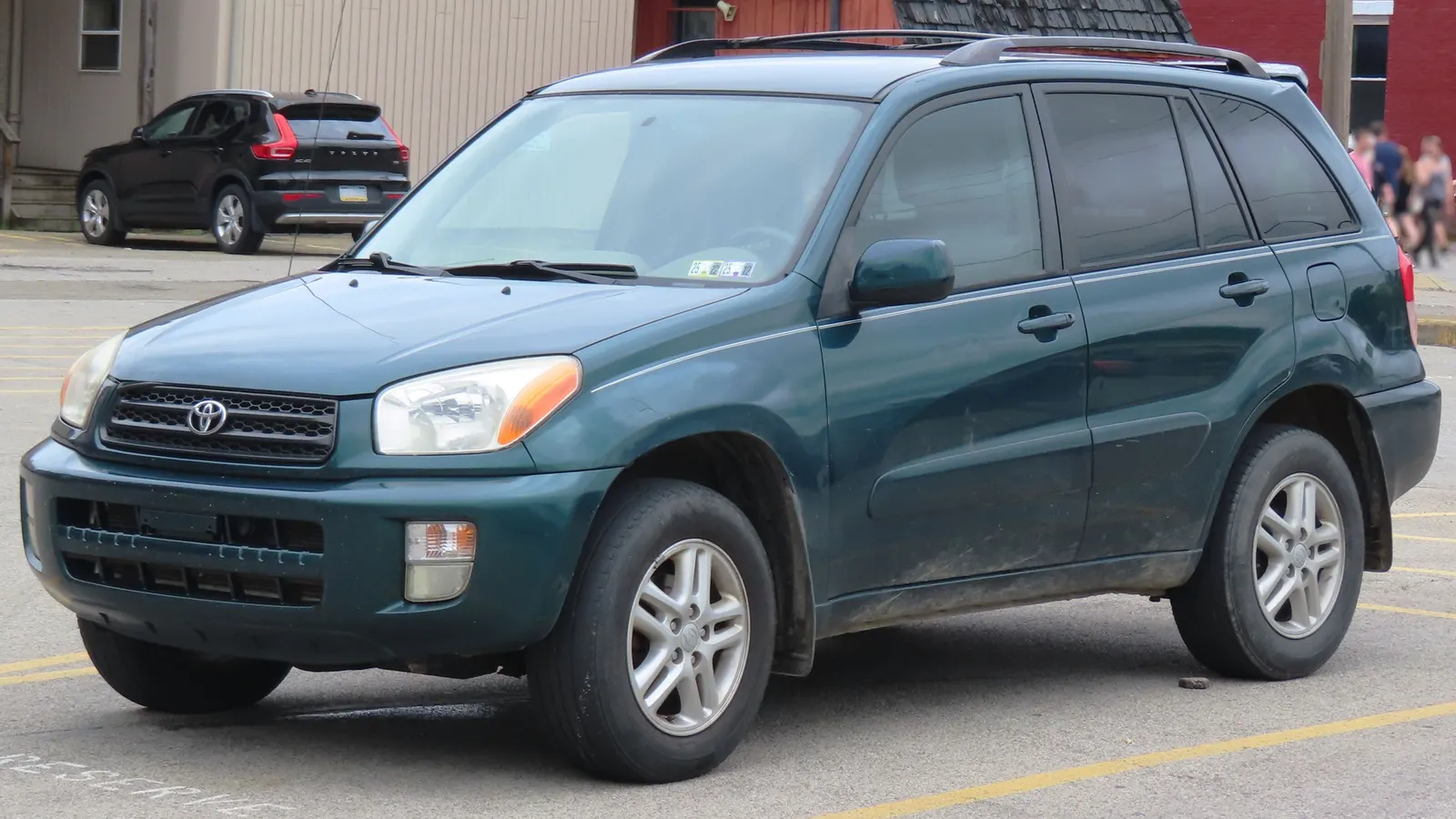
Pictured: 2003 Toyota RAV4 L. Photo: MercurySable99, CC BY-SA 4.0, cropped
NHTSA lists no safety recalls for this model year.
Owner complaints
315
23 report a crash, fire, injury or death
Recalls
0
None listed by NHTSA
Most common problem
31%
of complaints: harsh, jerky shifting
Complaints per year filed
2002–2023 · peak 90
In short
Serious known problemsThe 2003 Toyota RAV4 has serious known problems: 52% of its 315 owner complaints (163) describe transmission trouble such as harsh shifting, failure or delayed engagement. Of all complaints, 23 report a crash, fire, injury or death. The most common problems are harsh, jerky shifting, hesitation or slipping, and engine control module failure. There are no recalls.
Reliability
How Reliable Is the 2003 Toyota RAV4?
The 2003 RAV4 has the verdict of serious known problems because transmission trouble dominates its complaints: just over half describe harsh or jerky shifting, hesitation, delayed engagement or outright failure. This is not a minor annoyance. Owners describe the car lurching, not moving when they pull out into traffic, or stalling in an intersection, and 23 complaints report a crash, fire, injury or death.
Four problems stand out: harsh, jerky shifting (about 1 in 3 complaints), hesitation or slipping while driving (about 1 in 5), engine control module failure (about 1 in 5) and transmission failure needing replacement (about 1 in 6). They overlap heavily. Owners who report engine control module failure often describe the same lurching, slipping and poor shifting, and some say the computer and the transmission were both replaced or rebuilt. For a buyer, that means one symptom can point to more than one expensive repair. Stalling is reported less often, but it is the most safety-critical of these problems.
This model year has no recall for any of these problems, so there is no free factory fix to rely on. Where owners report what happened after repairs, the results are poor. Among harsh-shifting reports that describe an outcome, most say the repair did not fix it and only a few say it did, and transmission failure and stalling reports lean the same way. Complaints lean toward repairs that failed, so a past repair is not proof that a car is sorted.
The problems cluster at similar mileage. Harsh shifting is typically reported around 97,500 miles, hesitation around 95,200 miles, engine control module failure around 93,000 miles, and transmission failure around 98,000 miles, with stalling near 100,000 miles. Few complaints come from very low mileage. A RAV4 well below about 80,000 miles may not have shown these problems yet, and one well past 100,000 miles has gone through the range where owners most often report them.
If you are considering one, treat the transmission and engine control module as the main risks and judge each car on its records and a thorough drive. Complaint counts show what owners reported, not how many vehicles are affected, and they cannot show how any particular vehicle was maintained, so a well-kept car may be fine.
Top problems
The 6 problems owners report most
Named from 315 NHTSA complaints. Open a problem for symptoms, the fix, cost and owners' accounts.
1.Harsh, jerky shiftingSeriousAbout 1 in 3 complaints83,200–116,400 mi~$2,800 repair
Owners describe harsh shifting, jerking, slipping and sluggish acceleration, often in the lower gears and when shifting from first to second. Most reports with mileage fall between about 83,200 and 116,400 miles, with a typical report near 97,500 miles. No recall for this problem exists for this model year.
What owners describe
- Harsh or hard shifts31%
- Jerking or lurching29%
- Slipping between gears8%
- Trouble in first and second6%
Fix
Most common repair owners describe: transmission replacement advised (3 reports).
Repair worked in 24% of complaints that describe one (complaints lean toward repairs that failed)
Mileage
97,500 mi
Middle half 83,200–116,400 mi · 92 reports
Repair cost
$2,767
Middle half $1,500–$4,000 · 33 owner amounts
How common
31%
99 of 315 complaints
Crash, fire or injury
1%
of these complaints
In owners' words
“The ecm/transmission suddenly downshifts or accelerates out of sequence and it causes the entire vehicle to abruptly jerk in a forward/backward motion.”
Owner in CA2.0L 4-cylFiled 2011NHTSA 10392839 “The dealer says I am 2 months past their secret deadline in the secret goodwill warranty so Toyota denies responsibility.”
Owner in MTFiled 2013NHTSA 10496683 “Vehicle started to begin takeoff really slow and hesitant, and then shift really hard with a jerking motion into second.”
Owner in NM2.0L 4-cylFiled 2011NHTSA 10419869 2.Hesitation or slipping while drivingSeriousAbout 1 in 5 complaints85,000–123,500 mi
Owners describe slipping, loss of power, sputtering before the car jerks into gear and a check engine light, often in the lower gears and in heavy traffic. Reports with mileage cluster between 85,000 and 123,500 miles, with a typical report near 95,200 miles. This model year has no recall for it.
What owners describe
- Slipping out of gear15%
- Sputtering then jerking12%
- Check engine light7%
Fix
Most common repair owners describe: ecm replacement advised (2 reports).
Repair worked in 36% of complaints that describe one (complaints lean toward repairs that failed)
Mileage
95,200 mi
Middle half 85,000–123,500 mi · 65 reports
Repair cost
—
Fewer than 10 owners report a repair cost
How common
21%
67 of 315 complaints
Crash, fire or injury
0%
of these complaints
In owners' words
“I contacted manufacturer, they said they will pay for the ecu but not for transmission (if necessary) nor for labor cost.”
Owner in CO2.0L 4-cylFiled 2013NHTSA 10512475 “Several times I was almost rear ended because the car would balk shifting from second to third gear.”
Owner in IL2.0L 4-cylFiled 2011NHTSA 10380138 “The transmission slipped, slowly getting into gear, and then only gradually caught”
Owner in PA2.0L 4-cylFiled 2015NHTSA 10676954 3.Engine control module failureSeriousAbout 1 in 5 complaints83,000–109,100 mi
Owners describe lurching, a car that would not shift from first to second, a check engine light and power loss at a stop, often when accelerating or pulling out in front of traffic. Reports with mileage fall between 83,000 and 109,100 miles, with a typical report near 93,000 miles. This model year has no recall for it.
What owners describe
- Lurching when accelerating8%
- Will not shift 1st to 2nd6%
- Check engine light6%
Fix
Most common repair owners describe: ecu replaced (2 reports).
Repair worked in 45% of complaints that describe one (complaints lean toward repairs that failed)
Mileage
93,000 mi
Middle half 83,000–109,100 mi · 63 reports
Repair cost
—
Fewer than 10 owners report a repair cost
How common
21%
65 of 315 complaints
Crash, fire or injury
2%
of these complaints
In owners' words
“My vehicle began to "buck" and then shortly thereafter the check engine light came on.”
Owner in PA2.0L 4-cylFiled 2015NHTSA 10760770 4.Transmission failure needing replacementSeriousAbout 1 in 6 complaints81,200–121,500 mi~$4,000 repair
Owners describe the transmission failing, jerking, stalling and shuddering, often in the lower gears or when pulling out into traffic. Reports with mileage fall between 81,200 and 121,500 miles, with a typical report near 98,000 miles. This model year has no recall for it.
What owners describe
- Transmission fails outright20%
- Jerking or shuddering16%
- Check engine light10%
Fix
Most common repair owners describe: transmission replacement advised (2 reports).
Repair worked in 17% of complaints that describe one (complaints lean toward repairs that failed)
Mileage
98,000 mi
Middle half 81,200–121,500 mi · 46 reports
Repair cost
$4,000
Middle half $3,700–$5,000 · 17 owner amounts
How common
16%
50 of 315 complaints
Crash, fire or injury
2%
of these complaints
In owners' words
“The consumer had a 110,000 miles on his vehicle, but was five months over the extended warranty.”
Owner in NJFiled 2013NHTSA 10510077 “The dealer stated that there was no recall; therefore, they were not liable for the repairs.”
Owner in NC2.0L 4-cylFiled 2008NHTSA 10241458 “The vehicle began to experience a harsh shift while the vehicle began to reduce in speed.”
Owner in MI2.0L 4-cylFiled 2016NHTSA 10888167 5.Delayed engagement pulling awaySeriousAbout 1 in 7 complaints84,500–115,000 mi~$3,100 repair
Owners describe the car jolting into gear after several seconds, sputtering before it engages and moving slowly when accelerating from a stop or pulling out in front of traffic. Reports with mileage fall between 84,500 and 115,000 miles, with a typical report near 100,000 miles. This model year has no recall for it.
What owners describe
- Trouble after a stop16%
Fix
Most common repair owners describe: transmission repair with many internal parts replaced (1 report).
Repair worked in 32% of complaints that describe one (complaints lean toward repairs that failed)
Mileage
100,000 mi
Middle half 84,500–115,000 mi · 43 reports
Repair cost
$3,079
Middle half $1,448–$4,517 · 10 owner amounts
How common
14%
44 of 315 complaints
Crash, fire or injury
0%
of these complaints
In owners' words
“Step on gas and nothing happens for several seconds then jerks forward, loud thunking sound, extremely dangerous to drive as unknown when it will occur.”
Owner in WI2.0L 4-cylFiled 2013NHTSA 10549358 “There seemed to be hardly any power when the gas pedal was pressed, and then about 5-8 seconds later the car would jolt into gear.”
Owner in GA2.0L 4-cylFiled 2013NHTSA 10548647 “The transmission failed to engage immediately when I accelerated. It hesitated for a few seconds then finally lurched forward.”
Owner in CA2.0L 4-cylFiled 2014NHTSA 10560563
Show 1 more problemShow fewer problems
6.Stalling or shutting off while drivingCriticalAbout 1 in 16 complaints92,000–125,000 mi
Owners describe the engine stalling without warning, losing power and shutting off, sometimes in traffic or at a stop, and some restart it right away. Reports with mileage fall between 92,000 and 125,000 miles, with a typical report near 100,000 miles. This model year has no recall for it.
What owners describe
- Stalls without warning35%
- Stalls in traffic10%
- Rough running after restart10%
- Loses power and shuts off5%
Fix
Most common repair owners describe: dealer found intermittent ground wire connection between computers (1 report).
Mileage
100,000 mi
Middle half 92,000–125,000 mi · 19 reports
Repair cost
—
Fewer than 10 owners report a repair cost
How common
6%
20 of 315 complaints
Crash, fire or injury
0%
of these complaints
In owners' words
“You can be driving 55 one second and it stalls out to 3 MPH the next second without any indication that it is going to happen.”
Owner in MN2.0L 4-cylFiled 2015NHTSA 10750071 “The car worked fine for a few days and now the check engine light has turned back on and the car began to stall again.”
Owner in NV2.0L 4-cylFiled 2011NHTSA 10388868 “The vehicle failed to respond when the accelerator pedal was engaged and the vehicle stalled intermittently.”
Owner in FL2.0L 4-cylFiled 2014NHTSA 10563251
Buying one
Should you buy a used 2003 Toyota RAV4?
What to check before you buy, based on the complaint and recall data.
Test drive any 2003 RAV4 for a long time, including stop-and-go traffic and pulling away from a stop, and walk away if it jerks, slips, hesitates or throws a check engine light. Ask for service records showing the transmission and engine control module have been checked or replaced. Owners often describe repairs that did not last, so a car with a transmission or computer repair on record deserves extra caution. This model year has no recall to confirm.
- 1Still run the VIN. NHTSA lists no recalls for this model year, but recalls can be added later. Check at nhtsa.gov/recalls.
- 2Test-drive for stalling while driving. It's the most common safety-critical complaint, in about 1 in 16 owner complaints, usually around 100,000 miles.
- 3Check for harsh, jerky shifting. The most common complaint, in about 1 in 3 owner complaints.
- 4Get a pre-purchase inspection. An independent mechanic can spot leaks, stored fault codes and accident repairs that a test drive misses.
Toyota RAV4 model years
Early complaints are those filed in a model year's first 3 years. They follow how many were sold, so they don't show which years are better.
Crash test ratings
NHTSA 5-Star Safety Ratings.
| 4-DR. | |
|---|---|
| Overall | Not rated |
| Frontal crash | Not rated |
| Side crash | Not rated |
| Rollover | ★★★ |
| Rollover risk | 0% |
Owning one
If you already own one
Find your symptom, see when problems tend to show up, and check which recalls apply.
Watch for harsh or jerky shifts, slipping, a delay before the car moves from a stop, a check engine light and sudden stalling. Stalling and hesitation in traffic can be dangerous, so have the car inspected as soon as these start and avoid driving it in heavy traffic until it is checked. Owners tend to report these problems around 95,000 to 100,000 miles, so be alert as the odometer approaches that range.
- Harsh, jerky shiftingSeriousAbout 1 in 3 owner complaints99 of 315Median 97,500 mi
Most common repair owners describe: transmission replacement advised (3 reports).
- Hesitation or slipping while drivingSeriousAbout 1 in 5 owner complaints67 of 315Median 95,200 mi
Most common repair owners describe: ecm replacement advised (2 reports).
- Engine control module failureSeriousAbout 1 in 5 owner complaints65 of 315Median 93,000 mi
Most common repair owners describe: ecu replaced (2 reports).
- Transmission failure needing replacementSeriousAbout 1 in 6 owner complaints50 of 315Median 98,000 mi
Most common repair owners describe: transmission replacement advised (2 reports).
- Delayed engagement pulling awaySeriousAbout 1 in 7 owner complaints44 of 315Median 100,000 mi
Most common repair owners describe: transmission repair with many internal parts replaced (1 report).
- Stalling or shutting off while drivingCriticalAbout 1 in 16 owner complaints20 of 315Median 100,000 mi
Most common repair owners describe: dealer found intermittent ground wire connection between computers (1 report).
- Sudden or unintended accelerationCriticalAbout 1 in 22 owner complaints14 of 315Median 75,000 mi
- Hesitation or no response when acceleratingSeriousAbout 1 in 29 owner complaints11 of 315Median 108,100 mi
of complaints that list mileage (11 of 275) came in before 25,000 miles. A low odometer reading is no guarantee.
Recalls
No recalls
NHTSA lists no safety recalls for the 2003 Toyota RAV4.
Reliability history
Toyota RAV4 reliability by year
Complaints filed in each model year's first 3 years, by trouble spot. Darker cells have more complaints; counts aren't adjusted for how many were sold each year.
All problems
Every problem reported on the 2003 RAV4
Every problem found in the 315 owner complaints, by area of the vehicle.
Transmission & drivetrain
198 63%- Harsh, jerky shiftingSerious99 31%typically at 97,500 mi · repair $2,767 · 24% fixed97,500$2,76724%
- 67 21%typically at 95,200 mi · 36% fixed95,200–36%
- 50 16%typically at 98,000 mi · repair $4,000 · 17% fixed98,000$4,00017%
- 44 14%typically at 100,000 mi · repair $3,079 · 32% fixed100,000$3,07932%
- Drops into neutral or loses drive while movingCritical7 2%typically at 107,000 mi107,000––
- Vehicle rolls away when shifted out of park2 0.6%–––
Show 5 more transmission & drivetrain problemsShow fewer transmission & drivetrain problems
- Transmission shudder or judderSerious2 0.6%–––
- Shifter easily bumped from drive into neutral1 0.3%–––
- Transmission shifts up and down on its own1 0.3%–––
- High idle when stopped1 0.3%–––
- Gear shifter fails with warning indicator1 0.3%–––
Engine
95 30%- 65 21%typically at 93,000 mi · 45% fixed93,000–45%
- 20 6%typically at 100,000 mi100,000––
- Engine failureCritical6 2%typically at 78,700 mi78,700––
- Sludge in the engine2 0.6%–––
- Drive belt tensioner or housing breaks1 0.3%–––
- Odor from heating and air conditioning making occupant ill1 0.3%–––
Show 4 more engine problemsShow fewer engine problems
- Oil leaks or low oilSerious1 0.3%–––
- Burns oil1 0.3%–––
- Engine overheating1 0.3%–––
- Repeated oxygen sensor failures and engine light1 0.3%–––
Acceleration & speed control
36 11%- Sudden or unintended accelerationCritical14 4%typically at 75,000 mi75,000––
- Hesitation or no response when acceleratingSerious11 3%typically at 108,100 mi108,100––
- Loss of acceleration powerCritical5 2%–––
- Vehicle speeds up and slows down on its ownCritical4 1%–––
- Cruise control surges around set speed1 0.3%–––
- Throttle body whine1 0.3%–––
Show 1 more acceleration & speed control problemsShow fewer acceleration & speed control problems
- Vehicle does not slow down when throttle is released1 0.3%–––
Airbags & seat belts
14 4%- Airbags did not deploy in a crashCritical8 3%typically at 35,500 mi35,500––
- Frayed seat beltMinor4 1%–––
- Seat belt did not restrain in a crash2 0.6%–––
- Seat belt buckle will not latch1 0.3%–––
- Rear seat belt shredded by sharp metal loop1 0.3%–––
Body, lights & visibility
7 2%- Crunching or squeaking noise in the dashboard2 0.6%–––
- Sun visor drops2 0.6%–––
- Sun visor loses tension and falls down1 0.3%–––
- Driver door electrical console comes loose1 0.3%–––
- Power door locks and security system stop working1 0.3%–––
Brakes
4 1%- Brake pedal sinks or brakes failCritical1 0.3%–––
- Front brake rotors rust, crack and separate from hubs1 0.3%–––
- Poor braking on slippery roads1 0.3%–––
- Brake noise and early wearMinor1 0.3%–––
Wheels & tires
3 1.0%- Tire blowoutCritical3 1.0%–––
Fire
3 1.0%- Vehicle catches fireCritical3 1.0%–––
Steering
3 1.0%- Tie rod fractures2 0.6%–––
- Loss of power steeringCritical1 0.3%–––
Suspension
3 1.0%- Clunks or knocks from the suspensionMinor2 0.6%–––
- Rear control arm rusting or breakingCritical1 0.3%–––
Electrical
2 0.6%- Water leaks damaging electronicsSerious1 0.3%–––
- Battery drain or no-startSerious1 0.3%–––
Fuel system & stalling
2 0.6%- Fuel tank sensor failure1 0.3%–––
- Poor fuel economy1 0.3%–––
52 problems found in all 315 complaints. One complaint can describe more than one problem, so counts add up to more than the total. Not counted as a defect: 1 about recall paperwork or parts delays, 2 describing no vehicle defect. Typical miles, repair cost and fix rate show only when enough owners report them.
The data
Behind the numbers
Every figure comes from NHTSA's complaint file and APIs.
- Complaints
- 315
- Recalls
- 0
- Crashes
- 19
- Fires
- 4
- Injuries
- 9
- Deaths
- 0
Crashes and fires count complaints that report one; injuries and deaths count people.
FAQ
2003 Toyota RAV4 questions
Is the 2003 Toyota RAV4 reliable?
The 2003 Toyota RAV4 has serious known problems. 52% of its 315 owner complaints (163) describe transmission problems such as harsh, jerky shifting, transmission failure and delayed engagement from a stop. Of all complaints, 23 report a crash, fire, injury or death, so a car should be judged on its records and a long test drive.
What are the most common 2003 Toyota RAV4 problems?
The most common problems are harsh, jerky shifting (about 1 in 3 complaints), hesitation or slipping while driving (about 1 in 5), engine control module failure (about 1 in 5) and transmission failure needing replacement (about 1 in 6). Delayed engagement from a stop is about 1 in 7, and stalling while driving is about 1 in 16.
Does the 2003 Toyota RAV4 have any recalls?
There are no recalls for the 2003 Toyota RAV4, so there is no free factory fix for its transmission or engine control module complaints. Check your VIN at nhtsa.gov/recalls to confirm the current status for a specific car before you buy it or if you already own one.
Does the 2003 Toyota RAV4 have transmission problems?
Yes, transmission trouble is the main complaint, with 198 complaints in the transmission and drivetrain area, or 63% of the total. Owners describe harsh shifting, slipping, jerking and a delay before the car moves from a stop. Where owners report an outcome, repairs often did not fix harsh shifting, and 24% say the repair worked.
At what mileage do 2003 Toyota RAV4 problems start?
Owners most often report the main problems between about 93,000 and 100,000 miles. Harsh shifting is typically reported near 97,500 miles, hesitation near 95,200 miles, engine control module failure near 93,000 miles, transmission failure near 98,000 miles and stalling near 100,000 miles. The overall median is 95,500 miles.
What should I check before buying a 2003 Toyota RAV4?
Test drive it for a long time, including stop-and-go traffic and pulling away from a stop. Walk away if it jerks, slips, hesitates or shows a check engine light. Ask for service records showing the transmission and engine control module have been checked or replaced, and be extra cautious about a past repair, since owners often describe repairs that did not last.
Methodology
How we researched this
- Complaints. NHTSA's owner complaint file, counted as unique complaint numbers for make TOYOTA, model RAV4, model year 2003. Data through Oct 4, 2026.
- Verdict. Judged from this model year's own complaints, not against other models, using shares rather than counts. Serious known problems: one serious problem (transmission, engine or stalling, steering, brakes, airbags, fire, fuel leaks) is in a quarter or more of complaints; or a smaller but clear cluster comes with an unusual share of crash, fire, injury or loss-of-power reports or early failures; or an urgent recall or NHTSA investigation matches a top complaint. Some known problems: one of those signals on its own. No pattern of serious problems: none of them; this doesn't mean the vehicle is trouble-free. Too few complaints to judge: under 50 complaints. Why this verdict: 52% of complaints (163) describe transmission problems (harsh, jerky shifting, transmission failure, delayed engagement from a stop).
- No grade or class ranking. Raw complaint counts favor models that sell fewer cars, so we don't score or rank this vehicle against other models until we can adjust for sales.
- Trouble spots and history. Complaints grouped by the part owners chose when filing. The history grid counts complaints filed in each model year's first 3 years so older and newer years compare fairly; years with fewer than 3 complete years are marked too new.
- Named problems. Every one of the 315 complaints was researched and classified by its problems, severity, symptoms, repairs and any cost the owner mentions; the counts, costs and fix rates on this page are tallies of those classifications. Quotes are verbatim excerpts, checked against the original text. Engines are decoded from partial VINs with NHTSA's vPIC service.
- Repair costs and fix rates. Shown only when at least 10 owners report a repair cost, or at least 10 complaints describe whether a repair worked.
- Not adjusted for sales. Not affiliated with NHTSA. Page updated Nov 23, 2026.