2013 Mazda CX-5 Reliability & Problems
By Adrian V. LockhartUpdated All 194 NHTSA owner reports researched and classified
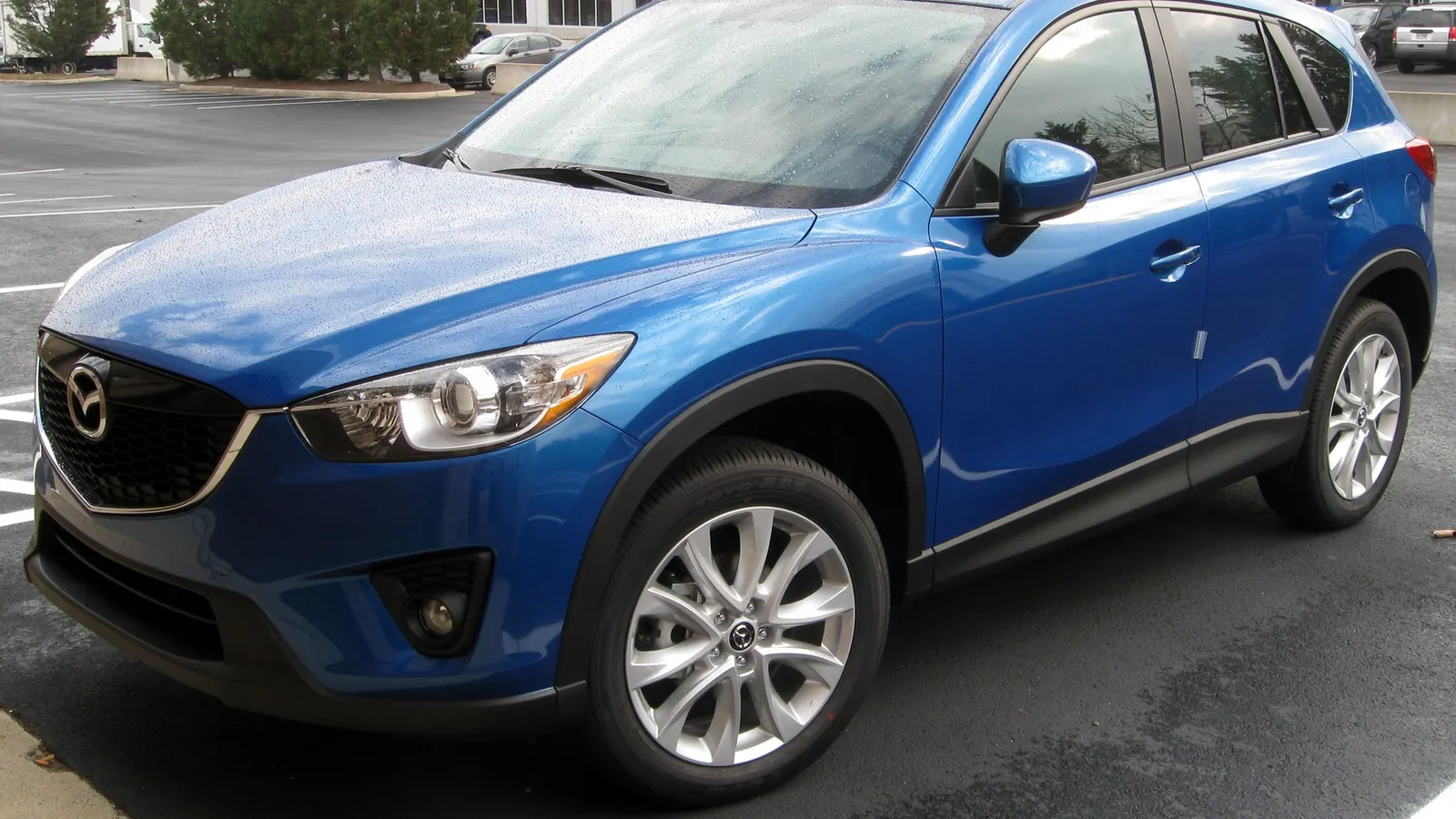
Pictured: 2013 Mazda CX-5 Grand Touring.
Owner complaints
194
10 report a crash, fire, injury or death
Recalls
1
None urgent
Most common problem
27%
of complaints: ignition not shutting off
Complaints per year filed
2012–2025 · peak 31
In short
Some known problemsThe 2013 Mazda CX-5 has some known problems: 80% of serious complaints that list mileage came before 50,000 miles. NHTSA has 194 owner complaints, and 10 report a crash, fire, injury or death. The most common are the ignition not shutting off, battery drain or no-start, and brake noise and early wear. There is 1 recall.
Reliability
How Reliable Is the 2013 Mazda CX-5?
The 2013 Mazda CX-5 has some known problems, and the main reason is timing. Of the serious complaints that list a mileage, 80% came before 50,000 miles, which is a high share of early trouble. Most complaints are about the car not shutting off properly and about the battery. These are more often frustrating and costly than dangerous, but one group is different: owners who describe the car suddenly losing drive on the road.
The biggest group, about 1 in 4 complaints, is the ignition or engine not shutting off. Owners describe the car not fully turning off after parking, the shifter switch not recognizing park, the radio and lights staying on, and an orange light on the start button. Many also report a battery that drains or dies, and the battery complaints list the same symptoms. For a buyer, these two groups are probably the same trouble seen from two sides, so a flat battery on a car like this deserves a closer look rather than a quick replacement. Few owners say what fixed it, and the two who reported a repair outcome for the ignition problem said it did not work. Repairs named include a mass air flow sensor, a gear sensor switch, and a starter and battery. Complaints lean toward repairs that failed. This model year has no recall for these problems.
The most worrying complaints are about the car dropping into neutral or losing drive while moving. Owners describe sudden power loss, speed dropping rapidly, an accelerator that stopped responding, and traction and tire pressure lights coming on, sometimes on the freeway. This is a safety issue because it can happen at speed. One owner said a valve body was replaced and one said a PCM reflash was done, but the reports are too few to say whether repairs worked, and complaints lean toward repairs that failed. This model year has no recall for it. Brake complaints are the minor group: grinding, rust-locked pads and worn rotors, sometimes in the first couple of years.
Mileage helps when you look at a particular car. Drive-loss reports come early, around 17,100 miles in the middle, with most between 7,900 and 28,400 miles. Brake complaints cluster near 30,400 miles. Ignition and battery problems come later: ignition complaints are centered near 87,000 miles and battery ones near 75,000 miles. A car with high mileage and no ignition or battery history has not necessarily escaped. The one recall covers the liftgate support struts: the defect text says they may corrode, possibly causing them to break or the liftgate to drop unexpectedly, and the fix is replacement of both supports free of charge. That recall does not address any of the problems above.
Complaint counts show what owners chose to report, not how many vehicles are affected, and they cannot show how a given car was maintained or driven. A low-mileage car can still have these issues. Ask for service records, check the battery and brakes, and test the start and shutdown routine and a highway drive before you buy.
Top problems
The 4 problems owners report most
Named from 194 NHTSA complaints. Open a problem for symptoms, the fix, cost and owners' accounts.
1.Ignition would not shut offSeriousAbout 1 in 4 complaints71,100–102,000 mi
Owners describe the car not fully turning off after parking, a shifter switch that does not recognize park, and the radio and lights staying on. Many also report a drained battery. Reports are centered around 87,000 miles, with most between 71,100 and 102,000 miles. No recall for this problem is mentioned.
What owners describe
- Battery drains while parked30%
- Car cannot fully turn off17%
- Radio and lights stay on17%
- Shifter does not register park9%
Fix
Most common repair owners describe: mass air flow sensor repair (1 report).
Mileage
87,000 mi
Middle half 71,100–102,000 mi · 35 reports
Repair cost
—
Fewer than 10 owners report a repair cost
How common
27%
53 of 194 complaints
Crash, fire or injury
0%
of these complaints
In owners' words
“Ignition button to not allow vehicle to shut down completely unless you fidget the shifter back and forth”
Owner in FL2.0LFiled 2018NHTSA 11092139 “The engine is refusing to turn off when I hit the off button and it is in the park position”
Owner in NYFiled 2018NHTSA 11073818 “Car sometimes will not turn off auxiliary power when put in park and engine is turned off”
Owner in WV2.0LFiled 2017NHTSA 11012852 2.Battery drain or no-startSeriousAbout 1 in 8 complaints49,000–82,500 mi
Owners describe a battery that drains or runs down, a dead battery, and the car not fully turning off, often when parked or in a garage. Reports are centered around 75,000 miles, with most between 49,000 and 82,500 miles. No recall for this problem is mentioned.
What owners describe
- Battery drains repeatedly64%
- Car will not fully shut down28%
- Dead battery16%
- Alarm sounds with ignition on16%
Fix
Most common repair owners describe: mass air flow sensor repair (1 report).
Mileage
75,000 mi
Middle half 49,000–82,500 mi · 15 reports
Repair cost
—
Fewer than 10 owners report a repair cost
How common
13%
25 of 194 complaints
Crash, fire or injury
0%
of these complaints
In owners' words
“The dealership said that these were known issues but no recalls have been issued”
Owner in MO2.0LFiled 2017NHTSA 11001694 3.Brake noise and early wearMinorAbout 1 in 10 complaints26,600–35,300 mi
Owners describe loud grinding when stopping, rust-locked pads, and rear pads and rotors worn through. Reports are centered around 30,400 miles, with most between 26,600 and 35,300 miles. No recall for this problem is mentioned.
What owners describe
- Pads and rotors worn out74%
- Grinding when braking32%
- Sticking calipers or pads16%
- Steering wheel shimmy5%
Fix
Most common repair owners describe: brakes replaced (2 reports).
Mileage
30,400 mi
Middle half 26,600–35,300 mi · 16 reports
Repair cost
—
Fewer than 10 owners report a repair cost
How common
10%
19 of 194 complaints
Crash, fire or injury
0%
of these complaints
In owners' words
“Rear brake pads and rotors completely worn, calipers sticking before 40,000 miles were even on the car”
Owner in OHFiled 2014NHTSA 10616202 “There was a notice sent to the dealers to look for this problem if there was a customer complaint”
Owner in NY2.0LFiled 2015NHTSA 10733394 4.Drops into neutral or loses driveCriticalAbout 1 in 11 complaints7,900–28,400 mi
Owners describe sudden power loss, speed dropping rapidly and an accelerator that stopped responding, often with traction and tire pressure lights, and on the freeway. Reports are centered around 17,100 miles, with most between 7,900 and 28,400 miles. No recall for this problem is mentioned.
What owners describe
- Traction and warning lights56%
- Speed drops rapidly33%
- Sudden power loss28%
- Acts as if out of gear11%
Fix
Most common repair owners describe: pcm reflash (1 report).
Mileage
17,100 mi
Middle half 7,900–28,400 mi · 17 reports
Repair cost
—
Fewer than 10 owners report a repair cost
How common
9%
18 of 194 complaints
Crash, fire or injury
0%
of these complaints
In owners' words
“A dangerous loss of engine/transmission power shortly after accelerating from a full stop at a stoplight”
Owner in GA2.0LFiled 2014NHTSA 10562519 “I lost forward power in all gears (engine revved, but no power to wheels through transmission)”
Owner in IA2.0LFiled 2014NHTSA 10560258
Buying one
Should you buy a used 2013 Mazda CX-5?
What to check before you buy, based on the complaint and recall data.
Before buying, start the car, put it in park, press the start button and check that everything shuts off and the car locks. Ask whether the battery has been replaced or has gone flat while parked. Check the brakes for grinding and uneven wear, and take a highway drive to see that the car pulls and shifts normally. Confirm the liftgate strut recall (16V644000) has been done.
- 1Run the VIN for open recalls. NHTSA lists 1 recall. Check at nhtsa.gov/recalls.
- 2Test-drive for loss of drive while moving. It's the most common safety-critical complaint, in about 1 in 11 owner complaints, usually around 17,100 miles.
- 3Check for ignition not shutting off. The most common complaint, in about 1 in 4 owner complaints.
- 4Get a pre-purchase inspection. An independent mechanic can spot leaks, stored fault codes and accident repairs that a test drive misses.
Mazda CX-5 model years
Which Mazda CX-5 years to avoid? Every model year compared
Early complaints are those filed in a model year's first 3 years. They follow how many were sold, so they don't show which years are better. The tag on 2013 is its verdict from our research of its owner complaints.
Crash test ratings
NHTSA 5-Star Safety Ratings.
| SUV FWD | SUV AWD | |
|---|---|---|
| Overall | ★★★★ | ★★★★ |
| Frontal crash | ★★★★ | ★★★★ |
| Side crash | ★★★★★ | ★★★★★ |
| Rollover | ★★★★ | ★★★★ |
| Rollover risk | 17% | 17% |
Owning one
If you already own one
Find your symptom, see when problems tend to show up, and check which recalls apply.
Watch for a car that stays on or sounds an alarm after you park, a shifter that does not register park, an orange light on the start button, or a battery that keeps going flat. If the car loses power or drops speed suddenly on the road, with traction or tire pressure lights, get it checked before driving further. Listen for grinding when braking. Ask a Mazda dealer to confirm the liftgate support recall, since replacement parts were not yet available when it was issued.
- Ignition would not shut offSeriousAbout 1 in 4 owner complaints53 of 194Median 87,000 mi
Most common repair owners describe: mass air flow sensor repair (1 report).
- Battery drain or no-startSeriousAbout 1 in 8 owner complaints25 of 194Median 75,000 mi
Most common repair owners describe: mass air flow sensor repair (1 report).
- Brake noise and early wearMinorAbout 1 in 10 owner complaints19 of 194Median 30,400 mi
Most common repair owners describe: brakes replaced (2 reports).
- Drops into neutral or loses driveCriticalAbout 1 in 11 owner complaints18 of 194Median 17,100 mi
Most common repair owners describe: pcm reflash (1 report).
- Sudden loss of engine powerCriticalAbout 1 in 14 owner complaints14 of 194Median 76,300 mi
of complaints that list mileage (47 of 141) came in before 25,000 miles. A low odometer reading is no guarantee.
1 recall, newest first
Open one for the risk, the remedy and what to do now.
Body › Hatchback/liftgateOn the affected vehicles, the lift gate support struts may corrode, possibly causing the struts to break and/or the…Sep 6, 2016580,455 vehicles16V644000
- Defect
- On the affected vehicles, the lift gate support struts may corrode, possibly causing the struts to break and/or the lift gate to drop unexpectedly.
- Risk
- If the lift gate falls unexpectedly, it may hit the user, increasing their risk of injury.
- Remedy
- Mazda dealers will replace the both lift gate supports, free of charge, however parts are not currently available.
What to do
Check the VIN at nhtsa.gov/recalls. If a recall is open, any dealer will fix it free. For NHTSA's full record of a campaign, search its number there (for example 16V644000).
Reliability history
Mazda CX-5 reliability by year
Complaints filed in each model year's first 3 years, by trouble spot. Darker cells have more complaints; counts aren't adjusted for how many were sold each year.
All problems
Every problem reported on the 2013 CX-5
Every problem found in the 194 owner complaints, by area of the vehicle.
Electrical
68 35%- Ignition would not shut offSerious53 27%typically at 87,000 mi87,000––
- Battery drain or no-startSerious25 13%typically at 75,000 mi75,000––
- Many warning lights at onceMinor7 4%typically at 9,300 mi9,300––
- Instrument cluster blank2 1%–––
- Electrical systems shut down and reboot while driving1 0.5%–––
- Mass air flow sensor failure1 0.5%–––
Engine
29 15%- Sudden loss of engine powerCritical14 7%typically at 76,300 mi76,300––
- Stalling or shutting off while drivingCritical6 3%typically at 36,500 mi36,500––
- Heater core problemSerious4 2%–––
- Engine hesitation with check engine light2 1%–––
- Engine failure1 0.5%–––
- Misfires or head gasket failureSerious1 0.5%–––
Show 1 more engine problemsShow fewer engine problems
- Oil leaks or low oilSerious1 0.5%–––
Transmission & drivetrain
28 14%- 18 9%typically at 17,100 mi17,100––
- Transmission warning messagesMinor5 3%–––
- Hesitation or slipping while drivingSerious4 2%–––
- Transmission failure needing replacementSerious4 2%–––
- Delayed engagement pulling away from a stopSerious3 2%–––
- Harsh, jerky shiftingSerious3 2%–––
Show 2 more transmission & drivetrain problemsShow fewer transmission & drivetrain problems
- Drivetrain noise that rises with speed2 1%–––
- Shifter will not move out of park1 0.5%–––
Body, lights & visibility
28 14%- Sunroof glass shattersSerious5 3%–––
- Power seat reclines on its ownSerious5 3%–––
- Mirror vibrationMinor4 2%–––
- Windshield crackingMinor4 2%–––
- Liftgate failure3 2%–––
- Head restraints push head too far forward2 1%–––
Show 7 more body, lights & visibility problemsShow fewer body, lights & visibility problems
- Driver seat loose, jostles and clicks1 0.5%–––
- Power seat no pinch protection1 0.5%–––
- Door and hatch locks fail1 0.5%–––
- Rear seat unlatches when braking1 0.5%–––
- Liftgate damper anchors corroded1 0.5%–––
- Paint peeling1 0.5%–––
- Power seat recline will not stop1 0.5%–––
Brakes
26 13%- 19 10%typically at 30,400 mi30,400––
- Brake pedal sinks or brakes failCritical7 4%typically at 35,000 mi35,000––
Acceleration & speed control
10 5%- Sudden or unintended accelerationCritical8 4%typically at 30,300 mi30,300––
- Pedals too close together1 0.5%–––
- Vehicle will not accelerate when merging1 0.5%–––
Wheels & tires
5 3%- Tire pressure warning light comes on2 1%–––
- Factory tires wear out early1 0.5%–––
- Wheel bearings fail repeatedly1 0.5%–––
- Wheel detached from front axle1 0.5%–––
Steering
3 2%- Loss of power steeringCritical2 1%–––
- Ball joint breaks1 0.5%–––
Driver aids & stability
2 1%- Backup camera stops working1 0.5%–––
- Rearview camera image foggy1 0.5%–––
Fire
1 0.5%- Vehicle catches fireCritical1 0.5%–––
Other
1 0.5%- Area under glovebox gets hot and burns feet1 0.5%–––
Airbags & seat belts
1 0.5%- Passenger airbag turns off with an adult in the seatCritical1 0.5%–––
Suspension
1 0.5%- Front lower control arm breaks1 0.5%–––
51 problems found in all 194 complaints. One complaint can describe more than one problem, so counts add up to more than the total. Not counted as a defect: 9 about recall paperwork or parts delays. Typical miles, repair cost and fix rate show only when enough owners report them.
The data
Behind the numbers
Every figure comes from NHTSA's complaint file and APIs.
- Complaints
- 194
- Recalls
- 1
- Crashes
- 6
- Fires
- 1
- Injuries
- 8
- Deaths
- 0
Crashes and fires count complaints that report one; injuries and deaths count people.
FAQ
2013 Mazda CX-5 questions
Is the 2013 Mazda CX-5 reliable?
The 2013 Mazda CX-5 has some known problems. Of the serious complaints that list a mileage, 80% came before 50,000 miles, which points to early trouble. NHTSA has 194 owner complaints, and 10 report a crash, fire, injury or death. Most concern the ignition not shutting off and the battery.
What are the most common 2013 Mazda CX-5 problems?
The most common is the ignition not shutting off, about 1 in 4 owner complaints. Next come battery drain or no-start (about 1 in 8) and brake noise and early wear (about 1 in 10). Owners also report loss of drive while moving, about 1 in 11 complaints, which is the most serious of these.
How many recalls does the 2013 Mazda CX-5 have?
The 2013 Mazda CX-5 has 1 recall, and none carries a do-not-drive or park-outside warning. Recall 16V644000 covers the lift gate support struts, which may corrode and break, so the lift gate could drop unexpectedly. Mazda dealers will replace both supports free of charge, but parts were not yet available. Check your VIN at nhtsa.gov/recalls.
Does the 2013 Mazda CX-5 have ignition or battery problems?
Yes, and they are the most reported issues. Ignition complaints (53) describe the car not fully turning off after parking, a shifter switch not recognizing park, and the radio and lights staying on. Battery complaints (25) describe a battery that drains or dies. Ignition reports center near 87,000 miles and battery reports near 75,000 miles.
Does the 2013 Mazda CX-5 lose power while driving?
Some owners say it does. Loss of drive while moving, rated critical, appears in 18 complaints. Owners describe sudden power loss, speed dropping rapidly and an accelerator that stopped responding, often with traction and tire pressure lights and sometimes on the freeway. Reports are centered around 17,100 miles, with most between 7,900 and 28,400 miles.
What are the 2013 Mazda CX-5 crash test ratings?
NHTSA gives the 2013 Mazda CX-5 an overall rating of 4 out of 5 stars, for both front-wheel drive and all-wheel drive. Both versions score 4 out of 5 stars in the frontal test, 5 out of 5 stars in the side test and 4 out of 5 stars for rollover.
What should I check before buying a 2013 Mazda CX-5?
Start the car, put it in park, press the start button and check that everything shuts off and the car locks. Ask whether the battery has been replaced or has gone flat while parked. Check the brakes for grinding, take a highway drive, and confirm recall 16V644000 for the liftgate support struts has been done.
Which Mazda CX-5 years should you avoid?
No Mazda CX-5 model year shows serious known problems in owner complaints. The 2013–2014 and 2016 are worth checking carefully: complaints show some known problems. The 2015 and 2017–2023 show no pattern of serious problems. The 2024–2026 have too few complaints to judge. Every model year is compared on the Mazda CX-5 years-to-avoid page.
Methodology
How we researched this
- Complaints. NHTSA's owner complaint file, counted as unique complaint numbers for make MAZDA, model CX-5, model year 2013. Data through Oct 4, 2026.
- Verdict. Judged from this model year's own complaints, not against other models, using shares rather than counts. Serious known problems: one serious problem (transmission, engine or stalling, steering, brakes, airbags, fire, fuel leaks) is in a quarter or more of complaints; or a smaller but clear cluster comes with an unusual share of crash, fire, injury or loss-of-power reports or early failures; or an urgent recall or NHTSA investigation matches a top complaint. Some known problems: one of those signals on its own. No pattern of serious problems: none of them; this doesn't mean the vehicle is trouble-free. Too few complaints to judge: under 50 complaints. Why this verdict: 80% of serious complaints that list mileage came before 50,000 miles (typical: 38%).
- No grade or class ranking. Raw complaint counts favor models that sell fewer cars, so we don't score or rank this vehicle against other models until we can adjust for sales.
- Trouble spots and history. Complaints grouped by the part owners chose when filing. The history grid counts complaints filed in each model year's first 3 years so older and newer years compare fairly; years with fewer than 3 complete years are marked too new.
- Named problems. Every one of the 194 complaints was researched and classified by its problems, severity, symptoms, repairs and any cost the owner mentions; the counts, costs and fix rates on this page are tallies of those classifications. Quotes are verbatim excerpts, checked against the original text. Engines are decoded from partial VINs with NHTSA's vPIC service.
- Repair costs and fix rates. Shown only when at least 10 owners report a repair cost, or at least 10 complaints describe whether a repair worked.
- Not adjusted for sales. Not affiliated with NHTSA. Page updated Nov 5, 2026.