2026 Hyundai Palisade Reliability & Problems
By Adrian V. LockhartUpdated All 120 NHTSA owner reports researched and classified
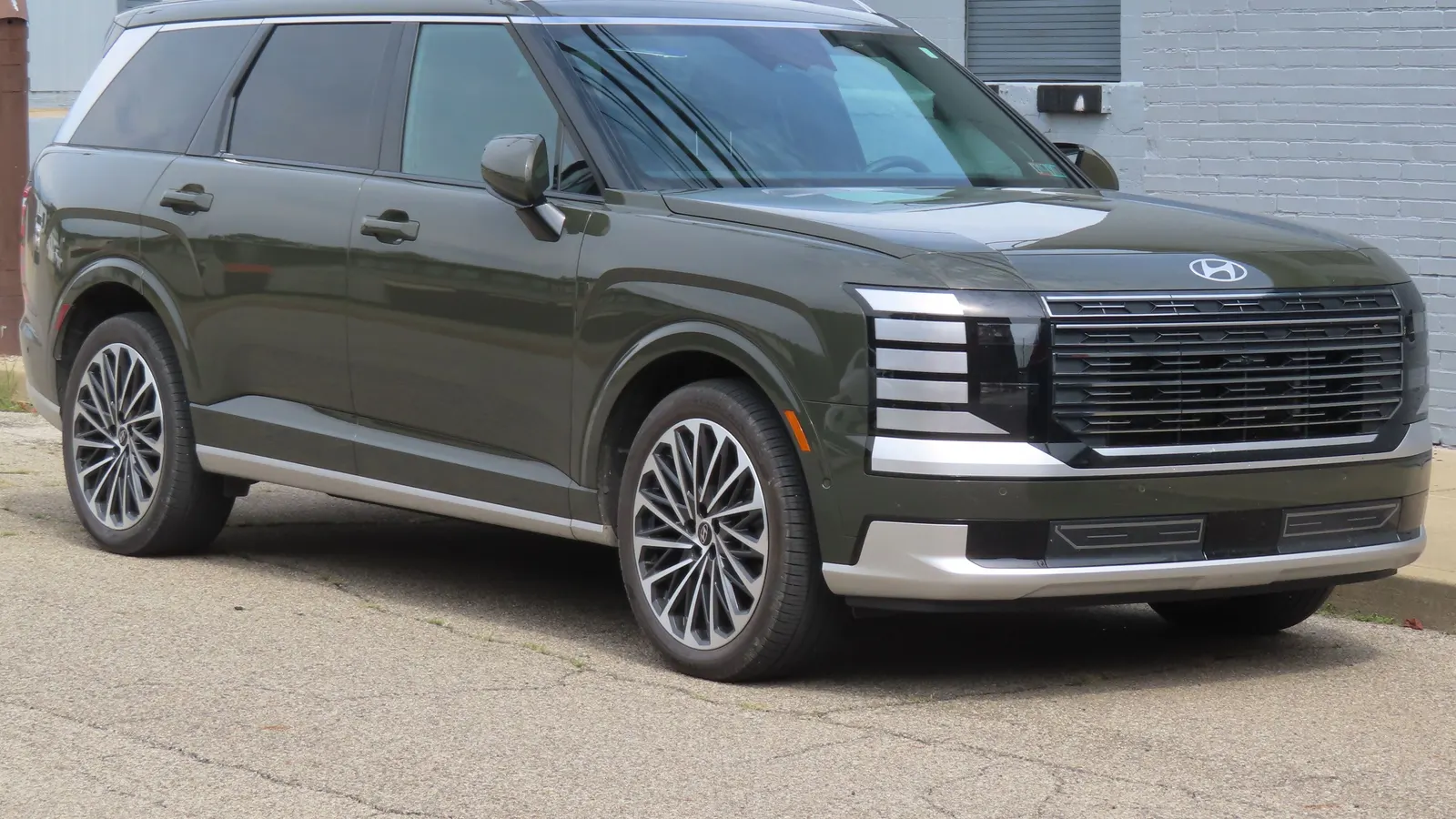
Pictured: 2026 Hyundai Palisade Calligraphy. Photo: MercurySable99, CC BY-SA 4.0, cropped
Owner complaints
120
13 report a crash, fire, injury or death
Recalls
3
None urgent
Most common problem
31%
of complaints: power seat pinch protection failure
In short
No pattern of serious problemsThe 2026 Hyundai Palisade shows no pattern of serious problems: its largest serious problem class, engine failure or stalling, makes up 7% of complaints. NHTSA has 120 owner complaints, and 13 report a crash, fire, injury or death. The most common, power seats that do not stop when blocked, is about 1 in 3 complaints. There are 3 recalls.
Reliability
How Reliable Is the 2026 Hyundai Palisade?
The 2026 Palisade has no pattern of serious problems in its owner complaints. The largest serious group, engine failure or stalling, is a small part of what owners report, and no recall tells owners to stop driving or park outside. Safety-related complaints are 16% of the total. That is worth knowing, but it does not point to one dominant danger in how the vehicle drives.
The complaints that do stand out are about the power seats in the second and third rows. Owners describe seats that kept moving or folding with a person in them, including a child in the third row, an occupant squeezed or pinned, and a head trapped between a seatback and a pillar. This is a safety issue, and it is the one problem that clearly repeats in this model year. It is also the main reason injuries show up in the complaint counts. Most of these reports come from the 3.5L V6, though some come from the 2.5L hybrid.
Recall 26V160000 covers this problem. Its defect text says the second and third row power seats may fail to detect a person and may continue to move after contacting one during powered functions such as one-touch tilt-and-slide or automatic power fold-and-stow. The listed remedy says owners are advised to exercise caution when operating those seat functions until the repair is performed. There are too few reports on repair results to say how well the fix works, so ask what was done on any vehicle you consider and test the seats yourself.
Two other recalls apply to this model year. One covers the third-row driver-side seat belt buckle, where internal wiring may be damaged and show that seat as permanently belted on the instrument panel. The other covers a software error that may make the instrument panel display fail. Neither is a stop-driving recall, but both are free to fix, so confirm they were done.
Mileage tells you little here. The few owners who gave a mileage reported problems at very low odometer readings, with a middle value of about 3,000 miles, which fits a vehicle this new. A low odometer is not a sign that a given vehicle is free of the seat problem, so check the recall status instead. Complaint counts show what owners reported, not how many vehicles are affected, and they cannot show how a particular vehicle was maintained or used. A model year this new also has limited history, so longer-term problems may not have appeared yet.
Top problems
The problem owners report most
Named from 120 NHTSA complaints. Open a problem for symptoms, the fix, cost and owners' accounts.
1.Power seats don't stop when blockedCriticalAbout 1 in 3 complaints1,500–3,700 mi
Owners describe third row seats folding onto a child, seats that failed to detect a person, and passengers squeezed or pinned while the seat kept moving. It often happened with the vehicle parked, such as when exiting the third row, leaning in to help a child, or after a button was bumped with a passenger in the middle row. Several owners mention recall 26V160000, and one mentions 26V169000.
What owners describe
- Seat folds onto a person16%
- Passenger squeezed or pinned16%
- Seat fails to detect a person11%
- Seat moves without warning8%
Fix
Most common repair owners describe: replaced battery (1 report). Recall 26V160000.
Mileage
2,000 mi
Middle half 1,500–3,700 mi · 5 reports
Repair cost
—
Fewer than 10 owners report a repair cost
How common
31%
37 of 120 complaints
By engine
- 3.5L V681%
- 2.5L 4-cyl hybrid19%
In owners' words
“The seat began moving and folding forward, pinning the passenger between the seat they were in and the back of the front seat.”
Owner in OR3.5L V6Filed 2025NHTSA 11707828 “Occupant exiting the 3rd row of the vehicle was squished between the 2nd row seat and door frame of vehicle”
Owner in WA3.5L V6Filed 2025NHTSA 11706920 “Despite the occupant seated in the second row, the seat continued to fold, nearly crushing the occupant.”
Owner in FL2.5L 4-cyl hybridFiled 2026NHTSA 11724606
Buying one
Should you buy a used 2026 Hyundai Palisade?
What to check before you buy, based on the complaint and recall data.
Before you buy, ask the seller or dealer to confirm in writing that recall 26V160000, the second and third row power seat recall, has been completed. Test the power seat functions yourself with the vehicle parked and nobody in the seats, and keep your hands and body clear while they move. Also confirm that recalls 26V169000 and 26V047000 were done. Both are free repairs at a dealer.
- 1Run the VIN for open recalls. NHTSA lists 3 recalls. Check at nhtsa.gov/recalls.
- 2Test-drive for power seat pinch protection failure. It's the most common safety-critical complaint, in about 1 in 3 owner complaints, usually around 2,000 miles.
- 3Ask for software update records. 18% of complaints mention a software update or reflash.
- 4Get a pre-purchase inspection. An independent mechanic can spot leaks, stored fault codes and accident repairs that a test drive misses.
Hyundai Palisade model years
Which Hyundai Palisade years to avoid? Every model year compared
Early complaints are those filed in a model year's first 3 years. They follow how many were sold, so they don't show which years are better. The tag on 2026 is its verdict from our research of its owner complaints.
Owning one
If you already own one
Find your symptom, see when problems tend to show up, and check which recalls apply.
Take care with the second and third row power seats. Keep children and other passengers clear of the seats and out from behind them while the seats fold, tilt or slide, and do not rely on the seat stopping if something is in the way. Check with a dealer that all 3 recalls are complete, and report any seat that keeps moving into a person or object to NHTSA and to Hyundai.
- Power seats don't stop when blockedCriticalAbout 1 in 3 owner complaints37 of 120Median 2,000 mi
Most common repair owners describe: replaced battery (1 report).
- Loss of power or accelerationCriticalAbout 1 in 10 owner complaints12 of 120Median 3,500 mi
- Power seat problems after the recall software updateMinorAbout 1 in 11 owner complaints11 of 120
3 recalls, newest first
Open one for the risk, the remedy and what to do now.
Rear/other › Buckle assemblyThe internal wiring within the third-row driver-side seat belt buckle may become damaged and result in a permanent…Mar 20, 202646,787 vehicles26V169000
- Defect
- The internal wiring within the third-row driver-side seat belt buckle may become damaged and result in a permanent display of a belted third-row driver-side seat on the instrument panel.
- Risk
- A faulty seat belt status indicator may fail to alert occupants to an unfastened seat belt, increasing the risk of injury.
- Remedy
- Dealers will install a wiring harness extension and replace the seat belt assembly, as necessary, free of charge.
Mid/rear assembly › Power adjustThe second and third row power seats may fail to detect a person. The seat may continue to move after contacting a…Mar 17, 202661,307 vehicles26V160000
- Defect
- The second and third row power seats may fail to detect a person. The seat may continue to move after contacting a person during powered seat functions, such as one-touch tilt-and-slide or automatic power fold-and-stow.
- Risk
- A person, especially a child, may become trapped by a rear powered seat, increasing the risk of injury or death.
- Remedy
- Owners are advised to exercise caution when operating the second and third row power seat functions until the repair is performed.
Electrical system › Instrument cluster/panelDue to a software error, the instrument panel display may fail. As such, these vehicles fail to comply with the…Jan 27, 202641,651 vehicles26V047000
- Defect
- Due to a software error, the instrument panel display may fail. As such, these vehicles fail to comply with the requirements of Federal Motor Vehicle Safety Standard (FMVSS) number 101, "Controls and Displays."
- Risk
- An instrument panel display that fails to show critical safety information, such as the speedometer or warning lights, increases the risk of a crash.
- Remedy
- The instrument panel display software will be updated over-the-air (OTA) or by a dealer, free of charge.
What to do
Check the VIN at nhtsa.gov/recalls. If a recall is open, any dealer will fix it free. For NHTSA's full record of a campaign, search its number there (for example 26V169000).
Reliability history
Hyundai Palisade reliability by year
Complaints filed in each model year's first 3 years, by trouble spot. Darker cells have more complaints; counts aren't adjusted for how many were sold each year.
All problems
Every problem reported on the 2026 Palisade
Every problem found in the 120 owner complaints, by area of the vehicle.
Body, lights & visibility
58 48%- 37 31%typically at 2,000 mi2,000––
- Power seat problems after the recall software updateMinor11 9%–––
- Windshield cracks easilyMinor5 4%–––
- Power seat stuck or won't move2 2%–––
- Sunroof glass shatters1 0.8%–––
- Hood flies open while drivingCritical1 0.8%–––
Show 2 more body, lights & visibility problemsShow fewer body, lights & visibility problems
- Rear window shatters1 0.8%–––
- Windshield distorts the view1 0.8%–––
Acceleration & speed control
19 16%- Loss of power or accelerationCritical12 10%–––
- Sudden or unintended accelerationCritical5 4%–––
- Jerky acceleration from a stop1 0.8%–––
- Cruise control misreads route signs as speed limits1 0.8%–––
Electrical
18 15%- Battery drain or no-startSerious7 6%–––
- Instrument cluster goes blankSerious4 3%–––
- Many warning lights at onceMinor3 3%–––
- Speedometer lags or reads zero1 0.8%–––
- Screen or infotainment glitchesMinor1 0.8%–––
- Active air flap system error1 0.8%–––
Show 2 more electrical problemsShow fewer electrical problems
- Electrical network (CAN bus) fault1 0.8%–––
- Electronic parking brake engages on its ownCritical1 0.8%–––
Engine
10 8%- Stalling or shutting off while drivingCritical5 4%–––
- Misfires or head gasket failureSerious3 3%–––
- Engine timing correlation fault code1 0.8%–––
- Wireless charging pad overheats1 0.8%–––
Wheels & tires
6 5%- False 'Eyes on road, hands on wheel' warningsSerious3 3%–––
- Tire sidewall bulges or failsSerious3 3%–––
Driver aids & stability
6 5%- Lane keeping assist steers wrongly3 3%–––
- Automatic emergency braking activates for no reasonCritical2 2%–––
- Front sensor not operating warning1 0.8%–––
Transmission & drivetrain
5 4%- Hesitation or slipping while drivingSerious2 2%–––
- Drops into neutral or loses drive while movingCritical1 0.8%–––
- Transmission failure needing replacementSerious1 0.8%–––
- Shifter system malfunction warning1 0.8%–––
- Harsh, jerky shiftingSerious1 0.8%–––
Brakes
4 3%- Brake pedal sinks or brakes failCritical3 3%–––
- Repeated ABS fault codes in app1 0.8%–––
Airbags & seat belts
3 3%- Seat belt buckle shows false latched status2 2%–––
- Seat belt retractor locks and won't release1 0.8%–––
Other
1 0.8%- Front grille warps or melts1 0.8%–––
39 problems found in all 120 complaints. One complaint can describe more than one problem, so counts add up to more than the total. Not counted as a defect: 3 about recall paperwork or parts delays, 1 describing no vehicle defect. Typical miles, repair cost and fix rate show only when enough owners report them.
The data
Behind the numbers
Every figure comes from NHTSA's complaint file and APIs.
- Complaints
- 120
- Recalls
- 3
- Crashes
- 2
- Fires
- 0
- Injuries
- 11
- Deaths
- 0
Crashes and fires count complaints that report one; injuries and deaths count people.
Mileage at failure
Not enough data yet
Only 11 complaints list mileage; we chart this from 30.
Complaints by engine
Decoded from the partial VINs owners include. Not adjusted for how many of each engine were sold.
FAQ
2026 Hyundai Palisade questions
Is the 2026 Hyundai Palisade reliable?
The 2026 Hyundai Palisade shows no pattern of serious problems in its owner complaints. The largest serious group, engine failure or stalling, is 7% of complaints, and no recall tells owners to stop driving or park outside. The one problem that clearly repeats is the second and third row power seats, so check that its recall was done.
What are the most common 2026 Hyundai Palisade problems?
The most common problem is power seats that do not stop when blocked, about 1 in 3 of the 120 owner complaints (37 complaints, 31%). Owners describe second and third row seats folding or moving onto a person. Other groups include power seat problems after the recall software update (11 complaints) and loss of power or acceleration (12 complaints).
Does the 2026 Hyundai Palisade have any recalls?
There are 3 recalls, and none is a do-not-drive or park-outside recall. 26V160000 covers second and third row power seats that may fail to detect a person. 26V169000 covers the third-row driver-side seat belt buckle wiring, and 26V047000 covers an instrument panel display software error. Check your VIN at nhtsa.gov/recalls.
Does the 2026 Hyundai Palisade have power seat problems?
Yes, and it is rated Critical severity. The second and third row power seats may keep moving or folding when a person is in their path. Owners describe a seat folding onto a child, passengers squeezed or pinned, and seats failing to detect a person. Recall 26V160000 covers this, and owners are advised to use caution with those seat functions until the repair is done.
What should I check before buying a 2026 Hyundai Palisade?
Ask the seller or dealer to confirm in writing that recall 26V160000, the second and third row power seat recall, has been completed. Test the power seat functions with the vehicle parked and nobody in the seats, keeping your hands and body clear. Also confirm recalls 26V169000 (third-row seat belt buckle) and 26V047000 (instrument panel display) were done.
At what mileage do 2026 Hyundai Palisade problems appear?
Owners report problems at very low mileage. The 11 owners who gave a mileage reported a middle value of about 3,000 miles, which fits a vehicle this new. A low odometer does not mean a vehicle is free of the power seat problem, so check the recall status instead. Longer-term problems may not have appeared yet.
Which Hyundai Palisade years should you avoid?
Avoid the 2024 Hyundai Palisade: owner complaints for that year show serious known problems. The 2023 is worth checking carefully: complaints show some known problems. For the 2020–2022 and 2025, make sure the recall repairs were done: an urgent recall matters more than their complaint pattern. The 2026 shows no pattern of serious problems. Every model year is compared on the Hyundai Palisade years-to-avoid page.
Methodology
How we researched this
- Complaints. NHTSA's owner complaint file, counted as unique complaint numbers for make HYUNDAI, model PALISADE, model year 2026. Data through Oct 4, 2026.
- Verdict. Judged from this model year's own complaints, not against other models, using shares rather than counts. Serious known problems: one serious problem (transmission, engine or stalling, steering, brakes, airbags, fire, fuel leaks) is in a quarter or more of complaints; or a smaller but clear cluster comes with an unusual share of crash, fire, injury or loss-of-power reports or early failures; or an urgent recall or NHTSA investigation matches a top complaint. Some known problems: one of those signals on its own. No pattern of serious problems: none of them; this doesn't mean the vehicle is trouble-free. Too few complaints to judge: under 50 complaints. Why this verdict: Checked: the largest serious problem class is engine failure or stalling (stalling while driving, misfires and head gasket failures), 7% of complaints; safety-related complaints are 16% (typical: 17%), and there's no do-not-drive or park-outside recall or open serious NHTSA investigation..
- No grade or class ranking. Raw complaint counts favor models that sell fewer cars, so we don't score or rank this vehicle against other models until we can adjust for sales.
- Trouble spots and history. Complaints grouped by the part owners chose when filing. The history grid counts complaints filed in each model year's first 3 years so older and newer years compare fairly; years with fewer than 3 complete years are marked too new.
- Named problems. Every one of the 120 complaints was researched and classified by its problems, severity, symptoms, repairs and any cost the owner mentions; the counts, costs and fix rates on this page are tallies of those classifications. Quotes are verbatim excerpts, checked against the original text. Engines are decoded from partial VINs with NHTSA's vPIC service.
- Repair costs and fix rates. Shown only when at least 10 owners report a repair cost, or at least 10 complaints describe whether a repair worked.
- Not adjusted for sales. Not affiliated with NHTSA. Page updated Nov 5, 2026.