2023 Hyundai Palisade Reliability & Problems
By Adrian V. LockhartUpdated All 400 NHTSA owner reports researched and classified
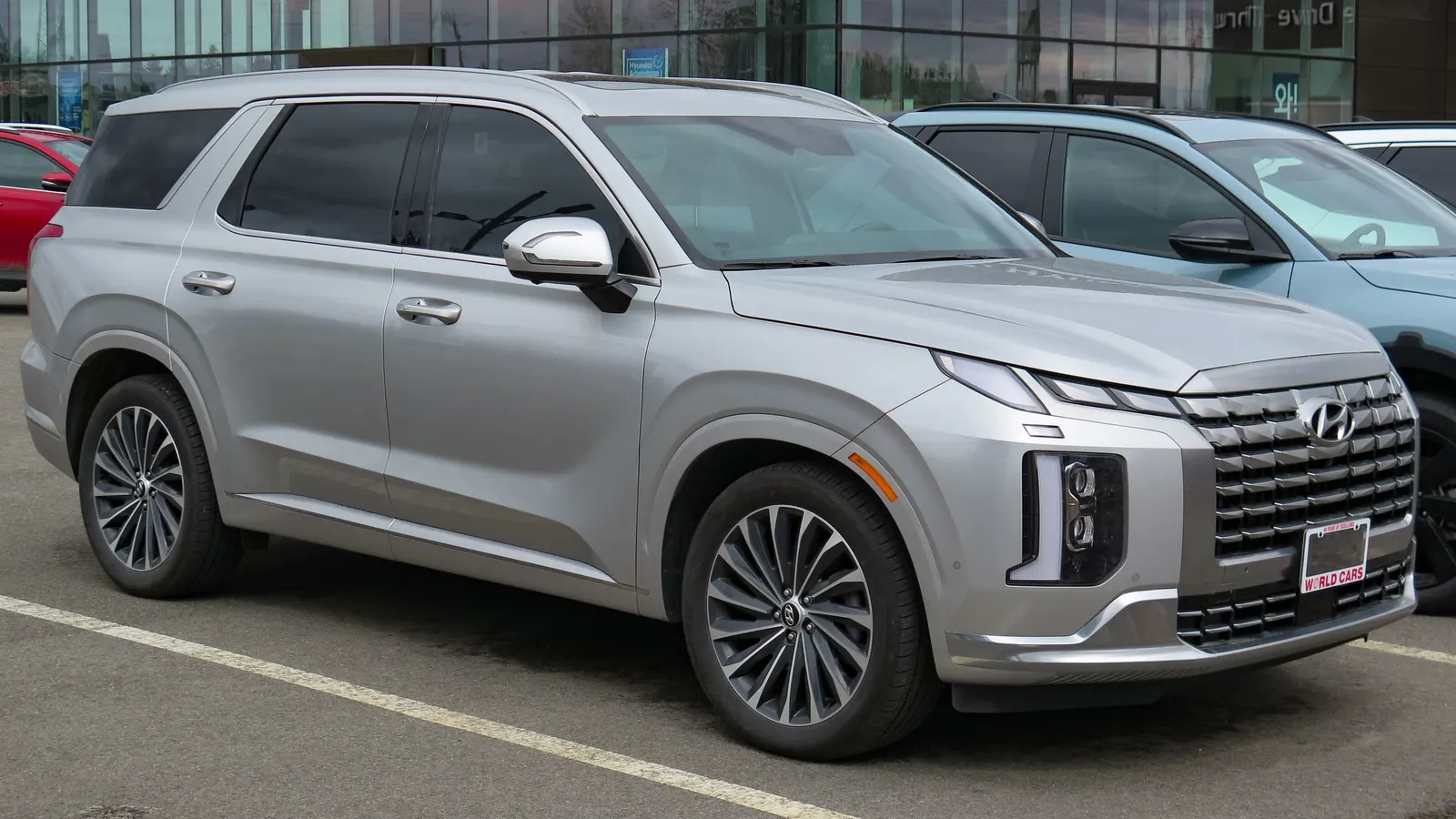
Pictured: 2023 Hyundai Palisade Ultimate Calligraphy (Canadian model). Photo: Elise240SX, CC BY-SA 4.0, cropped
Owner complaints
400
7 report a crash, fire, injury or death
Recalls
5
1 with a park-outside warning
Most common problem
14%
of complaints: brake pedal or brake failure problem
Complaints per year filed
2022–2025 · peak 102
In short
Some known problemsThe 2023 Hyundai Palisade has some known problems: 15% of owner complaints (61) describe brake problems, including brake failure and unwanted automatic braking. NHTSA has 400 owner complaints, and 7 report a crash, fire, injury or death. The most common are brakes that sink or fail, ABS activating on bumps and hazy second-row windows. There are 5 recalls.
Reliability
How Reliable Is the 2023 Hyundai Palisade?
This model year has some known problems, and the brakes are the reason. About 1 in 7 owner complaints describes the brake pedal sinking or the brakes failing, and a similar share describes the ABS activating on small bumps, with owners reporting longer stopping distances. Brakes are safety-critical, so these reports matter more than the many minor complaints. Of the 400 complaints, 7 report a crash, fire, injury or death. The verdict is also shaped by a park-outside recall and by an NHTSA investigation into seat belts that unlatch.
The brake complaints overlap. Owners describe a car that would not slow down, a pedal that went to the floor or turned hard, and the ABS kicking in at low speed, such as over a small bump or in a parking lot. Some of the stalling reports mention a hard brake pedal and the engine shutting off while driving, so brake and stalling complaints are not always separate events. Stalling is less common than the brake problems, and the few owners who described a repair outcome said the failure came back. Hazy second-row windows are the third most common complaint, but they are a minor issue: owners describe a film that is most visible in direct sunlight and does not clean off.
Recalls cover some of this but not all. For the brake pedal complaints, recall 23V415000 says the brake booster diaphragm may become misaligned and cause an internal vacuum leak, which can result in a loss of power brake assist, and dealers will inspect and replace the brake booster as necessary, free of charge. That recall covers only 322 vehicles, so it may not apply to yours. This model year has no recall for ABS activating on bumps, for stalling, for the sunroof glass or for the rear shocks. For seat belts, recall 25V607000 says the buckles in the driver, passenger and second-row window seats may fail to latch, and until the repair is done, passengers are advised to insert the belt firmly and pull on it to confirm it is secured. Of the 11 owners who described the outcome of rear shock repairs, 10 said the repair did not fix it. Across all problems, complaints lean toward repairs that failed.
Mileage reports are thin, but they point to early trouble. The few brake failure reports with a mileage have a median of about 10,800 miles, and the stalling reports are even earlier, around 1,700 miles. Seat belt reports with a mileage have a median of about 33,000 miles, and rear shock failures a median of about 28,600 miles. Across all complaints that give a mileage, 72% were under 25,000 miles. A low odometer reading therefore does not rule out these problems, and a higher one does not mean they have been avoided.
If you are buying, treat the brake, seat belt and recall history as the first things to check, and test drive for the symptoms owners describe. Sunroof glass shattering while driving is reported by a smaller group of owners, with some saying it happened with a loud bang, so it is worth asking about. Complaint counts show what owners reported, not how many vehicles are affected, and they cannot show how a particular vehicle was maintained or repaired. A clean recall record and a careful inspection tell you more about one vehicle than the totals here.
Top problems
The 7 problems owners report most
Named from 400 NHTSA complaints. Open a problem for symptoms, the fix, cost and owners' accounts.
1.Brake pedal sinks or brakes failCriticalAbout 1 in 7 complaints2,700–19,300 mi
Owners describe a car that would not brake or slow down, a pedal that vibrated, went hard or dropped to the floor, and longer stopping distances. Reports often come at low speeds, such as in stop and go traffic, in a parking lot or when leaving the highway. The few reports with a mileage are early, with a median of about 10,800 miles, and 3 owners mention recall 23V415000.
What owners describe
- Car will not slow down20%
- Pedal hard or sinks9%
- Pedal vibrates, ABS kicks in9%
Fix
Most common repair owners describe: replaced abs sensor then master cylinder (1 report). Recall 23V415000.
Mileage
10,800 mi
Middle half 2,700–19,300 mi · 4 reports
Repair cost
—
Fewer than 10 owners report a repair cost
How common
14%
55 of 400 complaints
Crash, fire or injury
4%
of these complaints
In owners' words
“The car would not brake when approaching a stoplight and I nearly ran into the vehicle in front of me.”
Owner in TX3.8LFiled 2024NHTSA 11613172 “The contact depressed the brake pedal forcefully to the floor and was able to stop the vehicle.”
Owner in PA3.8LFiled 2023NHTSA 11535477 “Brakes locked up the steering wheel starting to shake and brakes were pulsating up and down”
Owner in MA3.8LFiled 2024NHTSA 11598421 2.ABS activates on bumpsCriticalAbout 1 in 7 complaints23,000–23,000 mi
Owners describe the ABS kicking in over small bumps, speed bumps, potholes and gravel inclines, with shaking at the front end and a car that does not slow in time. Longer stopping distance is the most common symptom. This model year has no recall for it.
What owners describe
- Car shakes when braking24%
- ABS engages over small bumps19%
- Longer stopping distance15%
- Car does not slow down13%
Fix
Owners don't describe a consistent repair yet.
Mileage
23,000 mi
Middle half 23,000–23,000 mi · 1 reports
Repair cost
—
Fewer than 10 owners report a repair cost
How common
14%
54 of 400 complaints
Crash, fire or injury
4%
of these complaints
In owners' words
“After hitting any size bump my car does not stop, the car starts shaking, and I have to slam on the brake in order to stop.”
Owner in NY3.8LFiled 2024NHTSA 11597861 “When applying the brakes if you hit a bump in the road the front end of the vehicle shakes violently and does not stop”
Owner in MN3.8LFiled 2023NHTSA 11550525 “Felt the brake pedal begin to vibrate like the automatic emergency braking system kicked in.”
Owner in CT3.8LFiled 2024NHTSA 11591848 3.Hazy second-row windowsMinorAbout 1 in 10 complaints
Owners describe hazy, cloudy or milky second-row windows that are most visible in direct sunlight, and a haze that will not clean off. A few say it is hard to see through when merging. This model year has no recall for it.
What owners describe
- Milky look in sunlight28%
- Hazy second-row windows25%
- Film that will not clean off15%
Fix
Owners don't describe a consistent repair yet.
Mileage
—
0 reports
Repair cost
—
Fewer than 10 owners report a repair cost
How common
10%
40 of 400 complaints
Crash, fire or injury
0%
of these complaints
In owners' words
“Was told that they hadn't heard anything from Hyundai on it so there was nothing they could do.”
Owner in VA3.8LFiled 2023NHTSA 11503337 “They confirmed and reported the problem to Hyundai. Hyundai has not responded to the issue.”
Owner in NC3.8LFiled 2022NHTSA 11491407 4.Seat belt buckles come unlatchedSeriousAbout 1 in 10 complaints22,300–39,300 mi
Owners describe driver, passenger, second-row and third-row belts coming undone while driving, sometimes with a seat belt alarm. Reports with a mileage have a median of about 33,000 miles. Recall 25V607000 is mentioned by 6 owners, and some were offered a buckle inspection and replacement.
What owners describe
- Belt unbuckles while driving59%
- Second-row buckle releases26%
- Seat belt alarm sounds8%
Fix
Most common repair owners describe: offered to inspect and replace buckles (1 report). Recall 25V607000.
Mileage
33,000 mi
Middle half 22,300–39,300 mi · 6 reports
Repair cost
—
Fewer than 10 owners report a repair cost
How common
10%
39 of 400 complaints
Crash, fire or injury
0%
of these complaints
In owners' words
“The seatbelt suddenly unlatched midway through the drive without any pressing of the release button”
Owner in CO3.8LFiled 2025NHTSA 11635829 “Rear passenger seat belt has unbuckled / unlatched itself multiple times during driving.”
Owner in TX3.8LFiled 2025NHTSA 11633637 “Buckle clips in as expected, and then disengages on its own without user touching it.”
Owner in MA3.8LFiled 2024NHTSA 11580235 5.Sunroof glass shattersSeriousAbout 1 in 13 complaints11,000–21,400 mi
Owners describe the sunroof exploding or shattering on its own, many times while driving, with a bang like a gunshot and glass landing in the seats. Some say it happened on the second day of ownership. This model year has no recall for it.
What owners describe
- Sunroof explodes or shatters87%
- Happens while driving32%
- Loud bang like a gunshot19%
Fix
Most common repair owners describe: sunroof replaced (1 report).
Mileage
20,300 mi
Middle half 11,000–21,400 mi · 3 reports
Repair cost
—
Fewer than 10 owners report a repair cost
How common
8%
31 of 400 complaints
Crash, fire or injury
3%
of these complaints
In owners' words
“Hyundai has replaced it at no cost. I was told there have been 36 instances and a service bulletin was put out.”
Owner in SC3.8LFiled 2023NHTSA 11514037 “The sunroof of my Hyundai palisade Calligraphy shattered on its own on the very second day of owning it.”
Owner in TX3.8LFiled 2023NHTSA 11501001 “Driving on the interstate and sunroof just exploded. Sounded like a shotgun going off.”
Owner in OH3.8LFiled 2023NHTSA 11559612
Show 2 more problemsShow fewer problems
6.Stalling or shutting off while drivingCriticalAbout 1 in 19 complaints1,600–13,900 mi
Owners describe the engine shutting off while driving or in traffic, with warning lights, a loud beep, a red triangle and a shift to P alert. Mileages are early, with a median of about 1,700 miles across the few reports that give one. This model year has no recall for it.
What owners describe
- Engine shuts off while driving62%
- Warning lights and beeping29%
- Shift to P or N alert14%
Fix
Most common repair owners describe: replaced starter (1 report).
Mileage
1,700 mi
Middle half 1,600–13,900 mi · 3 reports
Repair cost
—
Fewer than 10 owners report a repair cost
How common
5%
21 of 400 complaints
Crash, fire or injury
0%
of these complaints
In owners' words
“While driving, the engine suddenly turned off on its own showing a safety alert on dashboard "Engine is off. Shift to P or N."”
Owner in TX3.8LFiled 2023NHTSA 11548941 “My engine shut off and a loud beep and red triangle warning came on that read engine failure and to start engine.”
Owner in LA3.8LFiled 2022NHTSA 11488319 “Suddenly all of the warning lights came on the dashboard and the car shuddered to a very rapid stop”
Owner in FL3.8LFiled 2025NHTSA 11678563 7.Rear shock absorbers failSeriousAbout 1 in 21 complaints18,200–37,000 mi
Owners describe rear self-leveling shocks failing repeatedly, with clanking, banging, creaking and thumping from the rear, mostly at low speeds and over small bumps. Reports with a mileage have a median of about 28,600 miles, and of 11 owners who described the outcome, 10 said the repair did not fix it. This model year has no recall for it.
What owners describe
- Rear shocks fail repeatedly42%
- Clanking or banging from rear26%
- Creaking or popping11%
- Rougher ride, rear vibration11%
Fix
Most common repair owners describe: shocks replaced with the same part (2 reports).
Repair worked in 5% of complaints that describe one (complaints lean toward repairs that failed)
Mileage
28,600 mi
Middle half 18,200–37,000 mi · 10 reports
Repair cost
—
Fewer than 10 owners report a repair cost
How common
5%
19 of 400 complaints
Crash, fire or injury
0%
of these complaints
In owners' words
“I and others have been replacing rear shocks every 10,000 to 20,000 miles due to failure.”
Owner in AZ3.8LFiled 2025NHTSA 11692324 “I and others have been replacing rear shocks every 10,000 to 20,000 miles due to failure.”
Owner in CA3.8LFiled 2025NHTSA 11694072
Buying one
Should you buy a used 2023 Hyundai Palisade?
What to check before you buy, based on the complaint and recall data.
Ask the seller for proof that recall 23V415000 (brake booster) and recall 25V607000 (seat belt buckles) were handled, and check NHTSA's recall lookup with the VIN. Test the brakes on a drive that includes small bumps and slow-speed stops, and check every seat belt buckle, including the second and third rows. If the vehicle has a panoramic sunroof, ask whether the glass was ever replaced. Ask for the service history of the rear shocks.
- 1Run the VIN for open recalls. NHTSA lists 5 recalls, and 1 carries a do-not-drive or park-outside warning (23V526000). Check at nhtsa.gov/recalls.
- 2Test-drive for brake pedal or brake failure problem. It's the most common safety-critical complaint, in about 1 in 7 owner complaints, usually around 10,800 miles.
- 3Get a pre-purchase inspection. An independent mechanic can spot leaks, stored fault codes and accident repairs that a test drive misses.
Hyundai Palisade model years
Which Hyundai Palisade years to avoid? Every model year compared
Early complaints are those filed in a model year's first 3 years. They follow how many were sold, so they don't show which years are better. The tag on 2023 is its verdict from our research of its owner complaints.
Crash test ratings
NHTSA 5-Star Safety Ratings.
| SUV AWD | SUV FWD | |
|---|---|---|
| Overall | ★★★★★ | ★★★★★ |
| Frontal crash | ★★★★★ | ★★★★★ |
| Side crash | ★★★★★ | ★★★★★ |
| Rollover | ★★★★ | ★★★★ |
| Rollover risk | 14% | 16% |
Owning one
If you already own one
Find your symptom, see when problems tend to show up, and check which recalls apply.
Have a dealer confirm that every open recall on your VIN is done, especially the brake booster recall, the seat belt buckle recall and the park-outside recall 23V526000, which advises parking outside and away from structures until the repair is complete. If the brake pedal goes hard or sinks, or the car does not slow as expected, stop driving and have it checked. Pull on each belt after buckling it to confirm it is latched. Report repeated rear shock failures to the dealer and keep every repair order.
- Brake pedal sinks or brakes failCriticalAbout 1 in 7 owner complaints55 of 400Median 10,800 mi
Most common repair owners describe: replaced abs sensor then master cylinder (1 report).
- ABS activates on bumpsCriticalAbout 1 in 7 owner complaints54 of 400Median 23,000 mi
Owners don't describe a consistent repair yet.
- Hazy second-row windowsMinorAbout 1 in 10 owner complaints40 of 400
Owners don't describe a consistent repair yet.
- Seat belt buckles come unlatchedSeriousAbout 1 in 10 owner complaints39 of 400Median 33,000 mi
Most common repair owners describe: offered to inspect and replace buckles (1 report).
- Sunroof glass shattersSeriousAbout 1 in 13 owner complaints31 of 400Median 20,300 mi
Most common repair owners describe: sunroof replaced (1 report).
- Stalling or shutting off while drivingCriticalAbout 1 in 19 owner complaints21 of 400Median 1,700 mi
Most common repair owners describe: replaced starter (1 report).
- Rear shock absorbers failSeriousAbout 1 in 21 owner complaints19 of 400Median 28,600 mi
Most common repair owners describe: shocks replaced with the same part (2 reports).
- Wipers stop workingSeriousAbout 1 in 29 owner complaints14 of 400Median 9,600 mi
Show all 9 problemsShow fewer problems
- Clunks or knocks from the suspensionMinorAbout 1 in 36 owner complaints11 of 400Median 32,000 mi
5 recalls, newest first
Open one for the risk, the remedy and what to do now.
Side/window › CurtainThe side curtain air bags for third-row occupants may deploy improperly in a crash. As such, these vehicles fail to…Jan 23, 2026568,576 vehicles26V034000
- Defect
- The side curtain air bags for third-row occupants may deploy improperly in a crash. As such, these vehicles fail to comply with the requirements of Federal Motor Vehicle Safety Standard (FMVSS) number 226, "Ejection Mitigation."
- Risk
- Improper side curtain air bag deployment increases the risk of injury during a crash.
- Remedy
- Dealers will install a protective film over the rear window and remove padding, as necessary free of charge.
Rear/other › Buckle assemblyThe seat belt buckles in the driver, passenger, and second-row window seats may fail to latch.Sep 12, 2025568,580 vehicles25V607000
- Defect
- The seat belt buckles in the driver, passenger, and second-row window seats may fail to latch.
- Risk
- Seat belt buckles that fail to latch may not properly restrain occupants in a crash, increasing the risk of injury.
- Remedy
- Passengers are advised to insert the belt firmly into the buckle with a quick and direct motion, pulling on the belt to confirm the seat belt is fully secured, until the recall remedy is performed.
Fluid/lubricant › PumpPark outsideThe electronic controller for the Idle Stop & Go oil pump assembly may contain damaged electrical components that can…Jul 27, 202352,109 vehicles23V526000
- Defect
- The electronic controller for the Idle Stop & Go oil pump assembly may contain damaged electrical components that can cause the pump controller to overheat.
- Risk
- An electric oil pump assembly that overheats increases the risk of a vehicle fire.
- Remedy
- Owners are advised to park outside and away from structures until the recall repair is complete.
- What to do
- Park outside and away from buildings until the recall repair is done.
Service brakes, hydraulic › Power assistThe brake booster diaphragm may become misaligned and cause an internal vacuum leak, which can result in a loss of…Jun 8, 2023322 vehicles23V415000
- Defect
- The brake booster diaphragm may become misaligned and cause an internal vacuum leak, which can result in a loss of power brake assist.
- Risk
- A loss of power brake assist can extend the distance required to stop, increasing the risk of a crash.
- Remedy
- Dealers will inspect and replace the brake booster as necessary, free of charge.
Visibility/wiperThe windshield wiper motor may operate intermittently or fail to operate due to snow or ice buildup on the…Mar 17, 2023167,085 vehicles23V180000
- Defect
- The windshield wiper motor may operate intermittently or fail to operate due to snow or ice buildup on the windshield, causing the wipers to fail.
- Risk
- Windshield wiper failure can reduce visibility, increasing the risk of a crash.
- Remedy
- Dealers will replace the driver-side windshield wiper arm, free of charge.
What to do
Check the VIN at nhtsa.gov/recalls. If a recall is open, any dealer will fix it free. For NHTSA's full record of a campaign, search its number there (for example 26V034000).
Reliability history
Hyundai Palisade reliability by year
Complaints filed in each model year's first 3 years, by trouble spot. Darker cells have more complaints; counts aren't adjusted for how many were sold each year.
All problems
Every problem reported on the 2023 Palisade
Every problem found in the 400 owner complaints, by area of the vehicle.
Body, lights & visibility
106 27%- 40 10%–––
- Sunroof glass shattersSerious31 8%–––
- Wipers stop workingSerious14 4%–––
- Windshield crackingMinor7 2%–––
- Wind noise4 1%–––
- Moisture inside headlights2 0.5%–––
Show 10 more body, lights & visibility problemsShow fewer body, lights & visibility problems
- Seat will not lock into its track1 0.3%–––
- Specks or blur in windshield in low sun1 0.3%–––
- Cracked or damaged door trim1 0.3%–––
- False door-open alert, doors will not lock1 0.3%–––
- Doors lock and dash goes dead1 0.3%–––
- Driver seat moves on its own1 0.3%–––
- Seat bolster does not inflate1 0.3%–––
- Cloudy rear window glass1 0.3%–––
- Power driver seat moves on its own1 0.3%–––
- Power seat height adjustment stopped working1 0.3%–––
Brakes
74 19%- Brake pedal sinks or brakes failCritical55 14%–––
- ABS activates on bumpsCritical54 14%–––
- Brake noise and early wearMinor1 0.3%–––
Airbags & seat belts
52 13%- 39 10%typically at 33,000 mi33,000––
- Seat belt stuck or not workingSerious5 1%–––
- Seat belt will not retract2 0.5%–––
- Passenger airbag turns off with an adult in the seatCritical1 0.3%–––
- Airbag warning light stays onSerious1 0.3%–––
- Seat belt will not pull out1 0.3%–––
Show 4 more airbags & seat belts problemsShow fewer airbags & seat belts problems
- Airbags did not deploy in a crashCritical1 0.3%–––
- Parked vehicle unlocks on its own1 0.3%–––
- Replacement seat belt buckle crushed by folding seat1 0.3%–––
- Air conditioning not working properly1 0.3%–––
Engine
32 8%- 21 5%–––
- Sudden loss of power while drivingCritical5 1%–––
- Misfires or head gasket failureSerious4 1%–––
- Engine failure warning and shutoff2 0.5%–––
- Engine will not restart after auto stop2 0.5%–––
- Engine control system warning message1 0.3%–––
Show 4 more engine problemsShow fewer engine problems
- Oil leaks or low oilSerious1 0.3%–––
- Center console overheats with burning smell1 0.3%–––
- Loud squeal on cold start1 0.3%–––
- Fuel pump or fuel injector failureCritical1 0.3%–––
Electrical
31 8%- Many warning lights at onceMinor8 2%–––
- Battery drain or no-startSerious7 2%–––
- Screen or infotainment glitchesMinor3 0.8%–––
- Instrument cluster goes blank3 0.8%–––
- Blue Link emergency button not working2 0.5%–––
- Water leaks damaging electronicsSerious2 0.5%–––
Show 9 more electrical problemsShow fewer electrical problems
- False wrong-way driving message2 0.5%–––
- Wiring harness damage2 0.5%–––
- False wrong-way notifications1 0.3%–––
- Electronic parking brake engages on its ownCritical1 0.3%–––
- Speedometer reads zero while driving1 0.3%–––
- Lower climate screen glare1 0.3%–––
- Previous owner keeps Bluelink access1 0.3%–––
- Rollaway in park1 0.3%–––
- Remote start does not work with key fob1 0.3%–––
Suspension
24 6%- Rear shock absorbers failSerious19 5%typically at 28,600 mi · 5% fixed28,600–5%
- Clunks or knocks from the suspensionMinor11 3%typically at 32,000 mi32,000––
- Rear suspension bushing failure1 0.3%–––
- Suspension failure1 0.3%–––
Transmission & drivetrain
17 4%- Transmission warning messagesMinor4 1%–––
- Drops into neutral or loses drive while movingCritical4 1%–––
- Hesitation or slipping while drivingSerious2 0.5%–––
- Delayed engagement pulling away from a stopSerious2 0.5%–––
- Power transfer unit (PTU) or 4WD failureCritical2 0.5%–––
- Harsh, jerky shiftingSerious1 0.3%–––
Show 4 more transmission & drivetrain problemsShow fewer transmission & drivetrain problems
- Abnormal odor while driving1 0.3%–––
- Transmission shudder or judderSerious1 0.3%–––
- Rear-end clunk and hesitation when turning from a stop1 0.3%–––
- Radiator leak1 0.3%–––
Driver aids & stability
13 3%- Automatic emergency braking activates for no reasonCritical5 1%–––
- Parking sensor errors2 0.5%–––
- Turn signal stuck and cameras disabled1 0.3%–––
- Rear and 360 camera stops working1 0.3%–––
- Speed Limit Assist slows car for false limit signs1 0.3%–––
- Front radar blocked warning disables safety system1 0.3%–––
Show 2 more driver aids & stability problemsShow fewer driver aids & stability problems
- Front safety sensors keep disabling1 0.3%–––
- Forward collision warning always on1 0.3%–––
Acceleration & speed control
12 3%- No acceleration in snow modeCritical8 2%–––
- Sudden or unintended accelerationCritical4 1%–––
Steering
11 3%- Loss of power steeringCritical6 2%–––
- Vehicle drifts to one side2 0.5%–––
- Steering thud when moving off after auto stop1 0.3%–––
- Sticky or notchy steeringSerious1 0.3%–––
- Steering locks when auto stop restarts engine1 0.3%–––
Wheels & tires
8 2%- Tire pressure monitor warningMinor3 0.8%–––
- Rear wheels skid or brakes pulse at low speed1 0.3%–––
- Steering wheel bounces and front end clunks1 0.3%–––
- Steering wheel clunks and jerks1 0.3%–––
- Tires wear out prematurely1 0.3%–––
- Tire sidewall cracking and bulging1 0.3%–––
89 problems found in all 400 complaints. One complaint can describe more than one problem, so counts add up to more than the total. Not counted as a defect: 41 about recall paperwork or parts delays, 6 describing no vehicle defect. Typical miles, repair cost and fix rate show only when enough owners report them.
The data
Behind the numbers
Every figure comes from NHTSA's complaint file and APIs.
- Complaints
- 400
- Recalls
- 5
- Crashes
- 6
- Fires
- 0
- Injuries
- 2
- Deaths
- 0
Crashes and fires count complaints that report one; injuries and deaths count people.
Mileage at failure
Not enough data yet
Only 18 complaints list mileage; we chart this from 30.
FAQ
2023 Hyundai Palisade questions
Is the 2023 Hyundai Palisade reliable?
The 2023 Hyundai Palisade has some known problems. 15% of its complaints (61) describe brake problems, there is a park-outside recall (23V526000) for a fire risk in the power train, and NHTSA investigated inadvertent seat belt unlatch (PE24021, closed with recall 25V607). Of 400 complaints, 7 report a crash, fire, injury or death.
What are the most common 2023 Hyundai Palisade problems?
The most common complaints are brakes that sink or fail (55 complaints, about 1 in 7), the ABS activating over small bumps (54 complaints, about 1 in 7) and hazy second-row windows (40 complaints, about 1 in 10). Seat belt buckles that come unlatched (39 complaints) and sunroof glass that shatters (31 complaints) follow.
How many recalls does the 2023 Hyundai Palisade have?
The 2023 Hyundai Palisade has 5 recalls, including one park-outside warning. Recall 23V526000 says an overheating oil pump controller increases the risk of a vehicle fire, so owners are advised to park outside and away from structures until the repair is done. The others cover the third-row side curtain air bags (26V034000), the seat belt buckles (25V607000), the brake booster (23V415000) and the windshield wiper arm (23V180000). Check your VIN at nhtsa.gov/recalls.
Does the 2023 Hyundai Palisade have seat belt problems?
Yes, seat belt buckles that come unlatched are a serious problem for this model year, with 39 complaints (about 1 in 10). Owners describe driver, passenger, second-row and third-row belts coming undone while driving. Reports with a mileage have a median of about 33,000 miles. Recall 25V607000 covers buckles that may fail to latch in the driver, passenger and second-row window seats.
Is the 2023 Hyundai Palisade safe?
NHTSA gives the 2023 Hyundai Palisade 5 out of 5 stars overall, 5 out of 5 stars for frontal crash, 5 out of 5 stars for side crash and 4 out of 5 stars for rollover. The ratings are the same for the AWD and FWD versions. Owners have also filed brake, seat belt and sunroof complaints, and there are 5 recalls to check.
What should I check before buying a 2023 Hyundai Palisade?
Ask for proof that recall 23V415000 (brake booster) and recall 25V607000 (seat belt buckles) were done, and check the VIN at nhtsa.gov/recalls. Test the brakes on a drive with small bumps and slow-speed stops, and check every seat belt buckle, including the second and third rows. Ask whether the sunroof glass was ever replaced and for the rear shock service history.
Which Hyundai Palisade years should you avoid?
Avoid the 2024 Hyundai Palisade: owner complaints for that year show serious known problems. The 2023 is worth checking carefully: complaints show some known problems. For the 2020–2022 and 2025, make sure the recall repairs were done: an urgent recall matters more than their complaint pattern. The 2026 shows no pattern of serious problems. Every model year is compared on the Hyundai Palisade years-to-avoid page.
Methodology
How we researched this
- Complaints. NHTSA's owner complaint file, counted as unique complaint numbers for make HYUNDAI, model PALISADE, model year 2023. Data through Oct 4, 2026.
- Verdict. Judged from this model year's own complaints, not against other models, using shares rather than counts. Serious known problems: one serious problem (transmission, engine or stalling, steering, brakes, airbags, fire, fuel leaks) is in a quarter or more of complaints; or a smaller but clear cluster comes with an unusual share of crash, fire, injury or loss-of-power reports or early failures; or an urgent recall or NHTSA investigation matches a top complaint. Some known problems: one of those signals on its own. No pattern of serious problems: none of them; this doesn't mean the vehicle is trouble-free. Too few complaints to judge: under 50 complaints. Why this verdict: 15% of complaints (61) describe brake problems (brake pedal or brake failure problem, phantom automatic braking, the parking brake engaging on its own); A park-outside recall (23V526000) for a fire risk in the power train; An NHTSA investigation into inadvertent seat belt unlatch (PE24021, closed with recall 25V607).
- No grade or class ranking. Raw complaint counts favor models that sell fewer cars, so we don't score or rank this vehicle against other models until we can adjust for sales.
- Trouble spots and history. Complaints grouped by the part owners chose when filing. The history grid counts complaints filed in each model year's first 3 years so older and newer years compare fairly; years with fewer than 3 complete years are marked too new.
- Named problems. Every one of the 400 complaints was researched and classified by its problems, severity, symptoms, repairs and any cost the owner mentions; the counts, costs and fix rates on this page are tallies of those classifications. Quotes are verbatim excerpts, checked against the original text. Engines are decoded from partial VINs with NHTSA's vPIC service.
- Repair costs and fix rates. Shown only when at least 10 owners report a repair cost, or at least 10 complaints describe whether a repair worked.
- Not adjusted for sales. Not affiliated with NHTSA. Page updated Nov 5, 2026.