2025 Hyundai Palisade Reliability & Problems
By Adrian V. LockhartUpdated All 248 NHTSA owner reports researched and classified
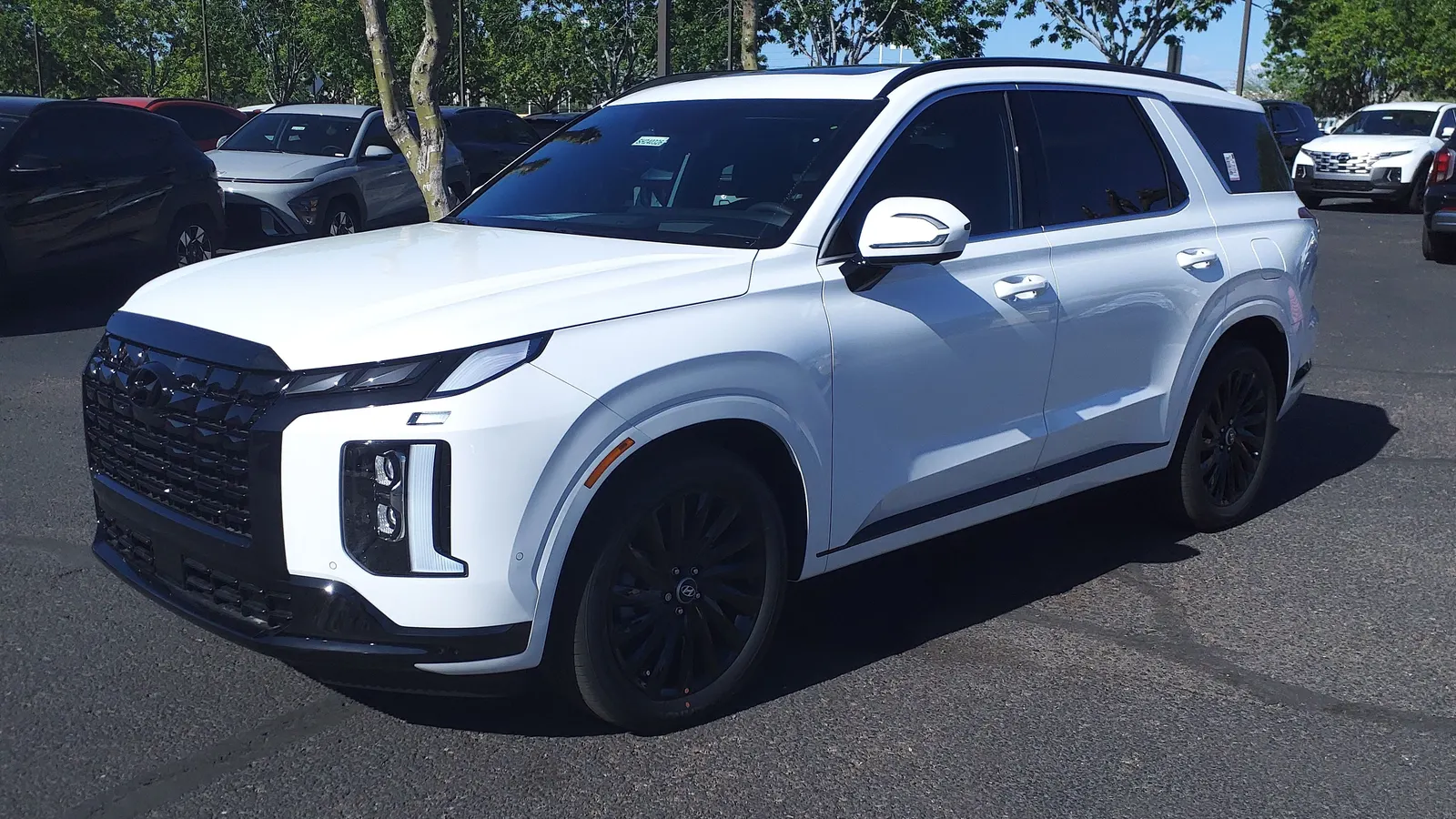
Pictured: 2024 Hyundai Palisade Calligraphy Night Edition (same design as 2025), same generation as the 2025 model.
Owner complaints
248
12 report a crash, fire, injury or death
Recalls
3
1 with a park-outside warning
Most common problem
31%
of complaints: ABS activating over bumps
In short
Some known problemsThe 2025 Hyundai Palisade has some known problems, driven by a park-outside recall (25V291000) for a fire risk in the power train. NHTSA has 248 owner complaints, 12 of them reporting a crash, fire, injury or death. The most common are ABS activating on bumps, brake pedal or brake failure, and seat belts unlatching. There are 3 recalls.
Reliability
How Reliable Is the 2025 Hyundai Palisade?
The 2025 Palisade is rated "Some known problems" because of an official recall, not because of a pattern across complaints. Recall 25V291000 covers a fire risk in the power train, and the manufacturer's advice is to park outside and away from structures until the remedy is done. The recall text says an insufficient seal on the controller for the electric oil pump may let moisture build up in the printed circuit board, which can cause an electrical short and a fire. It lists only 620 vehicles, so most owners will not be affected, but anyone buying one should confirm the recall status of the exact vehicle.
Owner complaints point mostly in a different direction: braking. The largest group, about 1 in 3 complaints, describes the ABS activating over bumps, potholes and rough roads. Owners describe longer stopping distances, a shaking pedal or steering, and in a few cases a car that did not stop at a stop sign. This is safety-critical, because it affects how quickly the car stops. A second, smaller group describes a brake pedal that sinks or brakes that do not respond, and some of these reports include hitting a fence. The two groups overlap, with some owners describing both ABS activation and a pedal that fails to respond. Neither problem has a recall for it on this model year.
Where owners reported what happened after repair, the news is not good. Among the reports on ABS activating over bumps that describe the outcome, none say the repair fixed it, one says it helped partly and nine say it did not. Owners mostly describe dealer inspections that found nothing to fix. Complaints naturally lean toward repairs that failed, since people with a fixed car are less likely to write to NHTSA, but this still means a dealer visit may not solve it.
Seat belts are the third recurring theme. Owners describe belts that unlatch while driving, including at highway speeds, or that will not buckle. Recall 25V607000 says the seat belt buckles in the driver, passenger and second-row window seats may fail to latch, and several owners cite it, along with 26V034000 for third-row curtain air bags. Some say the recall parts were on backorder. Until the remedy is done, the recall's own advice is to insert the belt firmly with a quick, direct motion and pull on it to confirm it is secured.
These vehicles are new, so mileage tells you little about wear. Across complaints that give a mileage, the middle figure is about 8,000 miles. ABS reports are even earlier: the middle report is around 1,700 miles, and most are under about 3,500 miles. That means a low odometer does not rule out these problems, and a car with very few miles has simply had little time to show them. Complaint counts show what owners reported, not how many vehicles are affected, and they cannot tell you how a particular vehicle was maintained or whether its recalls were done, so check the VIN and test the brakes yourself.
Top problems
The 3 problems owners report most
Named from 248 NHTSA complaints. Open a problem for symptoms, the fix, cost and owners' accounts.
1.ABS activates on bumps and rough roadsCriticalAbout 1 in 3 complaints1,400–3,500 mi
Owners describe longer stopping distances, a shaking pedal or steering wheel, and in some cases a car that lurched forward or did not stop at a stop sign. It happens at low speed over small bumps, potholes and rough asphalt. Reports with a mileage come in early, with a middle figure of about 1,700 miles. This model year has no recall for it.
What owners describe
- Longer stopping distance8%
- Car does not stop or lurches6%
- Pedal or steering shakes5%
Fix
Most common repair owners describe: dealer inspection (7 reports).
Repair worked in 5% of complaints that describe one (complaints lean toward repairs that failed)
Mileage
1,700 mi
Middle half 1,400–3,500 mi · 11 reports
Repair cost
—
Fewer than 10 owners report a repair cost
How common
31%
77 of 248 complaints
Crash, fire or injury
4%
of these complaints
In owners' words
“The ABS and traction control systems reacted and applied braking which caused me to have no control of my brakes”
Owner in VA3.8LFiled 2026NHTSA 11739628 2.Brake pedal sinks or brakes failCriticalAbout 1 in 10 complaints2,600–13,800 mi
Owners describe brakes that did not respond, a pedal that could not be fully pressed, and a car that failed to stop at stop signs or red lights. Some reports mention hitting a fence. This model year has no recall for it.
What owners describe
- Brakes do not respond17%
- Car does not stop at signs13%
- Shaking or stuttering when stopping13%
Fix
Most common repair owners describe: dealer inspection (2 reports).
Mileage
6,500 mi
Middle half 2,600–13,800 mi · 6 reports
Repair cost
—
Fewer than 10 owners report a repair cost
How common
10%
24 of 248 complaints
Crash, fire or injury
21%
of these complaints
In owners' words
“The brake pedal was depressed with both feet, but the brakes failed to engage properly”
Owner in NY3.8LFiled 2026NHTSA 11753975 3.Seat belt unlatches while drivingSeriousAbout 1 in 16 complaints3,000–8,200 mi
Owners describe front passenger and second-row belts that unlatch while driving, sometimes at highway speeds, and belts that will not click or lock. Several mention recall 25V607000 and two mention 26V034000, and some say the recall parts were not available.
What owners describe
- Belt unlatches while driving31%
- Belt will not buckle25%
- False seat belt warning13%
Fix
Most common repair owners describe: dealer repair attempts (1 report). Recall 25V607000.
Mileage
7,000 mi
Middle half 3,000–8,200 mi · 5 reports
Repair cost
—
Fewer than 10 owners report a repair cost
How common
6%
16 of 248 complaints
Crash, fire or injury
0%
of these complaints
In owners' words
“On multiple occasions while the vehicle has been in motion, the seat belt has unexpectedly unlatched on its own while occupied by a passenger.”
Owner in FLFiled 2026NHTSA 11739863
Buying one
Should you buy a used 2025 Hyundai Palisade?
What to check before you buy, based on the complaint and recall data.
Test drive any 2025 Palisade over a rough road or a small bump at low speed, and note whether the brakes shudder or stop the car slowly. Ask the seller or dealer whether recalls 25V291000, 25V607000 and 26V034000 have been completed, and check the VIN on NHTSA's recall lookup yourself. Make sure every seat belt latches firmly and stays latched. If the car is a new one still waiting on recall parts, ask when the remedy will be done.
- 1Run the VIN for open recalls. NHTSA lists 3 recalls, and 1 carries a do-not-drive or park-outside warning (25V291000). Check at nhtsa.gov/recalls.
- 2Test-drive for ABS activating over bumps. It's the most common safety-critical complaint, in about 1 in 3 owner complaints, usually around 1,700 miles.
- 3Get a pre-purchase inspection. An independent mechanic can spot leaks, stored fault codes and accident repairs that a test drive misses.
Hyundai Palisade model years
Which Hyundai Palisade years to avoid? Every model year compared
Early complaints are those filed in a model year's first 3 years. They follow how many were sold, so they don't show which years are better. The tag on 2025 is its verdict from our research of its owner complaints.
Crash test ratings
NHTSA 5-Star Safety Ratings.
| SUV AWD | SUV FWD | |
|---|---|---|
| Overall | ★★★★★ | ★★★★★ |
| Frontal crash | ★★★★★ | ★★★★★ |
| Side crash | ★★★★★ | ★★★★★ |
| Rollover | ★★★★ | ★★★★ |
| Rollover risk | 14% | 16% |
Owning one
If you already own one
Find your symptom, see when problems tend to show up, and check which recalls apply.
If the brakes feel unresponsive, the pedal sinks, or the car does not slow when you press it, stop driving and have it inspected before using it again. Report any braking problem to the dealer in writing and to NHTSA so it is on record. Check that each seat belt clicks and holds, and pull on it to confirm. Until recall 25V291000 is completed on an affected vehicle, park it outside and away from structures.
- ABS activates on bumps and rough roadsCriticalAbout 1 in 3 owner complaints77 of 248Median 1,700 mi
Most common repair owners describe: dealer inspection (7 reports).
- Brake pedal sinks or brakes failCriticalAbout 1 in 10 owner complaints24 of 248Median 6,500 mi
Most common repair owners describe: dealer inspection (2 reports).
- Seat belt unlatches while drivingSeriousAbout 1 in 16 owner complaints16 of 248Median 7,000 mi
Most common repair owners describe: dealer repair attempts (1 report).
- Sunroof glass shattersSeriousAbout 1 in 21 owner complaints12 of 248Median 9,600 mi
- Automatic emergency braking activates for no reasonCriticalAbout 1 in 25 owner complaints10 of 248Median 9,800 mi
3 recalls, newest first
Open one for the risk, the remedy and what to do now.
Side/window › CurtainThe side curtain air bags for third-row occupants may deploy improperly in a crash. As such, these vehicles fail to…Jan 23, 2026568,576 vehicles26V034000
- Defect
- The side curtain air bags for third-row occupants may deploy improperly in a crash. As such, these vehicles fail to comply with the requirements of Federal Motor Vehicle Safety Standard (FMVSS) number 226, "Ejection Mitigation."
- Risk
- Improper side curtain air bag deployment increases the risk of injury during a crash.
- Remedy
- Dealers will install a protective film over the rear window and remove padding, as necessary free of charge.
Rear/other › Buckle assemblyThe seat belt buckles in the driver, passenger, and second-row window seats may fail to latch.Sep 12, 2025568,580 vehicles25V607000
- Defect
- The seat belt buckles in the driver, passenger, and second-row window seats may fail to latch.
- Risk
- Seat belt buckles that fail to latch may not properly restrain occupants in a crash, increasing the risk of injury.
- Remedy
- Passengers are advised to insert the belt firmly into the buckle with a quick and direct motion, pulling on the belt to confirm the seat belt is fully secured, until the recall remedy is performed.
Fluid/lubricant › PumpPark outsideAn insufficient seal on the controller for the electric oil pump may allow moisture to accumulate in the printed…May 6, 2025620 vehicles25V291000
- Defect
- An insufficient seal on the controller for the electric oil pump may allow moisture to accumulate in the printed circuit board, which can cause an electrical short and result in a fire.
- Risk
- A fire while parked or driving can increase the risk of injury.
- Remedy
- Owners are advised to park their vehicles outside and away from structures until the recall remedy is completed.
- What to do
- Park outside and away from buildings until the recall repair is done.
What to do
Check the VIN at nhtsa.gov/recalls. If a recall is open, any dealer will fix it free. For NHTSA's full record of a campaign, search its number there (for example 26V034000).
Reliability history
Hyundai Palisade reliability by year
Complaints filed in each model year's first 3 years, by trouble spot. Darker cells have more complaints; counts aren't adjusted for how many were sold each year.
All problems
Every problem reported on the 2025 Palisade
Every problem found in the 248 owner complaints, by area of the vehicle.
Brakes
93 38%- 77 31%typically at 1,700 mi · 5% fixed1,700–5%
- Brake pedal sinks or brakes failCritical24 10%typically at 6,500 mi6,500––
- Front end shakes7 3%–––
- Brake noise and early wearMinor5 2%–––
- Abnormally high idle speed1 0.4%–––
Body, lights & visibility
31 13%- Sunroof glass shattersSerious12 5%–––
- Windshield crackingSerious7 3%–––
- Power seat folds without detecting a personCritical5 2%–––
- Dim low-beam headlightsSerious1 0.4%–––
- Sharp door edge cuts hands1 0.4%–––
- Front grille cracking and flaking1 0.4%–––
Show 5 more body, lights & visibility problemsShow fewer body, lights & visibility problems
- Wiper failure1 0.4%–––
- Power third-row seat folds on a person1 0.4%–––
- Grille and trim paint peeling1 0.4%–––
- Driveshaft unseated and subframe bolt loose after repair1 0.4%–––
- Power liftgate falls closed unexpectedly1 0.4%–––
Airbags & seat belts
18 7%- 16 6%typically at 7,000 mi7,000––
- Seat belt buckle blocked by car seat1 0.4%–––
- Seat belts did not lock in a crash1 0.4%–––
Driver aids & stability
17 7%- Automatic emergency braking activates for no reasonCritical10 4%–––
- Lane assist forces steeringCritical4 2%–––
- Sudden unexpected slowdown2 0.8%–––
- Front sensors did not detect obstacle1 0.4%–––
- False forward collision warning1 0.4%–––
Engine
11 4%- Stalling or shutting off while drivingCritical8 3%–––
- Misfires or head gasket failureSerious2 0.8%–––
- Engine failure1 0.4%–––
- Engine knocking1 0.4%–––
- Engine power limited1 0.4%–––
Acceleration & speed control
7 3%- Sudden or unintended accelerationCritical3 1%–––
- Delayed acceleration when pressing the gas2 0.8%–––
- Shaking and knocking when accelerating1 0.4%–––
- Smart cruise control sets wrong speed1 0.4%–––
Transmission & drivetrain
6 2%- Hesitation or slipping while drivingSerious1 0.4%–––
- Power transfer unit (PTU) or 4WD failureCritical1 0.4%–––
- Rear seal and transmission leak1 0.4%–––
- Transmission upshifts when coming to a stop1 0.4%–––
- Gear shift button needs repeated presses1 0.4%–––
- Delayed engagement pulling away from a stopSerious1 0.4%–––
Show 2 more transmission & drivetrain problemsShow fewer transmission & drivetrain problems
- Drops into neutral or loses drive while movingCritical1 0.4%–––
- Transmission warning messagesMinor1 0.4%–––
Suspension
5 2%- Rear shock failureSerious5 2%–––
Wheels & tires
5 2%- Front tires bald early1 0.4%–––
- Vibration and uneven tire wear1 0.4%–––
- Tire sidewall blowout1 0.4%–––
- Steering wheel locks up1 0.4%–––
- Steering wheel locks then snaps back1 0.4%–––
Other
4 2%- Driver attention warning appears too often2 0.8%–––
- Rear air conditioning blows hot air1 0.4%–––
- Headrest button stuck1 0.4%–––
Steering
4 2%- Loss of power steeringCritical2 0.8%–––
- Rear camber and toe adjuster cams coming loose1 0.4%–––
- Emergency steering activates for no reason1 0.4%–––
Electrical
4 2%- Push-button start and app start fail1 0.4%–––
- Electronic parking brake engages on its ownCritical1 0.4%–––
- Many warning lights at onceMinor1 0.4%–––
- Wiring harness damage1 0.4%–––
Fuel system & stalling
2 0.8%- Gasoline smell in cabin1 0.4%–––
- Fuel leaksCritical1 0.4%–––
Fire
2 0.8%- White smoke on cold start1 0.4%–––
- Vehicle catches fireCritical1 0.4%–––
61 problems found in all 248 complaints. One complaint can describe more than one problem, so counts add up to more than the total. Not counted as a defect: 49 about recall paperwork or parts delays, 5 describing no vehicle defect. Typical miles, repair cost and fix rate show only when enough owners report them.
The data
Behind the numbers
Every figure comes from NHTSA's complaint file and APIs.
- Complaints
- 248
- Recalls
- 3
- Crashes
- 8
- Fires
- 1
- Injuries
- 7
- Deaths
- 1
Crashes and fires count complaints that report one; injuries and deaths count people.
Mileage at failure
Not enough data yet
Only 21 complaints list mileage; we chart this from 30.
FAQ
2025 Hyundai Palisade questions
Is the 2025 Hyundai Palisade reliable?
The 2025 Hyundai Palisade has some known problems, because of a park-outside recall (25V291000) for a fire risk in the power train, not because of a pattern across complaints. NHTSA has 248 owner complaints, mostly about braking and seat belts. Confirm the recall status of the exact vehicle before buying.
What are the most common 2025 Hyundai Palisade problems?
Owners most often report ABS activating over bumps and rough roads, about 1 in 3 owner complaints (77 complaints). Next come brake pedal or braking failures, about 1 in 10, and seat belts unlatching, about 1 in 16. Brakes account for 93 of the 248 complaints.
Does the 2025 Hyundai Palisade have any recalls?
There are 3 recalls. Recall 25V291000 is a park-outside warning: an insufficient seal on the electric oil pump controller may let moisture build up and cause a fire, so owners should park outside and away from structures until the remedy is done. The others cover seat belt buckles that may fail to latch (25V607000) and third-row side curtain air bags (26V034000). Check your VIN at nhtsa.gov/recalls.
Does the 2025 Hyundai Palisade have brake problems?
Yes, braking is the biggest trouble spot, with 93 complaints. The largest group describes ABS activating over bumps, with longer stopping distances and a shaking pedal or steering wheel. A smaller group describes a pedal that sinks or brakes that do not respond. Neither problem has a recall on this model year.
Does the 2025 Hyundai Palisade have seat belt problems?
Owners filed 16 complaints about seat belts unlatching while driving, sometimes at highway speeds, or refusing to buckle. Recall 25V607000 says the buckles in the driver, passenger and second-row window seats may fail to latch. Until the remedy is done, insert the belt firmly with a quick, direct motion and pull on it to confirm it is secured.
Is the 2025 Hyundai Palisade safe?
NHTSA gives the 2025 Hyundai Palisade, in both AWD and FWD, 5 out of 5 stars overall, 5 out of 5 stars frontal, 5 out of 5 stars side and 4 out of 5 stars rollover. Owners also filed 248 complaints, and 12 of them reported a crash, fire, injury or death. Test the brakes and check every seat belt latches before buying.
Which Hyundai Palisade years should you avoid?
Avoid the 2024 Hyundai Palisade: owner complaints for that year show serious known problems. The 2023 is worth checking carefully: complaints show some known problems. For the 2020–2022 and 2025, make sure the recall repairs were done: an urgent recall matters more than their complaint pattern. The 2026 shows no pattern of serious problems. Every model year is compared on the Hyundai Palisade years-to-avoid page.
Methodology
How we researched this
- Complaints. NHTSA's owner complaint file, counted as unique complaint numbers for make HYUNDAI, model PALISADE, model year 2025. Data through Oct 4, 2026.
- Verdict. Judged from this model year's own complaints, not against other models, using shares rather than counts. Serious known problems: one serious problem (transmission, engine or stalling, steering, brakes, airbags, fire, fuel leaks) is in a quarter or more of complaints; or a smaller but clear cluster comes with an unusual share of crash, fire, injury or loss-of-power reports or early failures; or an urgent recall or NHTSA investigation matches a top complaint. Some known problems: one of those signals on its own. No pattern of serious problems: none of them; this doesn't mean the vehicle is trouble-free. Too few complaints to judge: under 50 complaints. Why this verdict: A park-outside recall (25V291000) for a fire risk in the power train.
- No grade or class ranking. Raw complaint counts favor models that sell fewer cars, so we don't score or rank this vehicle against other models until we can adjust for sales.
- Trouble spots and history. Complaints grouped by the part owners chose when filing. The history grid counts complaints filed in each model year's first 3 years so older and newer years compare fairly; years with fewer than 3 complete years are marked too new.
- Named problems. Every one of the 248 complaints was researched and classified by its problems, severity, symptoms, repairs and any cost the owner mentions; the counts, costs and fix rates on this page are tallies of those classifications. Quotes are verbatim excerpts, checked against the original text. Engines are decoded from partial VINs with NHTSA's vPIC service.
- Repair costs and fix rates. Shown only when at least 10 owners report a repair cost, or at least 10 complaints describe whether a repair worked.
- Not adjusted for sales. Not affiliated with NHTSA. Page updated Nov 5, 2026.