2024 Hyundai Palisade Reliability & Problems
By Adrian V. LockhartUpdated All 387 NHTSA owner reports researched and classified
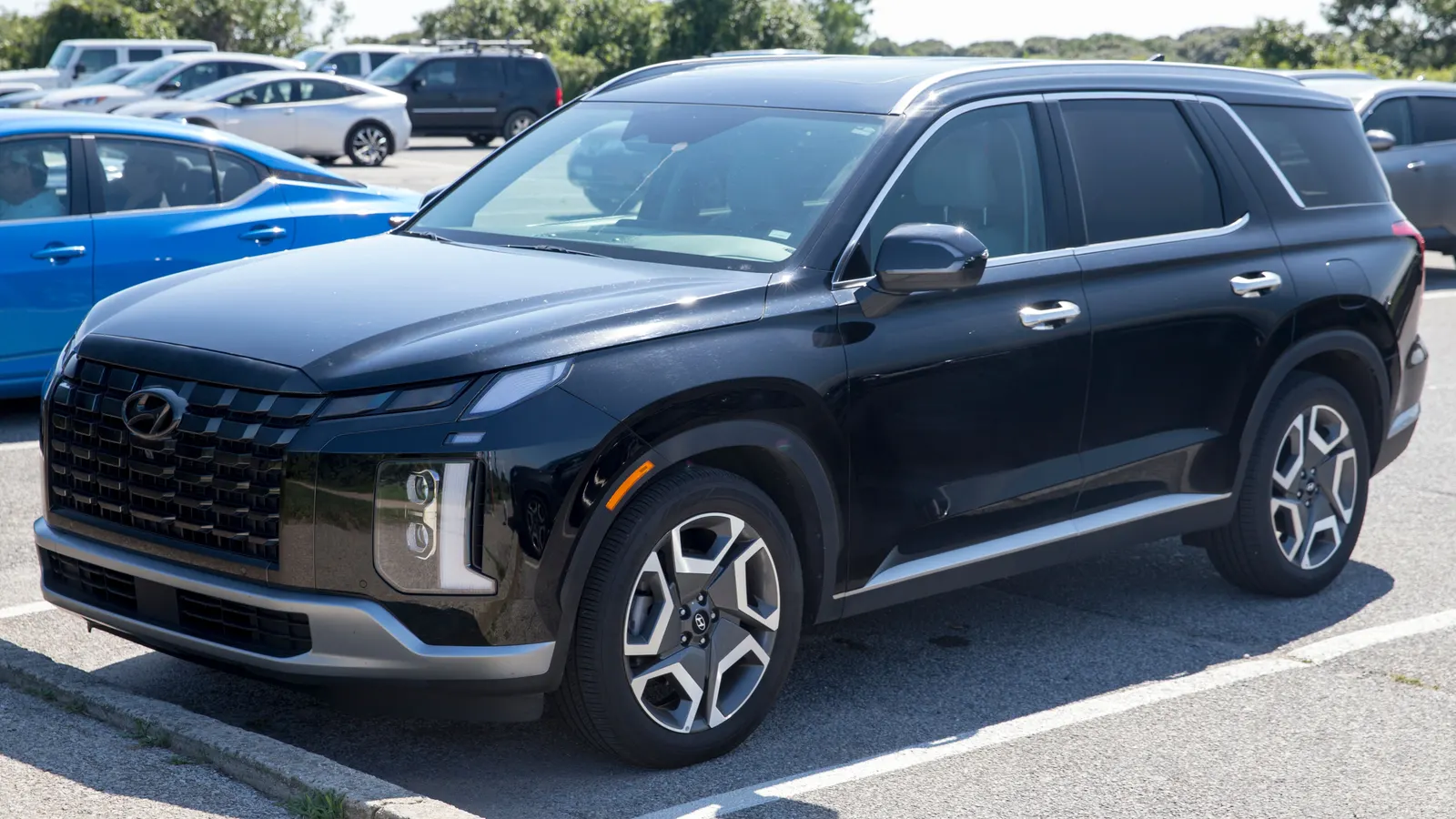
Pictured: 2024 Hyundai Palisade SEL Premium. Photo: Mr.choppers, CC BY-SA 3.0, cropped
Owner complaints
387
18 report a crash, fire, injury or death
Recalls
5
1 with a park-outside warning
Most common problem
30%
of complaints: brake failure
Complaints per year filed
2023–2025 · peak 163
In short
Serious known problemsThe 2024 Hyundai Palisade has serious known problems: 33% of its 387 NHTSA owner complaints (127) describe brake problems, including brake failure and phantom automatic braking, a safety-critical failure. 18 complaints report a crash, fire, injury or death. Owners also describe ABS kicking in over bumps and sunroof glass shattering. There are 5 recalls.
Reliability
How Reliable Is the 2024 Hyundai Palisade?
This model year has a serious-problems verdict because of its brakes. About a third of its owner complaints describe brake problems, such as brake failure and phantom automatic braking, and a park-outside recall for a fire risk in the power train adds to the verdict. Brake complaints dominate this model year. They are safety-critical, since owners describe the car being unable to stop or taking about twice as long to stop.
Two brake complaint groups recur and they overlap heavily. One describes the pedal sinking or the brakes failing. The other describes ABS kicking in, skidding or ineffective braking, often over bumps, railroad tracks, cobblestones or rough roads. In both, owners describe the car shaking, the steering wheel shaking, or the car lurching forward while braking. Read together, they probably describe the same experience in different words, so treat them as one serious concern when you shop. The sunroof is a smaller but separate issue. Owners describe the glass shattering with a loud bang, often on the highway and with nothing hitting it, which leaves glass inside the cabin.
None of the recalls for this model year covers the brake complaints, and none covers the sunroof. The park-outside recall 23V526000 says the electronic controller for the Idle Stop & Go oil pump assembly may contain damaged electrical components that can cause the pump controller to overheat, and owners are advised to park outside and away from structures until the repair is done. Other recalls cover third-row side curtain air bags that may deploy improperly in a crash, seat belt buckles that may fail to latch, and engine valve springs that may break while driving, which can cause a loss of drive power. Owners who describe repairs for the brake problems say they did not fix it, though only a few owners reported an outcome, and complaints lean toward repairs that failed.
Brake problems show up early. Where owners gave a mileage, the middle report was around 5,300 miles for brake failure and 5,000 miles for ABS and ineffective braking. Sunroof reports come later, with a middle figure near 22,000 miles. These mileages come from only a handful of reports, so a low odometer reading on a car you are considering does not rule out these problems, and a higher one does not mean the car has avoided them.
Complaint counts show what owners reported to NHTSA. They do not show how many vehicles are affected, and they cannot show how any particular vehicle was driven or maintained. Even so, the brake complaints are numerous and serious enough that a buyer should check them closely. Have the brakes inspected before you buy, confirm the recall work in writing, and be cautious about any car with a history of brake complaints or repair visits.
Top problems
The 3 problems owners report most
Named from 387 NHTSA complaints. Open a problem for symptoms, the fix, cost and owners' accounts.
1.Brake pedal sinks or brakes failCriticalAbout 1 in 3 complaints3,500–7,400 mi
Owners describe the ABS kicking in, the car shaking or lurching forward when braking, and stopping distances that take twice as long. It often happens when braking over bumps, railroad tracks, cobblestones or rough road. The few owners who gave a mileage reported it around 5,300 miles, and this model year has no recall for it.
What owners describe
- ABS kicks in17%
- Car shakes when braking17%
- Longer stopping distance10%
- Car lurches forward9%
Fix
Most common repair owners describe: repaired twice (1 report).
Mileage
5,300 mi
Middle half 3,500–7,400 mi · 6 reports
Repair cost
—
Fewer than 10 owners report a repair cost
How common
30%
117 of 387 complaints
Crash, fire or injury
5%
of these complaints
In owners' words
“The abs system kicks on and launches the car forward, sometimes in a series of occurances, before the car will stop”
Owner in MA3.8LFiled 2024NHTSA 11591911 “The car lurched forward repeatedly as the brakes were applied, bouncing forward in spurts rather than stopping”
Owner in TX3.8LFiled 2024NHTSA 11591766 “The car began to shake very dramatically, creating a more dangerous situation than needed to be”
Owner in MD3.8LFiled 2024NHTSA 11568712 2.Brakes ineffective or ABS kicks in over bumpsCriticalAbout 1 in 4 complaints788–10,200 mi
Owners describe longer stopping distances, skidding, a pulsing brake pedal and the car shaking violently or lurching forward. It is reported when braking over small bumps, uneven surfaces, brick road, railroad tracks and gravel, and when approaching an intersection. The few owners who gave a mileage reported it around 5,000 miles, and this model year has no recall for it.
What owners describe
- Car or wheel shakes16%
- Car skids11%
- Longer stopping distance9%
- Pedal pulses or rumbles8%
Fix
Most common repair owners describe: unspecified part fixed (1 report).
Mileage
5,000 mi
Middle half 788–10,200 mi · 4 reports
Repair cost
—
Fewer than 10 owners report a repair cost
How common
25%
95 of 387 complaints
Crash, fire or injury
4%
of these complaints
In owners' words
“The anti-lock system to kick in and apply pulsed braking resulting in the car having dangerously long stopping distances”
Owner in OH3.8LFiled 2025NHTSA 11668445 “Brake pedal vibrated under foot, went all the way to the floor and car failed to stop as expected.”
Owner in TX3.8LFiled 2025NHTSA 11668383 “My brakes lock up the whole front of my car shakes and the vehicle almost jumps up and down”
Owner in SC3.8LFiled 2025NHTSA 11663472 3.Sunroof glass shattersSeriousAbout 1 in 22 complaints18,000–30,000 mi
Owners describe a loud bang, often like a gunshot, followed by the sunroof glass shattering, usually on the highway and with nothing hitting it. Some describe glass falling inside the cabin, and one describes the glass shattering while the sunroof was closed. The few owners who gave a mileage reported it around 22,000 miles, and this model year has no recall for it.
What owners describe
- Sunroof glass explodes89%
- Happens with no impact44%
- Loud bang or boom28%
- Glass falls inside the cabin17%
Fix
Most common repair owners describe: sunroof replaced (2 reports).
Mileage
22,000 mi
Middle half 18,000–30,000 mi · 3 reports
Repair cost
—
Fewer than 10 owners report a repair cost
How common
5%
18 of 387 complaints
Crash, fire or injury
0%
of these complaints
In owners' words
“The dealership warranty manager says it was a road hazard but there was no hazard to be had around us.”
Owner in TN3.8LFiled 2024NHTSA 11617951
Buying one
Should you buy a used 2024 Hyundai Palisade?
What to check before you buy, based on the complaint and recall data.
Test drive the brakes on rough pavement, over bumps and at low speed, and walk away if the pedal sinks, the car lurches forward or the vehicle shakes while stopping. Ask the seller for proof that all 5 recalls were done, especially the park-outside recall 23V526000 and the engine recall 24V106000. Check the sunroof glass for damage and ask whether it has ever been replaced.
- 1Run the VIN for open recalls. NHTSA lists 5 recalls, and 1 carries a do-not-drive or park-outside warning (23V526000). Check at nhtsa.gov/recalls.
- 2Test-drive for brake failure. It's the most common safety-critical complaint, in about 1 in 3 owner complaints, usually around 5,300 miles.
- 3Get a pre-purchase inspection. An independent mechanic can spot leaks, stored fault codes and accident repairs that a test drive misses.
Hyundai Palisade model years
Which Hyundai Palisade years to avoid? Every model year compared
Early complaints are those filed in a model year's first 3 years. They follow how many were sold, so they don't show which years are better. The tag on 2024 is its verdict from our research of its owner complaints.
Crash test ratings
NHTSA 5-Star Safety Ratings.
| SUV Later Release AWD | SUV Later Release FWD | SUV Early Release AWD | SUV Early Release FWD | |
|---|---|---|---|---|
| Overall | Not rated | Not rated | ★★★★★ | ★★★★★ |
| Frontal crash | ★★★★★ | ★★★★★ | ★★★★★ | ★★★★★ |
| Side crash | Not rated | Not rated | ★★★★★ | ★★★★★ |
| Rollover | ★★★★ | ★★★★ | ★★★★ | ★★★★ |
| Rollover risk | 14% | 16% | 14% | 16% |
Owning one
If you already own one
Find your symptom, see when problems tend to show up, and check which recalls apply.
Watch for a brake pedal that goes soft or hard, longer stopping distances, the car shaking or lurching forward when you brake, and ABS activating on bumps or small road flaws. If the brakes seem unable to stop the car, stop driving and have it towed to a dealer. Confirm with a dealer that every recall is complete, and park outside and away from structures until recall 23V526000 is repaired.
- Brake pedal sinks or brakes failCriticalAbout 1 in 3 owner complaints117 of 387Median 5,300 mi
Most common repair owners describe: repaired twice (1 report).
- Brakes ineffective or ABS kicks in over bumpsCriticalAbout 1 in 4 owner complaints95 of 387Median 5,000 mi
Most common repair owners describe: unspecified part fixed (1 report).
- Sunroof glass shattersSeriousAbout 1 in 22 owner complaints18 of 387Median 22,000 mi
Most common repair owners describe: sunroof replaced (2 reports).
- Automatic emergency braking activates for no reasonCriticalAbout 1 in 35 owner complaints11 of 387Median 29,000 mi
- Seat belt will not latch or stay latchedSeriousAbout 1 in 39 owner complaints10 of 387Median 32,500 mi
5 recalls, newest first
Open one for the risk, the remedy and what to do now.
Side/window › CurtainThe side curtain air bags for third-row occupants may deploy improperly in a crash. As such, these vehicles fail to…Jan 23, 2026568,576 vehicles26V034000
- Defect
- The side curtain air bags for third-row occupants may deploy improperly in a crash. As such, these vehicles fail to comply with the requirements of Federal Motor Vehicle Safety Standard (FMVSS) number 226, "Ejection Mitigation."
- Risk
- Improper side curtain air bag deployment increases the risk of injury during a crash.
- Remedy
- Dealers will install a protective film over the rear window and remove padding, as necessary free of charge.
Rear/other › Buckle assemblyThe seat belt buckles in the driver, passenger, and second-row window seats may fail to latch.Sep 12, 2025568,580 vehicles25V607000
- Defect
- The seat belt buckles in the driver, passenger, and second-row window seats may fail to latch.
- Risk
- Seat belt buckles that fail to latch may not properly restrain occupants in a crash, increasing the risk of injury.
- Remedy
- Passengers are advised to insert the belt firmly into the buckle with a quick and direct motion, pulling on the belt to confirm the seat belt is fully secured, until the recall remedy is performed.
Engine › Hard parts internal/mechanicalThe engine valve springs may break while driving, which can result in a loss of drive power and possibly create a…Feb 13, 20244,245 vehicles24V106000
- Defect
- The engine valve springs may break while driving, which can result in a loss of drive power and possibly create a hole in the engine block.
- Risk
- A loss of drive power increases the risk of a crash. A hole in the engine block increases the risk of a fire.
- Remedy
- Dealers will replace the engine sub-assembly, free of charge.
Occupant classification › Front passengerThe Occupant Detection System (ODS) may fail to detect an occupant and deactivate the passenger-side front air bags.…Aug 25, 202363 vehicles23V599000
- Defect
- The Occupant Detection System (ODS) may fail to detect an occupant and deactivate the passenger-side front air bags. As such, these vehicles fail to comply with Federal Motor Vehicle Safety Standard number 208, "Occupant Crash Protection."
- Risk
- Deactivated front passenger air bags will not deploy as intended, increasing the risk of injury during a crash.
- Remedy
- Dealers will update the ODS software, free of charge.
Fluid/lubricant › PumpPark outsideThe electronic controller for the Idle Stop & Go oil pump assembly may contain damaged electrical components that can…Jul 27, 202352,109 vehicles23V526000
- Defect
- The electronic controller for the Idle Stop & Go oil pump assembly may contain damaged electrical components that can cause the pump controller to overheat.
- Risk
- An electric oil pump assembly that overheats increases the risk of a vehicle fire.
- Remedy
- Owners are advised to park outside and away from structures until the recall repair is complete.
- What to do
- Park outside and away from buildings until the recall repair is done.
What to do
Check the VIN at nhtsa.gov/recalls. If a recall is open, any dealer will fix it free. For NHTSA's full record of a campaign, search its number there (for example 26V034000).
Reliability history
Hyundai Palisade reliability by year
Complaints filed in each model year's first 3 years, by trouble spot. Darker cells have more complaints; counts aren't adjusted for how many were sold each year.
All problems
Every problem reported on the 2024 Palisade
Every problem found in the 387 owner complaints, by area of the vehicle.
Brakes
216 56%- Brake pedal sinks or brakes failCritical117 30%typically at 5,300 mi5,300––
- 95 25%–––
- Violent shaking after a bump2 0.5%–––
- Brakes do not release after hard braking1 0.3%–––
- Warped front brake rotors1 0.3%–––
- HVAC leaking fluid into floorboard1 0.3%–––
Show 2 more brakes problemsShow fewer brakes problems
- Brake caliper brackets dry and at risk of failing1 0.3%–––
- ABS activates unexpectedly at low speed1 0.3%–––
Body, lights & visibility
51 13%- Sunroof glass shattersSerious18 5%–––
- Windshield crackingMinor8 2%–––
- Paint peeling or flaking4 1%–––
- Dark shadow zones in low beam patternSerious4 1%–––
- Wiper failureSerious3 0.8%–––
- Dim low-beam headlightsSerious2 0.5%–––
Show 12 more body, lights & visibility problemsShow fewer body, lights & visibility problems
- Driver seat moves by itself2 0.5%–––
- Wiring fault under the seat2 0.5%–––
- Seat bolster not inflating1 0.3%–––
- Condensation in headlights1 0.3%–––
- Driver window won't close fully1 0.3%–––
- Window comes off track at highway speed1 0.3%–––
- Headrest locks in reversed position1 0.3%–––
- Rear window glass shatters1 0.3%–––
- Windshield trim comes loose1 0.3%–––
- Passenger seat left unbolted after recall service1 0.3%–––
- Rear-view mirror pulls loose from windshield1 0.3%–––
- Third-row power seat fold problem1 0.3%–––
Airbags & seat belts
18 5%- Seat belt will not latch or stay latchedSerious10 3%–––
- Seatbelt buckle stuck and won't latch2 0.5%–––
- Seatbelt retractor fails2 0.5%–––
- Airbags did not deploy in a crashCritical2 0.5%–––
- Seatbelt came off lower anchor1 0.3%–––
- Seatbelt too short for car seats1 0.3%–––
Show 1 more airbags & seat belts problemsShow fewer airbags & seat belts problems
- Rear charger port not working1 0.3%–––
Driver aids & stability
15 4%- Automatic emergency braking activates for no reasonCritical11 3%–––
- Rear collision warning doesn't always work1 0.3%–––
- Adaptive cruise control does not brake1 0.3%–––
- Parking collision system error message1 0.3%–––
- Radar blocked warning message1 0.3%–––
- Adaptive cruise accelerates instead of braking1 0.3%–––
Electrical
13 3%- Many warning lights at onceMinor7 2%–––
- Battery drain or no-startSerious4 1%–––
- Digital key unreliable1 0.3%–––
- Screen or infotainment glitchesMinor1 0.3%–––
- Complete electrical system failure1 0.3%–––
- Alternator failure1 0.3%–––
Suspension
10 3%- Clunks or knocks from the suspensionMinor8 2%–––
- Rear shock or strut failureMinor5 1%–––
Engine
9 2%- Stalling or shutting off while drivingCritical5 1%–––
- Oil consumption1 0.3%–––
- Coolant disappearing1 0.3%–––
- Check engine light on1 0.3%–––
- Fuel pump or fuel injector failureCritical1 0.3%–––
Steering
8 2%- Loss of power steeringCritical4 1%–––
- Sticky or notchy steeringSerious2 0.5%–––
- Vehicle pulls to the right1 0.3%–––
- Emergency steering alert activates for no reason1 0.3%–––
Transmission & drivetrain
8 2%- Transmission failure needing replacementSerious2 0.5%–––
- Hesitation or slipping while drivingSerious2 0.5%–––
- Harsh, jerky shiftingSerious2 0.5%–––
- Drops into neutral or loses drive while movingCritical2 0.5%–––
- Vehicle rolls away while in park2 0.5%–––
- Power transfer unit (PTU) or 4WD failureCritical1 0.3%–––
Show 2 more transmission & drivetrain problemsShow fewer transmission & drivetrain problems
- Delayed engagement pulling away from a stopSerious1 0.3%–––
- Shifting malfunction warning, stuck in gear1 0.3%–––
Acceleration & speed control
6 2%- Vehicle not responding to accelerator2 0.5%–––
- Sudden or unintended accelerationCritical2 0.5%–––
- No or delayed response to throttle2 0.5%–––
- Random electrical faults in dash and cruise control1 0.3%–––
Wheels & tires
4 1%- Steering wheel shakes over bumps2 0.5%–––
- Steering wheel switch graphics hard to see in daylight1 0.3%–––
- Premature tire wear1 0.3%–––
Fire
3 0.8%- Vehicle catches fireCritical3 0.8%–––
Other
1 0.3%- Jack bends and fails1 0.3%–––
73 problems found in all 387 complaints. One complaint can describe more than one problem, so counts add up to more than the total. Not counted as a defect: 39 about recall paperwork or parts delays, 4 describing no vehicle defect. Typical miles, repair cost and fix rate show only when enough owners report them.
The data
Behind the numbers
Every figure comes from NHTSA's complaint file and APIs.
- Complaints
- 387
- Recalls
- 5
- Crashes
- 15
- Fires
- 3
- Injuries
- 8
- Deaths
- 0
Crashes and fires count complaints that report one; injuries and deaths count people.
Mileage at failure
Not enough data yet
Only 13 complaints list mileage; we chart this from 30.
FAQ
2024 Hyundai Palisade questions
Is the 2024 Hyundai Palisade reliable?
The 2024 Hyundai Palisade has serious known problems. 33% of its 387 NHTSA owner complaints (127) describe brake problems, including brake failure and phantom automatic braking, and a park-outside recall (23V526000) covers a fire risk in the power train. 18 complaints report a crash, fire, injury or death.
What are the most common 2024 Hyundai Palisade problems?
Brake problems dominate. Brake pedal sinks or brakes fail is about 1 in 3 owner complaints (117), and brakes ineffective or ABS kicking in over bumps is about 1 in 4 (95). Sunroof glass shattering with no impact is about 1 in 22 (18). Seat belts that will not latch and automatic emergency braking activating for no reason also appear.
How many recalls does the 2024 Hyundai Palisade have?
The 2024 Hyundai Palisade has 5 recalls. Recall 23V526000 is a park-outside recall: the Idle Stop & Go oil pump controller may overheat, risking a fire, so park outside and away from structures until it is repaired. The others cover third-row side curtain air bags (26V034000), seat belt buckles that may fail to latch (25V607000), engine valve springs (24V106000) and the front passenger occupant detection system (23V599000). Check your VIN at nhtsa.gov/recalls.
Does the 2024 Hyundai Palisade have brake problems?
Yes, brake problems are the main concern. 127 owner complaints (33%) describe them, such as the pedal sinking, ABS kicking in over bumps, the car shaking or lurching forward, and stopping distances taking about twice as long. Owners who gave a mileage reported it around 5,300 miles, and none of the recalls covers the brakes.
What should I check before buying a 2024 Hyundai Palisade?
Test drive the brakes on rough pavement, over bumps and at low speed, and walk away if the pedal sinks, the car lurches forward or it shakes while stopping. Ask for proof that all 5 recalls were done, especially 23V526000 and the engine recall 24V106000. Check the sunroof glass for damage or replacement.
Is the 2024 Hyundai Palisade safe?
NHTSA rates the early release 2024 Hyundai Palisade 5 out of 5 stars overall, 5 out of 5 stars frontal, 5 out of 5 stars side and 4 out of 5 stars rollover, for both AWD and FWD. Later release models are rated 5 out of 5 stars frontal and 4 out of 5 stars rollover, with overall and side not rated. Owners also filed brake complaints.
Which Hyundai Palisade years should you avoid?
Avoid the 2024 Hyundai Palisade: owner complaints for that year show serious known problems. The 2023 is worth checking carefully: complaints show some known problems. For the 2020–2022 and 2025, make sure the recall repairs were done: an urgent recall matters more than their complaint pattern. The 2026 shows no pattern of serious problems. Every model year is compared on the Hyundai Palisade years-to-avoid page.
Methodology
How we researched this
- Complaints. NHTSA's owner complaint file, counted as unique complaint numbers for make HYUNDAI, model PALISADE, model year 2024. Data through Oct 4, 2026.
- Verdict. Judged from this model year's own complaints, not against other models, using shares rather than counts. Serious known problems: one serious problem (transmission, engine or stalling, steering, brakes, airbags, fire, fuel leaks) is in a quarter or more of complaints; or a smaller but clear cluster comes with an unusual share of crash, fire, injury or loss-of-power reports or early failures; or an urgent recall or NHTSA investigation matches a top complaint. Some known problems: one of those signals on its own. No pattern of serious problems: none of them; this doesn't mean the vehicle is trouble-free. Too few complaints to judge: under 50 complaints. Why this verdict: 33% of complaints (127) describe brake problems (brake failure, phantom automatic braking); A park-outside recall (23V526000) for a fire risk in the power train.
- No grade or class ranking. Raw complaint counts favor models that sell fewer cars, so we don't score or rank this vehicle against other models until we can adjust for sales.
- Trouble spots and history. Complaints grouped by the part owners chose when filing. The history grid counts complaints filed in each model year's first 3 years so older and newer years compare fairly; years with fewer than 3 complete years are marked too new.
- Named problems. Every one of the 387 complaints was researched and classified by its problems, severity, symptoms, repairs and any cost the owner mentions; the counts, costs and fix rates on this page are tallies of those classifications. Quotes are verbatim excerpts, checked against the original text. Engines are decoded from partial VINs with NHTSA's vPIC service.
- Repair costs and fix rates. Shown only when at least 10 owners report a repair cost, or at least 10 complaints describe whether a repair worked.
- Not adjusted for sales. Not affiliated with NHTSA. Page updated Nov 5, 2026.