2021 Kia Telluride Reliability & Problems
By Adrian V. LockhartUpdated All 365 NHTSA owner reports researched and classified
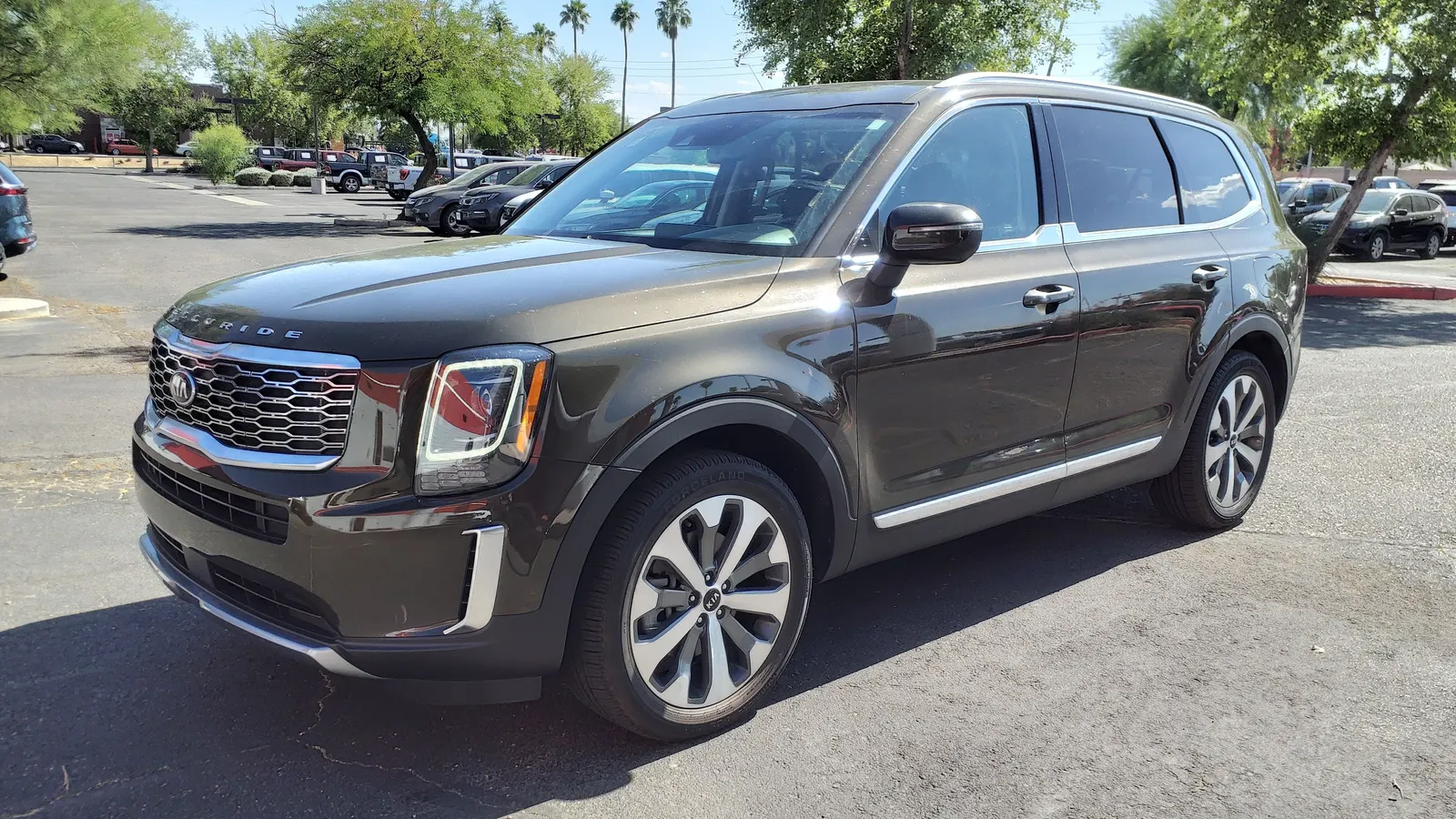
Pictured: 2020 Kia Telluride EX, same generation as the 2021 model.
Owner complaints
365
16 report a crash, fire, injury or death
Recalls
5
3 with a park-outside warning
Most common problem
18%
of complaints: windshield cracking
Complaints per year filed
2020–2025 · peak 72
In short
Some known problemsThe 2021 Kia Telluride has some known problems, mainly because a park-outside recall (22V626000) covers a fire risk in the trailer hitches. NHTSA has 365 owner complaints, and 16 of them report a crash, fire, injury or death. The most common are windshield cracks, sunroof failures and engines burning oil. This model year has 5 recalls.
Reliability
How Reliable Is the 2021 Kia Telluride?
This model year is rated as having some known problems, and the main reason is official rather than owner-driven. Recall 22V626000 covers a fire risk in the trailer hitches and tells owners to park outside and away from structures until the repair is done. The complaints themselves are led by windshield cracks and a group of sunroof problems, with oil burning and engine failure behind them. Most of what owners describe is more annoying than dangerous, but several reports are serious, and 16 complaints mention a crash, fire, injury or death.
The sunroof is the biggest theme, and it shows up in three forms. Some owners say the sunroof is stuck open or will not close, some describe a broken wind deflector or a track that came apart, and some describe the glass exploding or shattering, with a loud pop and glass falling into the cabin. These overlap, since a broken deflector or rail can leave the roof unable to close. Among owners who gave an amount for the stuck or broken sunroof, the middle figure was about $5,000, and several were quoted a full sunroof replacement. Owners who describe repairs for it mostly say the problem was not fully fixed. The shattering reports come mainly while driving at highway speed, and one owner says glass hit the driver in the face. The windshield complaints are mostly about small chips that spread fast or cracks that appear while parked, and owners say a replacement is often needed.
The engine reports are fewer but more serious. Owners describe engines with no oil on the dipstick, check engine lights, rattling, loss of power and, in the worst cases, engine replacement. Some say there was no warning light before the oil ran low. Of the owners who describe the outcome of oil consumption repairs, most say the repair did not fix it, and complaints lean toward repairs that failed. This model year has no recall for the sunroof, the windshield, oil burning or engine failure.
The recalls that do apply cover other things. The front power seat motor may overheat and cause a fire while parked or driving, which led to recalls 24V407000 and 26V430000, and the second recall mentions an improper repair under the first. Recall 24V214000 covers a driveshaft that may not be fully engaged, which can result in roll away while in park, and owners are advised to use the emergency parking brake until the remedy is performed. A vehicle can be missing any of these repairs, so check each one by its number.
Mileage matters for the engine problems. Windshield cracks are reported very early, with a middle figure of about 2,800 miles, so they say little about an older vehicle. Oil burning and engine failure show up much later, with middle figures around 102,000 miles, and the engine failure reports start around 78,000 miles. A vehicle with low miles has not yet reached the range where those complaints cluster, while one near or past 100,000 miles deserves a close look at the oil level and service records. Complaint counts show what owners reported, not how many vehicles are affected, and they cannot show how a particular vehicle was maintained, so use them to decide what to inspect rather than as a prediction.
Top problems
The 6 problems owners report most
Named from 365 NHTSA complaints. Open a problem for symptoms, the fix, cost and owners' accounts.
1.Windshield cracksMinorAbout 1 in 6 complaints1,200–3,400 mi
Owners describe a chip that spread across the glass within seconds, or a crack found after the car sat parked in a driveway or overnight. A few mention reduced visibility and collision or lane departure warning lights coming on. Reports of this problem tend to come early, with a middle figure of about 2,800 miles, and no recall is mentioned.
What owners describe
- Crack found while parked18%
- Chip that spreads quickly11%
Fix
Most common repair owners describe: needs replacement (2 reports).
Mileage
2,800 mi
Middle half 1,200–3,400 mi · 17 reports
Repair cost
—
Fewer than 10 owners report a repair cost
How common
18%
66 of 365 complaints
Crash, fire or injury
0%
of these complaints
In owners' words
“Both times the damage was cause by road debris hitting the windshield, but the crack quickly spreads across the windshield.”
Owner in FL3.8L V6Filed 2021NHTSA 11386171 “There is one major chip, one minor chip and over 20 micro-chips/pock marks in the windshield.”
Owner in MO3.8L V6Filed 2021NHTSA 11404247 “There was a minor rock hit but nothing that should have caused this sort of issue.”
Owner in OH3.8L V6Filed 2021NHTSA 11406425 2.Sunroof breaks or will not closeSeriousAbout 1 in 6 complaints32,800–50,800 mi~$5,000 repair
Owners most often say the sunroof is stuck open or will not close, usually when they press the button to open it. Others describe a broken track, a plastic rail that snapped, or glass that came off the rails. No recall is mentioned.
What owners describe
- Trouble when opening35%
- Sunroof stuck open22%
- Will not close18%
- Broken track or rail10%
Fix
Most common repair owners describe: whole sunroof assembly replacement quoted (1 report).
Mileage
41,100 mi
Middle half 32,800–50,800 mi · 6 reports
Repair cost
$5,000
Middle half $4,000–$6,000 · 15 owner amounts
How common
16%
60 of 365 complaints
Crash, fire or injury
2%
of these complaints
In owners' words
“After a few days the dealership said they needed to order parts, that the entire sunroof track has to be replaced and it may take weeks.”
Owner in VA3.8L V6Filed 2024NHTSA 11603612 “Tried to open Our Sunroof and it went off the rails, sounded like something broke off while driving.”
Owner in TX3.8L V6Filed 2023NHTSA 11549339 “Sunroof glass panel stuck when opening, broke from track and became unattached from vehicle.”
Owner in GA3.8L V6Filed 2023NHTSA 11542663 3.Engine burns oilSeriousAbout 1 in 10 complaints94,000–111,000 mi
Owners describe no oil on the dipstick, a check engine light in some cases and no warning light in others, and engine shaking or stalling. Reports come late, with a middle figure of about 102,000 miles and most between 94,000 and 111,000 miles. No recall is mentioned.
What owners describe
- No oil on dipstick29%
- Shaking, stalling or rattling14%
- Check engine light11%
- No warning before low oil9%
Fix
Most common repair owners describe: engine replacement (2 reports).
Repair worked in 10% of complaints that describe one (complaints lean toward repairs that failed)
Mileage
102,000 mi
Middle half 94,000–111,000 mi · 17 reports
Repair cost
—
Fewer than 10 owners report a repair cost
How common
10%
35 of 365 complaints
Crash, fire or injury
0%
of these complaints
In owners' words
“Dealership wants me to pay diagnostic fees for them doing absolutely nothing other and resetting the code and conducting an oil change.”
Owner in TX3.8L V6Filed 2025NHTSA 11681754 “Excessive Oil usage to the point of no oil on dip stick yet engine doesnt alert to low oil or pressure.”
Owner in OH3.8L V6Filed 2025NHTSA 11655365 “So i check the oil and its completely empty i've went less than 3k miles on this oil change”
Owner in VA3.8L V6Filed 2025NHTSA 11663599 4.Sunroof glass shattersSeriousAbout 1 in 15 complaints900–4,400 mi
Owners describe a loud pop or boom and glass that exploded or fell into the cabin, often at highway speed in clear weather. One says the driver veered momentarily and another says glass hit the driver in the face. No recall is mentioned.
What owners describe
- Sunroof explodes50%
- Happens at highway speed33%
- Loud pop or boom25%
- Glass falls into cabin13%
Fix
Most common repair owners describe: repaired in shop for several weeks (1 report).
Mileage
2,200 mi
Middle half 900–4,400 mi · 5 reports
Repair cost
—
Fewer than 10 owners report a repair cost
How common
7%
24 of 365 complaints
Crash, fire or injury
0%
of these complaints
In owners' words
“Glass hit me in the face while driving at highway speeds, luckily I remained in control of the car.”
Owner in CO3.8L V6Filed 2021NHTSA 11436039 “There was a loud bang above the driver’s head causing the driver to become startled and swerve.”
Owner in FL3.8L V6Filed 2022NHTSA 11494501 “Heard a loud, explosion-like sound. This made me swerve onto the other traveling lane.”
Owner in TX3.8L V6Filed 2024NHTSA 11583629 5.Engine failureCriticalAbout 1 in 16 complaints78,000–116,000 mi
Owners describe catastrophic engine failure, a complete loss of power, rattling and no oil on the dipstick, with engine replacement the most common repair. Reports are late, with a middle figure of about 102,000 miles and a quarter of them at or below about 78,000 miles. No recall is mentioned.
What owners describe
- Catastrophic engine failure26%
- Rattling, smoke or fire22%
- No oil on dipstick17%
- Complete loss of power13%
Fix
Most common repair owners describe: engine replacement (3 reports).
Mileage
102,000 mi
Middle half 78,000–116,000 mi · 13 reports
Repair cost
—
Fewer than 10 owners report a repair cost
How common
6%
23 of 365 complaints
Crash, fire or injury
9%
of these complaints
In owners' words
“On all three occasions, the vehicle lost power on the freeway at night while my family with two kids was in the vehicle.”
Owner in TX3.8L V6Filed 2026NHTSA 11746847 “2021 Kia Telluride experienced sudden engine failure at approximately 120,000 miles.”
Owner in INFiled 2026NHTSA 11722576 “Service guy told me no active recalls and also that I was outside of the warranty.”
Owner in GA3.8L V6Filed 2025NHTSA 11652471
Show 1 more problemShow fewer problems
6.Sunroof wind deflector breaksMinorAbout 1 in 16 complaints60,500–60,500 mi
Owners say the deflector, its clips or its brackets broke, most often when opening the sunroof, and the roof then would not close or stayed jammed open. Some describe deflector springs wedged in the track. No recall is mentioned.
What owners describe
- Deflector or clips break57%
- Sunroof will not close43%
- Sunroof stuck open26%
- Glass off its track13%
Fix
Most common repair owners describe: part on order (1 report).
Mileage
60,500 mi
Middle half 60,500–60,500 mi · 1 reports
Repair cost
—
Fewer than 10 owners report a repair cost
How common
6%
23 of 365 complaints
Crash, fire or injury
0%
of these complaints
In owners' words
“I was quoted approximately $4,000+ for replacement of the entire sunroof assembly instead of the component repair procedure described by Kia.”
Owner in NC3.8L V6Filed 2026NHTSA 11753524 “Wind deflector arms broke, got stuck open, and caused the glass to go off-track, rendering the sunroof inoperable and completely ruined.”
Owner in MDFiled 2026NHTSA 11759860 “This dislodged the sunroof mechanism from its tracks and prevents the sunroof from closing.”
Owner in CO3.8L V6Filed 2024NHTSA 11600430
Buying one
Should you buy a used 2021 Kia Telluride?
What to check before you buy, based on the complaint and recall data.
Ask the seller for proof that every recall was completed, especially 22V626000 for the trailer hitch fire risk and the two seat motor recalls, 24V407000 and 26V430000. Check the sunroof by opening and closing it several times, and look for cracks or chips in the windshield. On a higher-mileage vehicle, ask for oil change records and check the dipstick, since owners report engines low on oil and some engine failures.
- 1Run the VIN for open recalls. NHTSA lists 5 recalls, and 3 carry a do-not-drive or park-outside warning (26V430000, 24V407000, 22V626000). Check at nhtsa.gov/recalls.
- 2Test-drive for engine failure. It's the most common safety-critical complaint, in about 1 in 16 owner complaints, usually around 102,000 miles.
- 3Check for windshield cracking. The most common complaint, in about 1 in 6 owner complaints.
- 4Get a pre-purchase inspection. An independent mechanic can spot leaks, stored fault codes and accident repairs that a test drive misses.
Kia Telluride model years
Which Kia Telluride years to avoid? Every model year compared
Early complaints are those filed in a model year's first 3 years. They follow how many were sold, so they don't show which years are better. The tag on 2021 is its verdict from our research of its owner complaints.
Crash test ratings
NHTSA 5-Star Safety Ratings.
| SUV FWD | SUV AWD | |
|---|---|---|
| Overall | ★★★★★ | ★★★★★ |
| Frontal crash | ★★★★ | ★★★★ |
| Side crash | ★★★★★ | ★★★★★ |
| Rollover | ★★★★ | ★★★★ |
| Rollover risk | 16% | 14% |
Owning one
If you already own one
Find your symptom, see when problems tend to show up, and check which recalls apply.
Confirm that recalls 22V626000, 24V407000, 26V430000 and 24V214000 have been done, and park outside and away from structures until the fire-related repairs are complete. If the sunroof sticks open, stops moving or makes a loud pop, stop using it and have it checked. Check the oil level regularly, and stop driving if the engine knocks, shakes or loses power.
- Windshield cracksMinorAbout 1 in 6 owner complaints66 of 365Median 2,800 mi
Most common repair owners describe: needs replacement (2 reports).
- Sunroof breaks or will not closeSeriousAbout 1 in 6 owner complaints60 of 365Median 41,100 mi
Most common repair owners describe: whole sunroof assembly replacement quoted (1 report).
- Engine burns oilSeriousAbout 1 in 10 owner complaints35 of 365Median 102,000 mi
Most common repair owners describe: engine replacement (2 reports).
- Sunroof glass shattersSeriousAbout 1 in 15 owner complaints24 of 365Median 2,200 mi
Most common repair owners describe: repaired in shop for several weeks (1 report).
- Engine failureCriticalAbout 1 in 16 owner complaints23 of 365Median 102,000 mi
Most common repair owners describe: engine replacement (3 reports).
- Sunroof wind deflector breaksMinorAbout 1 in 16 owner complaints23 of 365Median 60,500 mi
Most common repair owners describe: part on order (1 report).
- Rear shocks failSeriousAbout 1 in 26 owner complaints14 of 365Median 47,500 mi
- Stalling or shutting off while drivingCriticalAbout 1 in 28 owner complaints13 of 365Median 64,000 mi
Show all 11 problemsShow fewer problems
- Many warning lights at onceMinorAbout 1 in 30 owner complaints12 of 365Median 105,300 mi
- Oil leaks or low oilSeriousAbout 1 in 33 owner complaints11 of 365Median 95,600 mi
- No low-oil warning before failureCriticalAbout 1 in 33 owner complaints11 of 365Median 92,000 mi
of complaints that list mileage (33 of 40) came in before 25,000 miles. A low odometer reading is no guarantee.
5 recalls, newest first
Open one for the risk, the remedy and what to do now.
Front assembly › Power adjustPark outsideThe front power seat motor may overheat due to a stuck power seat slide knob or an improper recall 24V407 repair,…Jul 2, 2026462,869 vehicles26V430000
- Defect
- The front power seat motor may overheat due to a stuck power seat slide knob or an improper recall 24V407 repair, which can result in a fire while parked or driving.
- Risk
- A fire increases the risk of injury.
- Remedy
- Owners are advised to park outside and away from structures until the recall repair is complete.
- What to do
- Park outside and away from buildings until the recall repair is done.
Front assembly › Power adjustPark outsideThe front power seat motor may overheat due to a stuck power seat slide knob, which can result in a fire while parked…Jun 5, 2024462,869 vehicles24V407000
- Defect
- The front power seat motor may overheat due to a stuck power seat slide knob, which can result in a fire while parked or driving.
- Risk
- A fire increases the risk of injury.
- Remedy
- Owners are advised to park outside and away from structures until the recall repair is complete.
- What to do
- Park outside and away from buildings until the recall repair is done.
Driveline › DriveshaftThe intermediate shaft and right front driveshaft may not be fully engaged, which can result in vehicle roll away…Mar 20, 2024427,407 vehicles24V214000
- Defect
- The intermediate shaft and right front driveshaft may not be fully engaged, which can result in vehicle roll away while in PARK.
- Risk
- A vehicle roll away increases the risk of a crash or injury.
- Remedy
- Owners are advised to manually engage the emergency parking brake prior to exiting the vehicle until the recall remedy is performed.
Trailer hitchesPark outsideDebris and moisture accumulation on the tow hitch harness module printed circuit board (PCB) may cause an electrical…Aug 15, 202236,417 vehicles22V626000
- Defect
- Debris and moisture accumulation on the tow hitch harness module printed circuit board (PCB) may cause an electrical short, which can result in a fire.
- Risk
- A fire while parked or driving can increase the risk of injury.
- Remedy
- Owners are advised to park outside and away from structures until the recall repair is complete.
- What to do
- Park outside and away from buildings until the recall repair is done.
Air bags › Air bag/restraint control moduleThe Occupant Classification and Detection System (OCS/ODS) unit may not detect the presence of a child restraint…Mar 11, 2021142 vehicles21V164000
- Defect
- The Occupant Classification and Detection System (OCS/ODS) unit may not detect the presence of a child restraint system in the front passenger seat. As such, these vehicles fail to comply with the requirements of Federal Motor Vehicle Safety Standard (FMVSS) number 208, "Occupant Crash Protection."
- Risk
- In the event of a crash, deployment of the front passenger air bag, with a child in that seat, can increase the risk of injury to the child.
- Remedy
- Dealers will replace the OCS/ODS unit, free of charge.
What to do
Check the VIN at nhtsa.gov/recalls. If a recall is open, any dealer will fix it free. For NHTSA's full record of a campaign, search its number there (for example 26V430000).
Reliability history
Kia Telluride reliability by year
Complaints filed in each model year's first 3 years, by trouble spot. Darker cells have more complaints; counts aren't adjusted for how many were sold each year.
All problems
Every problem reported on the 2021 Telluride
Every problem found in the 365 owner complaints, by area of the vehicle.
Body, lights & visibility
206 56%- Windshield cracksMinor66 18%typically at 2,800 mi2,800––
- 60 16%typically at 41,100 mi · repair $5,00041,100$5,000–
- Sunroof glass shattersSerious24 7%typically at 2,200 mi2,200––
- 23 6%–––
- Dim low-beam headlightsSerious3 0.8%–––
- Window stuck openMinor3 0.8%–––
Show 28 more body, lights & visibility problemsShow fewer body, lights & visibility problems
- Paint peels or delaminatesMinor3 0.8%–––
- Exterior door trim comes loose3 0.8%–––
- Side window shatters2 0.5%–––
- High beam failure2 0.5%–––
- Wipers pause mid-sweep2 0.5%–––
- Uneven airflow to rear rows1 0.3%–––
- Windows flex and will not roll up at highway speed1 0.3%–––
- Liftgate fails1 0.3%–––
- Wipers cannot clear light snow1 0.3%–––
- LED headlight housings fog up and frost1 0.3%–––
- Windshield molding comes loose1 0.3%–––
- Child lock latches and unlatches by itself1 0.3%–––
- Fuel door panel detaches1 0.3%–––
- Windshield pitting1 0.3%–––
- Power windows and mirrors work intermittently1 0.3%–––
- Headlights aimed too high1 0.3%–––
- Wipers stick1 0.3%–––
- Driver door loses electrical power1 0.3%–––
- Rear doors will not open from inside1 0.3%–––
- Headlight stops working1 0.3%–––
- Burning smell from heated seats1 0.3%–––
- Intermediate shaft failure1 0.3%–––
- Seat buttons stop working1 0.3%–––
- Leather ripping on seats1 0.3%–––
- Captain's chair folds unexpectedly1 0.3%–––
- Exhaust pipe burns people at the trunk1 0.3%–––
- Power seats stopped working1 0.3%–––
- Wipers stop mid-sweep in intermittent mode1 0.3%–––
Engine
65 18%- Engine burns oilSerious35 10%typically at 102,000 mi · 10% fixed102,000–10%
- Engine failureCritical23 6%typically at 102,000 mi102,000––
- Stalling or shutting off while drivingCritical13 4%–––
- Oil leaks or low oilSerious11 3%–––
- No low-oil warning before failure11 3%typically at 92,000 mi92,000––
- Squeal or whistle from engine on cold startMinor3 0.8%–––
Show 9 more engine problemsShow fewer engine problems
- Fuel pump or fuel injector failureCritical3 0.8%–––
- Cooling fan runs on its own2 0.5%–––
- Engine knocking2 0.5%–––
- Engine light and rough running on cold start1 0.3%–––
- Engine overheating1 0.3%–––
- Engine surges at a stop1 0.3%–––
- Popping sound from exhaust1 0.3%–––
- Overheating from leaking hoses and seals1 0.3%–––
- Shudder and rough running1 0.3%–––
Electrical
30 8%- Many warning lights at onceMinor12 3%–––
- Instrument cluster or gauges failSerious6 2%–––
- Battery drain or no-startSerious3 0.8%–––
- Electronic parking brake engages on its ownCritical3 0.8%–––
- Screen or infotainment glitchesMinor3 0.8%–––
- Alternator fails and drains battery2 0.5%–––
Show 6 more electrical problemsShow fewer electrical problems
- Wiring harness damage2 0.5%–––
- Battery discharge warning comes and goes1 0.3%–––
- Rear child safety lock fails1 0.3%–––
- Water leaks damaging electronicsSerious1 0.3%–––
- Charging system or electrical failure1 0.3%–––
- Drive mode or driver assist fails1 0.3%–––
Transmission & drivetrain
20 5%- Vibration at highway speedSerious5 1%–––
- Hesitation or slipping while drivingSerious4 1%–––
- Transmission failure needing replacementSerious3 0.8%–––
- CV axle or boot failsSerious3 0.8%–––
- Harsh, jerky shiftingSerious2 0.5%–––
- Power transfer unit (PTU) or 4WD failureCritical2 0.5%–––
Show 4 more transmission & drivetrain problemsShow fewer transmission & drivetrain problems
- Delayed engagement pulling away from a stopSerious1 0.3%–––
- Drops into neutral or loses drive while movingCritical1 0.3%–––
- Shifter stuck in Park1 0.3%–––
- Stuck in reverse and would not shift1 0.3%–––
Suspension
17 5%- Rear shocks failSerious14 4%–––
- Clunks or knocks from the suspensionMinor2 0.5%–––
- Harsh, uneven rear ride1 0.3%–––
- Broken weld in rear frame1 0.3%–––
- Ride height sagging1 0.3%–––
Brakes
11 3%- Brake pedal sinks or brakes failCritical7 2%–––
- Vehicle rolls away from park2 0.5%–––
- Brake vacuum leak1 0.3%–––
- Gear disengages and engine braking lost1 0.3%–––
Driver aids & stability
9 2%- Parking or collision sensors stop workingMinor3 0.8%–––
- Blind spot warning works intermittently1 0.3%–––
- Collision and lane departure warnings from camera fault1 0.3%–––
- Forward collision avoidance does not engage1 0.3%–––
- Automatic emergency braking activates for no reasonCritical1 0.3%–––
- Front collision warning goes off falsely1 0.3%–––
Show 1 more driver aids & stability problemsShow fewer driver aids & stability problems
- Forward collision warning shows with nothing ahead1 0.3%–––
Airbags & seat belts
8 2%- Airbags did not deploy in a crashCritical3 0.8%–––
- Seat belt not workingSerious3 0.8%–––
- Passenger airbag turns off with an adult in the seatCritical1 0.3%–––
- Seat belt anchor bolt comes loose1 0.3%–––
Steering
7 2%- Loss of power steeringCritical6 2%–––
- Steering does not respond1 0.3%–––
Fire
4 1%- Vehicle catches fireCritical4 1%–––
Wheels & tires
3 0.8%- Tires wear fast and blow out2 0.5%–––
- Steering wheel buttons fail1 0.3%–––
Acceleration & speed control
3 0.8%- Sudden or unintended accelerationCritical1 0.3%–––
- Dash part falls onto pedals1 0.3%–––
- Cannot accelerate past 30 mph with check engine light1 0.3%–––
Other
2 0.5%- Anti-theft bypass via USB port1 0.3%–––
- Vibration at highway speed1 0.3%–––
Fuel system & stalling
1 0.3%- Fuel leaksCritical1 0.3%–––
102 problems found in all 365 complaints. One complaint can describe more than one problem, so counts add up to more than the total. Not counted as a defect: 3 about recall paperwork or parts delays, 3 describing no vehicle defect. Typical miles, repair cost and fix rate show only when enough owners report them.
The data
Behind the numbers
Every figure comes from NHTSA's complaint file and APIs.
- Complaints
- 365
- Recalls
- 5
- Crashes
- 7
- Fires
- 4
- Injuries
- 9
- Deaths
- 0
Crashes and fires count complaints that report one; injuries and deaths count people.
FAQ
2021 Kia Telluride questions
Is the 2021 Kia Telluride reliable?
The 2021 Kia Telluride has some known problems, mainly because park-outside recall 22V626000 covers a fire risk in the trailer hitches. NHTSA has 365 owner complaints for this model year, and 16 of them report a crash, fire, injury or death. Owners are advised to park outside and away from structures until the repair is complete.
What are the most common 2021 Kia Telluride problems?
The most common complaints are windshield cracks, with 66 complaints (about 1 in 6 owner complaints), and sunroof breaks or will not close, with 60 (about 1 in 6). Engines burning oil come next with 35 complaints (about 1 in 10), followed by sunroof glass shattering with 24. Windshield cracks are reported early, with a middle figure of about 2,800 miles.
How many recalls does the 2021 Kia Telluride have?
This model year has 5 recalls, and three carry a park-outside warning: 22V626000 (trailer hitch electrical short that can cause a fire), 24V407000 and 26V430000 (front power seat motor that may overheat and cause a fire). Owners should park outside and away from structures until the repair is complete. The others cover the driveshaft roll away risk (24V214000) and the front passenger child-seat detection unit (21V164000). Check your VIN at nhtsa.gov/recalls.
Does the 2021 Kia Telluride have sunroof problems?
Yes, sunroof trouble is a main theme in owner complaints. 60 complaints describe a sunroof that sticks, comes off its track or will not close, and the middle repair amount owners gave was about $5,000. Another 24 describe the glass shattering, mostly at highway speed, and 23 describe a broken wind deflector. No recall is mentioned for the sunroof.
Does the 2021 Kia Telluride have engine problems?
Owners report engines burning oil, with 35 complaints, and engine failure, with 23 complaints, which is rated critical. Both tend to come late, with a middle figure of about 102,000 miles, and a quarter of the engine failure reports are at or below about 78,000 miles. Owners describe no oil on the dipstick, rattling and loss of power. No recall is mentioned for either problem.
What should I check before buying a 2021 Kia Telluride?
Ask the seller for proof that every recall was completed, especially 22V626000 for the trailer hitch fire risk and the seat motor recalls 24V407000 and 26V430000. Open and close the sunroof several times and look for cracks or chips in the windshield. On a higher-mileage vehicle, ask for oil change records and check the dipstick.
Is the 2021 Kia Telluride safe?
NHTSA gives the 2021 Kia Telluride 5 out of 5 stars overall, with 4 out of 5 stars for frontal, 5 out of 5 stars for side and 4 out of 5 stars for rollover. The front-wheel drive and all-wheel drive versions have the same ratings. Separately, 16 owner complaints mention a crash, fire, injury or death.
Which Kia Telluride years should you avoid?
Avoid the 2025 Kia Telluride: owner complaints for that year show serious known problems. For the 2020–2024, make sure the recall repairs were done: an urgent recall matters more than their complaint pattern. The 2027 has too few complaints to judge. Every model year is compared on the Kia Telluride years-to-avoid page.
Methodology
How we researched this
- Complaints. NHTSA's owner complaint file, counted as unique complaint numbers for make KIA, model TELLURIDE, model year 2021. Data through Oct 4, 2026.
- Verdict. Judged from this model year's own complaints, not against other models, using shares rather than counts. Serious known problems: one serious problem (transmission, engine or stalling, steering, brakes, airbags, fire, fuel leaks) is in a quarter or more of complaints; or a smaller but clear cluster comes with an unusual share of crash, fire, injury or loss-of-power reports or early failures; or an urgent recall or NHTSA investigation matches a top complaint. Some known problems: one of those signals on its own. No pattern of serious problems: none of them; this doesn't mean the vehicle is trouble-free. Too few complaints to judge: under 50 complaints. Why this verdict: A park-outside recall (22V626000) for a fire risk in the trailer hitches, matching a top complaint.
- No grade or class ranking. Raw complaint counts favor models that sell fewer cars, so we don't score or rank this vehicle against other models until we can adjust for sales.
- Trouble spots and history. Complaints grouped by the part owners chose when filing. The history grid counts complaints filed in each model year's first 3 years so older and newer years compare fairly; years with fewer than 3 complete years are marked too new.
- Named problems. Every one of the 365 complaints was researched and classified by its problems, severity, symptoms, repairs and any cost the owner mentions; the counts, costs and fix rates on this page are tallies of those classifications. Quotes are verbatim excerpts, checked against the original text. Engines are decoded from partial VINs with NHTSA's vPIC service.
- Repair costs and fix rates. Shown only when at least 10 owners report a repair cost, or at least 10 complaints describe whether a repair worked.
- Not adjusted for sales. Not affiliated with NHTSA. Page updated Nov 5, 2026.