2017 Volkswagen Golf Reliability & Problems
By Adrian V. LockhartUpdated All 116 NHTSA owner reports researched and classified
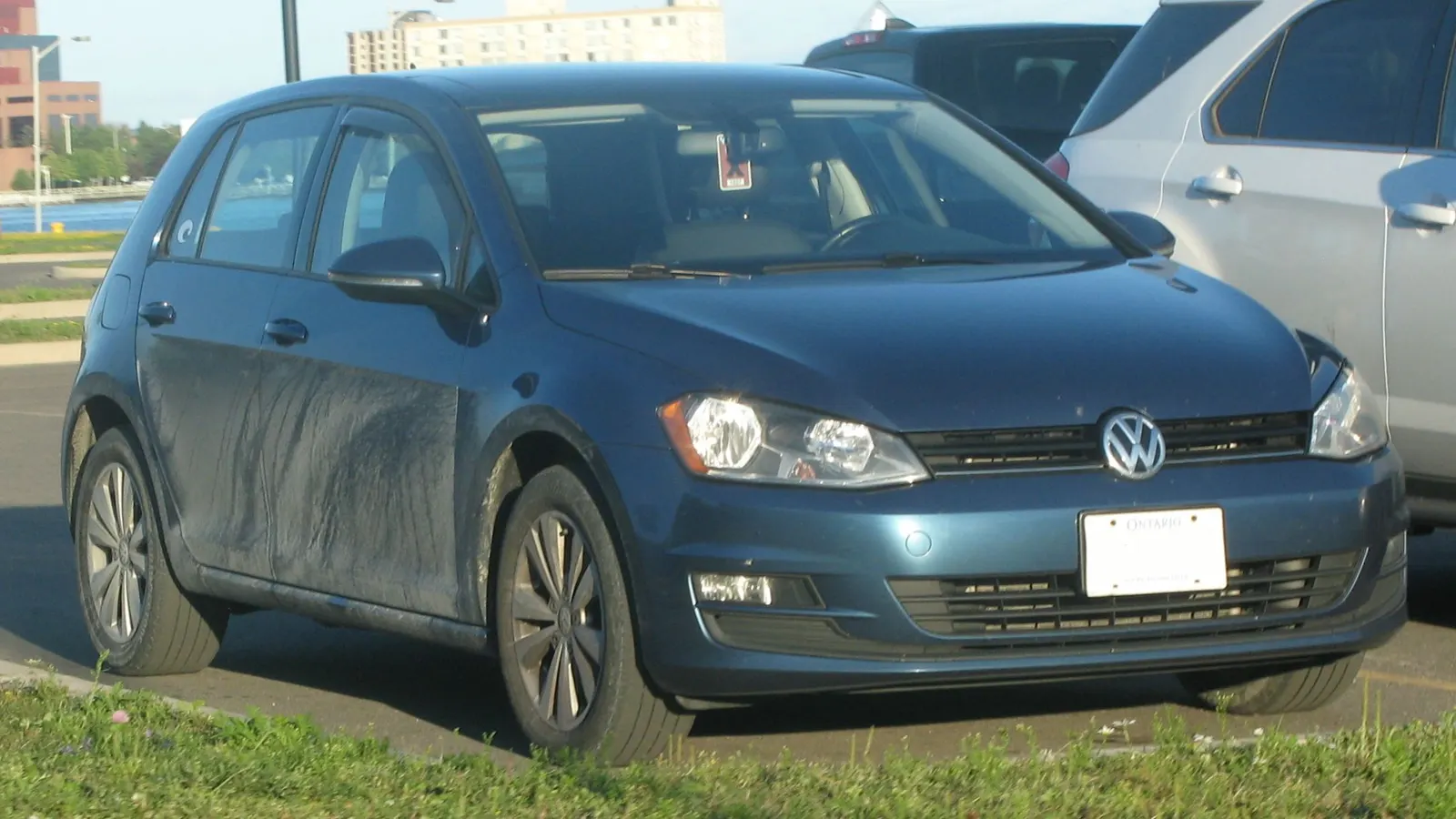
Pictured: 2015 Volkswagen Golf, Canadian model (same design as 2017), same generation as the 2017 model. Photo: SsmIntrigue, CC BY-SA 4.0, cropped
Owner complaints
116
6 report a crash, fire, injury or death
Recalls
5
None urgent
Most common problem
34%
of complaints: fuel leak
Complaints per year filed
2017–2025 · peak 27
In short
Serious known problemsThe 2017 Volkswagen Golf has serious known problems: 40 owner complaints (34%) describe fuel leaks, a critical issue. NHTSA has 116 owner complaints, and 6 report a crash, fire, injury or death. A fuel tank that will not fill is the next most common, with 25 complaints. This model year has 5 recalls, including one for a fuel tank pump seal.
Reliability
How Reliable Is the 2017 Volkswagen Golf?
This model year is rated as having serious known problems because of fuel leaks. About 1 in 3 owner complaints describe them, and they are classed as critical. NHTSA also opened an investigation into whether an earlier recall, 16V647, fixed a fuel leak caused by suction jet pump failure inside the fuel tank. That investigation closed with recall 24V110. Fuel on the ground or in the car's evaporative system is a safety concern, not just an annoyance.
A second problem overlaps with the first. About 1 in 5 owners say the fuel tank will not fill. Typical reports describe the pump shutting off after a small amount of gas, fuel overflowing while pumping, or gas backing up the filler neck. Several of these owners also describe fuel leaking from the rear passenger side or dripping from the charcoal canister. Many of these reports likely describe the same underlying trouble from different angles, so treat refueling trouble as a possible warning sign of a leak.
Recall 24V110000 addresses this area. Its defect text says that a problem with a suction jet pump seal inside the fuel tank may let fuel flow into the evaporative emissions system and possibly leak out of the charcoal canister. The remedy is a free suction pump replacement at a dealer. This model year has no recall for the tank-will-not-fill complaints on their own, though the same recall may relate to them. Only a handful of owners say how their repair turned out, so it is not possible to say how well repairs work. Owners also mention an earlier recall, 16V647, in connection with a leak, and the investigation into its remedy suggests that an earlier fix did not settle the matter for every car.
Mileage helps with a particular car. Among owners who gave a mileage, fuel leaks were reported at a median of about 40,000 miles, and half of those reports fell between about 33,500 and 56,400 miles. Overall, half of all mileage reports for this model year came in under 25,000 miles. A car with low or moderate mileage is therefore not clear of these problems, and a car past 56,400 miles can still be affected. The odometer alone does not tell you whether a car is safe from this problem. The recall record matters more.
When shopping, put the fuel system first: confirm the recall was done and inspect the car for leaks and refueling trouble. Keep the limits of the evidence in mind. Complaint counts show what owners reported, not how many cars are affected, and they cannot show how any one car was maintained. This model year earned a 5 overall crash rating for the 4 DR FWD tested, but that rating does not cover the fuel problems described here.
Top problems
The 2 problems owners report most
Named from 116 NHTSA complaints. Open a problem for symptoms, the fix, cost and owners' accounts.
1.Fuel leaksCriticalAbout 1 in 3 complaints33,500–56,400 mi
Owners describe fuel leaking from the rear passenger side, gas pouring out from under the car like a faucet, and fuel dripping from the charcoal canister. Most reports happen while refueling, and some occur while driving or when the vehicle is hot. Among the 11 owners who gave a mileage, the median was about 40,000 miles, with the middle half between about 33,500 and 56,400 miles. Recall 24V110000 covers a fuel tank suction pump seal that may let fuel leak from the charcoal canister.
What owners describe
- Gas overflowing while pumping38%
- Fuel leaking at rear of car13%
- Fuel dripping from canister5%
- Stalling or power loss5%
Fix
Most common repair owners describe: fuel tank pump assembly and vapor canister need replacing (1 report). Recall 24V110000.
Mileage
40,000 mi
Middle half 33,500–56,400 mi · 11 reports
Repair cost
—
Fewer than 10 owners report a repair cost
How common
34%
40 of 116 complaints
By engine
- 2.0L 4-cyl63%
- 1.8L 4-cyl38%
In owners' words
“When I finally made it home there was smoke coming out of my exhaust and fuel spilling out of the rear passenger wheel well.”
Owner in OH2.0L 4-cylFiled 2022NHTSA 11475400 “The car turn off in the middle of the a very transited road with a hig amoun of fuel under the car”
Owner in PR1.8L 4-cylFiled 2020NHTSA 11344021 “Raw fuel was also being pumped into the air intake of the engine (where air is supposed to go).”
Owner in TX1.8L 4-cylFiled 2021NHTSA 11436229 2.Fuel tank will not fillSeriousAbout 1 in 5 complaints37,000–54,800 mi
Owners report the pump clicking off after a small amount of gas, gas overflowing while pumping, and gas backing up and flowing onto the ground. Nearly all of these reports happen while refueling. Some owners also describe a whoosh of pressure when opening the tank, a bulging fuel tank, or bucking and jerking while driving. No recall is tied to these reports in this model year's complaints.
What owners describe
- Pump shuts off early16%
- Gas backs up filler neck16%
- Pressure when opening tank8%
- Bucking or jerking while driving8%
Fix
Most common repair owners describe: fuel tank replacement required (1 report).
Mileage
44,000 mi
Middle half 37,000–54,800 mi · 6 reports
Repair cost
—
Fewer than 10 owners report a repair cost
How common
22%
25 of 116 complaints
By engine
- 2.0L 4-cyl68%
- 1.8L 4-cyl32%
In owners' words
“The next day we could not get more than a gallon in it, and gas pooled in the neck of the tank and started oozing out around the rear bumper”
Owner in OK1.8L 4-cylFiled 2023NHTSA 11542548 “Unable to fill gas in the tank - pump clicks off after only a couple of seconds.”
Owner in TX2.0L 4-cylFiled 2022NHTSA 11467645
Buying one
Should you buy a used 2017 Volkswagen Golf?
What to check before you buy, based on the complaint and recall data.
Ask the seller whether recall 24V110000 was done, and get proof from the dealer or a VIN check on NHTSA's site. Before you buy, check the area under the rear of the car and around the fuel tank for wet spots or fuel smell. Refuel the car during a test drive and watch for the pump clicking off after a small amount of gas. Also confirm the other four recalls on this model year are closed.
- 1Run the VIN for open recalls. NHTSA lists 5 recalls. Check at nhtsa.gov/recalls.
- 2Test-drive for fuel leak. It's the most common safety-critical complaint, in about 1 in 3 owner complaints, usually around 40,000 miles.
- 3Get a pre-purchase inspection. An independent mechanic can spot leaks, stored fault codes and accident repairs that a test drive misses.
Volkswagen Golf model years
Which Volkswagen Golf years to avoid? Every model year compared
Early complaints are those filed in a model year's first 3 years. They follow how many were sold, so they don't show which years are better. The tag on 2017 is its verdict from our research of its owner complaints.
Crash test ratings
NHTSA 5-Star Safety Ratings.
| 4 DR FWD | |
|---|---|
| Overall | ★★★★★ |
| Frontal crash | ★★★★ |
| Side crash | ★★★★★ |
| Rollover | ★★★★ |
| Rollover risk | 13% |
Owning one
If you already own one
Find your symptom, see when problems tend to show up, and check which recalls apply.
Watch for fuel smell, drips under the rear of the car, gas backing up the filler neck, or the pump shutting off after a small amount of fuel. Owners report these most often while refueling. Stop driving and get the car inspected if you see fuel leaking onto the ground. Ask a Volkswagen dealer to confirm recall 24V110000 was completed, since the free repair replaces the suction pump.
Too few reports for a symptom finder
Only 2 symptoms reached 10 reports. If something is wrong with yours, report it at nhtsa.gov/report-a-safety-problem.
of complaints that list mileage (16 of 32) came in before 25,000 miles. A low odometer reading is no guarantee.
5 recalls, newest first
Open one for the risk, the remedy and what to do now.
Fuel system, gasolineDue to a problem with a suction jet pump seal inside the fuel tank, fuel may flow into the evaporative emissions…Feb 14, 2024261,257 vehicles24V110000
- Defect
- Due to a problem with a suction jet pump seal inside the fuel tank, fuel may flow into the evaporative emissions (EVAP) system and possibly leak out of the charcoal canister.
- Risk
- A fuel leak in the presence of an ignition source increases the risk of a fire.
- Remedy
- Dealers will replace the suction pump, free of charge.
Unknown or otherVolkswagen Group of America, Inc. (Volkswagen) is recalling certain 2017 Touareg GP, Tiguan, Golf A6, E-Golf GP, CCF,…May 5, 202146 vehicles21V321000
- Defect
- Volkswagen Group of America, Inc. (Volkswagen) is recalling certain 2017 Touareg GP, Tiguan, Golf A6, E-Golf GP, CCF, 2016-2017 Passat GP, 2018-2019 Golf R GP, and 2018 Atlas vehicles.
- Risk
- Vehicles that do not meet all regulatory requirements may have an increased risk of injury, crash, or fire.
- Remedy
- Volkswagen will repurchase the vehicles.
Springs › Coil springsThe rear coil springs may prematurely fracture.Mar 6, 201956,173 vehicles19V188000
- Defect
- The rear coil springs may prematurely fracture.
- Risk
- If a coil spring fractures while driving, it may damage a rear tire causing a loss of vehicle control, increasing the risk of a crash.
- Remedy
- Dealers will replace the rear axle coil springs, free of charge.
Column locking › Anti-theft deviceThe build of silicate on the shift lever micro switch contacts may enable the key to be removed from the ignition…Jul 11, 201833,168 vehicles18V464000
- Defect
- The build of silicate on the shift lever micro switch contacts may enable the key to be removed from the ignition while the vehicle shift lever is not in "Park." As such, these vehicles fail to comply with the requirements of Federal Motor Vehicle Safety Standard (FMVSS) number 114, "Theft Protection and Rollaway Prevention."
- Risk
- Removing the key while the shift lever is in a position other than "Park" increases the risk of an unintended vehicle rollaway that may result in personal injury or a crash.
- Remedy
- Dealers will install an additional switch and circuit board, free of charge.
Seat belts › PretensionerAdditionally, certain 2017 Audi Q7, A4 Sedan, A4 Allroad, and 2018 Audi Q5 vehicles are being recalled because the…Dec 29, 20165,947 vehicles16V955000
- Defect
- Additionally, certain 2017 Audi Q7, A4 Sedan, A4 Allroad, and 2018 Audi Q5 vehicles are being recalled because the seat belt pretensioners may not activate properly.
- Risk
- In the event of a crash, if the air bags and/or the seat belt pretensioners do not inflate or function properly, the vehicle occupants have an increased risk of injury.
- Remedy
- Dealers will replace the affected air bags and seat belt pretensioners, free of charge.
What to do
Check the VIN at nhtsa.gov/recalls. If a recall is open, any dealer will fix it free. For NHTSA's full record of a campaign, search its number there (for example 24V110000).
Reliability history
Volkswagen Golf reliability by year
Complaints filed in each model year's first 3 years, by trouble spot. Darker cells have more complaints; counts aren't adjusted for how many were sold each year.
| Trouble spot | 2012 | 2013 | 2014 | 2015 | 2016 | 2017 | 2018 | 2019 | 2020 | 2021 | 2022 |
|---|---|---|---|---|---|---|---|---|---|---|---|
| Transmission & drivetrain | 2012 Transmission & drivetrain: 6 complaints in the first 3 years. | 2013 Transmission & drivetrain: 0 complaints in the first 3 years. | 2014 Transmission & drivetrain: 0 complaints in the first 3 years. | 2015 Transmission & drivetrain: 6 complaints in the first 3 years. | 2016 Transmission & drivetrain: 0 complaints in the first 3 years. | 2017 Transmission & drivetrain: 1 complaints in the first 3 years. | 2018 Transmission & drivetrain: 2 complaints in the first 3 years. | 2019 Transmission & drivetrain: 13 complaints in the first 3 years. | 2020 Transmission & drivetrain: 0 complaints in the first 3 years. | 2021 Transmission & drivetrain: 0 complaints in the first 3 years. | 2022 Transmission & drivetrain: 25 complaints in the first 3 years. |
| Engine | 2012 Engine: 8 complaints in the first 3 years. | 2013 Engine: 6 complaints in the first 3 years. | 2014 Engine: 0 complaints in the first 3 years. | 2015 Engine: 15 complaints in the first 3 years. | 2016 Engine: 5 complaints in the first 3 years. | 2017 Engine: 3 complaints in the first 3 years. | 2018 Engine: 2 complaints in the first 3 years. | 2019 Engine: 32 complaints in the first 3 years. | 2020 Engine: 1 complaints in the first 3 years. | 2021 Engine: 0 complaints in the first 3 years. | 2022 Engine: 24 complaints in the first 3 years. |
| Fuel system & stalling | 2012 Fuel system & stalling: 10 complaints in the first 3 years. | 2013 Fuel system & stalling: 8 complaints in the first 3 years. | 2014 Fuel system & stalling: 1 complaints in the first 3 years. | 2015 Fuel system & stalling: 8 complaints in the first 3 years. | 2016 Fuel system & stalling: 6 complaints in the first 3 years. | 2017 Fuel system & stalling: 2 complaints in the first 3 years. | 2018 Fuel system & stalling: 1 complaints in the first 3 years. | 2019 Fuel system & stalling: 6 complaints in the first 3 years. | 2020 Fuel system & stalling: 0 complaints in the first 3 years. | 2021 Fuel system & stalling: 0 complaints in the first 3 years. | 2022 Fuel system & stalling: 0 complaints in the first 3 years. |
| Electrical | 2012 Electrical: 3 complaints in the first 3 years. | 2013 Electrical: 1 complaints in the first 3 years. | 2014 Electrical: 0 complaints in the first 3 years. | 2015 Electrical: 9 complaints in the first 3 years. | 2016 Electrical: 2 complaints in the first 3 years. | 2017 Electrical: 4 complaints in the first 3 years. | 2018 Electrical: 0 complaints in the first 3 years. | 2019 Electrical: 2 complaints in the first 3 years. | 2020 Electrical: 1 complaints in the first 3 years. | 2021 Electrical: 2 complaints in the first 3 years. | 2022 Electrical: 11 complaints in the first 3 years. |
| Driver aids & stability | 2012 Driver aids & stability: 0 complaints in the first 3 years. | 2013 Driver aids & stability: 0 complaints in the first 3 years. | 2014 Driver aids & stability: 0 complaints in the first 3 years. | 2015 Driver aids & stability: 0 complaints in the first 3 years. | 2016 Driver aids & stability: 1 complaints in the first 3 years. | 2017 Driver aids & stability: 1 complaints in the first 3 years. | 2018 Driver aids & stability: 1 complaints in the first 3 years. | 2019 Driver aids & stability: 1 complaints in the first 3 years. | 2020 Driver aids & stability: 1 complaints in the first 3 years. | 2021 Driver aids & stability: 0 complaints in the first 3 years. | 2022 Driver aids & stability: 24 complaints in the first 3 years. |
| Brakes | 2012 Brakes: 0 complaints in the first 3 years. | 2013 Brakes: 3 complaints in the first 3 years. | 2014 Brakes: 0 complaints in the first 3 years. | 2015 Brakes: 4 complaints in the first 3 years. | 2016 Brakes: 3 complaints in the first 3 years. | 2017 Brakes: 3 complaints in the first 3 years. | 2018 Brakes: 2 complaints in the first 3 years. | 2019 Brakes: 0 complaints in the first 3 years. | 2020 Brakes: 0 complaints in the first 3 years. | 2021 Brakes: 1 complaints in the first 3 years. | 2022 Brakes: 2 complaints in the first 3 years. |
| Steering | 2012 Steering: 0 complaints in the first 3 years. | 2013 Steering: 4 complaints in the first 3 years. | 2014 Steering: 0 complaints in the first 3 years. | 2015 Steering: 3 complaints in the first 3 years. | 2016 Steering: 2 complaints in the first 3 years. | 2017 Steering: 2 complaints in the first 3 years. | 2018 Steering: 0 complaints in the first 3 years. | 2019 Steering: 2 complaints in the first 3 years. | 2020 Steering: 0 complaints in the first 3 years. | 2021 Steering: 1 complaints in the first 3 years. | 2022 Steering: 3 complaints in the first 3 years. |
| Suspension | 2012 Suspension: 0 complaints in the first 3 years. | 2013 Suspension: 2 complaints in the first 3 years. | 2014 Suspension: 0 complaints in the first 3 years. | 2015 Suspension: 0 complaints in the first 3 years. | 2016 Suspension: 0 complaints in the first 3 years. | 2017 Suspension: 0 complaints in the first 3 years. | 2018 Suspension: 1 complaints in the first 3 years. | 2019 Suspension: 0 complaints in the first 3 years. | 2020 Suspension: 0 complaints in the first 3 years. | 2021 Suspension: 0 complaints in the first 3 years. | 2022 Suspension: 0 complaints in the first 3 years. |
| Airbags & seat belts | 2012 Airbags & seat belts: 2 complaints in the first 3 years. | 2013 Airbags & seat belts: 0 complaints in the first 3 years. | 2014 Airbags & seat belts: 0 complaints in the first 3 years. | 2015 Airbags & seat belts: 5 complaints in the first 3 years. | 2016 Airbags & seat belts: 3 complaints in the first 3 years. | 2017 Airbags & seat belts: 2 complaints in the first 3 years. | 2018 Airbags & seat belts: 0 complaints in the first 3 years. | 2019 Airbags & seat belts: 0 complaints in the first 3 years. | 2020 Airbags & seat belts: 0 complaints in the first 3 years. | 2021 Airbags & seat belts: 1 complaints in the first 3 years. | 2022 Airbags & seat belts: 0 complaints in the first 3 years. |
| Body, lights & visibility | 2012 Body, lights & visibility: 4 complaints in the first 3 years. | 2013 Body, lights & visibility: 1 complaints in the first 3 years. | 2014 Body, lights & visibility: 0 complaints in the first 3 years. | 2015 Body, lights & visibility: 6 complaints in the first 3 years. | 2016 Body, lights & visibility: 1 complaints in the first 3 years. | 2017 Body, lights & visibility: 10 complaints in the first 3 years. | 2018 Body, lights & visibility: 1 complaints in the first 3 years. | 2019 Body, lights & visibility: 1 complaints in the first 3 years. | 2020 Body, lights & visibility: 1 complaints in the first 3 years. | 2021 Body, lights & visibility: 0 complaints in the first 3 years. | 2022 Body, lights & visibility: 1 complaints in the first 3 years. |
| Acceleration & speed control | 2012 Acceleration & speed control: 3 complaints in the first 3 years. | 2013 Acceleration & speed control: 1 complaints in the first 3 years. | 2014 Acceleration & speed control: 0 complaints in the first 3 years. | 2015 Acceleration & speed control: 4 complaints in the first 3 years. | 2016 Acceleration & speed control: 2 complaints in the first 3 years. | 2017 Acceleration & speed control: 2 complaints in the first 3 years. | 2018 Acceleration & speed control: 1 complaints in the first 3 years. | 2019 Acceleration & speed control: 2 complaints in the first 3 years. | 2020 Acceleration & speed control: 0 complaints in the first 3 years. | 2021 Acceleration & speed control: 0 complaints in the first 3 years. | 2022 Acceleration & speed control: 4 complaints in the first 3 years. |
| Wheels & tires | 2012 Wheels & tires: 0 complaints in the first 3 years. | 2013 Wheels & tires: 1 complaints in the first 3 years. | 2014 Wheels & tires: 0 complaints in the first 3 years. | 2015 Wheels & tires: 4 complaints in the first 3 years. | 2016 Wheels & tires: 1 complaints in the first 3 years. | 2017 Wheels & tires: 0 complaints in the first 3 years. | 2018 Wheels & tires: 0 complaints in the first 3 years. | 2019 Wheels & tires: 0 complaints in the first 3 years. | 2020 Wheels & tires: 0 complaints in the first 3 years. | 2021 Wheels & tires: 0 complaints in the first 3 years. | 2022 Wheels & tires: 1 complaints in the first 3 years. |
All problems
Every problem reported on the 2017 Golf
Every problem found in the 116 owner complaints, by area of the vehicle.
Fuel system & stalling
48 41%- Fuel leaksCritical40 34%typically at 40,000 mi40,000––
- Fuel tank will not fillSerious25 22%typically at 44,000 mi44,000––
- Fuel suction jet pump failure1 0.9%–––
Engine
23 20%- Coolant leakSerious7 6%–––
- Stalling or shutting off while drivingCritical4 3%–––
- Water pump failureSerious3 3%–––
- Fuel pump or fuel injector failureCritical2 2%–––
- Thermostat housing failure2 2%–––
- Misfires or head gasket failureSerious1 0.9%–––
Show 6 more engine problemsShow fewer engine problems
- Engine failure1 0.9%–––
- Oil leaks or low oilSerious1 0.9%–––
- Excessive oil consumption1 0.9%–––
- Stalling right after refuelingCritical1 0.9%–––
- Turbo wastegate actuator seized1 0.9%–––
- Evap system engine light after recall repair1 0.9%–––
Body, lights & visibility
20 17%- Sunroof glass shattersSerious6 5%–––
- Horn stops working4 3%–––
- Sharp trim around gear shifterSerious3 3%–––
- Headrest does not fit shorter drivers2 2%–––
- Driver seat bolster digs into leg1 0.9%–––
- Ticking or cracking noise from B-pillar1 0.9%–––
Show 4 more body, lights & visibility problemsShow fewer body, lights & visibility problems
- Dim low-beam headlightsSerious1 0.9%–––
- Sunroof failure1 0.9%–––
- Windshield fogs up1 0.9%–––
- Driver's door latch fails1 0.9%–––
Electrical
10 9%- Water leaks damaging electronicsSerious7 6%–––
- Many warning lights at onceMinor2 2%–––
- Car does not recognize Park1 0.9%–––
- Screen or infotainment glitchesMinor1 0.9%–––
- Oxygen sensor failure1 0.9%–––
Airbags & seat belts
8 7%- Airbag warning light stays onSerious5 4%–––
- Seatbelt warning comes on for no reason1 0.9%–––
- Rear seat belt buckle will not latch1 0.9%–––
- Airbags did not deploy in a crashCritical1 0.9%–––
Suspension
7 6%- Clockspring failureSerious4 3%–––
- Rear coil spring breaks2 2%–––
- Clunks or knocks from the suspensionMinor1 0.9%–––
Driver aids & stability
5 4%- Automatic emergency braking activates for no reasonCritical2 2%–––
- Adaptive cruise control not available1 0.9%–––
- Front Assist not available1 0.9%–––
- Rear camera problems1 0.9%–––
Transmission & drivetrain
2 2%- Driveline vibration from loose axle bolts1 0.9%–––
- Drops into neutral or loses drive while movingCritical1 0.9%–––
- Transmission warning messagesMinor1 0.9%–––
Brakes
1 0.9%- Brakes lock up1 0.9%–––
Wheels & tires
1 0.9%- Wheel speed sensor failure1 0.9%–––
Steering
1 0.9%- Loss of power steeringCritical1 0.9%–––
Acceleration & speed control
1 0.9%- Sudden or unintended accelerationCritical1 0.9%–––
48 problems found in all 116 complaints. One complaint can describe more than one problem, so counts add up to more than the total. Not counted as a defect: 3 about recall paperwork or parts delays. Typical miles, repair cost and fix rate show only when enough owners report them.
The data
Behind the numbers
Every figure comes from NHTSA's complaint file and APIs.
- Complaints
- 116
- Recalls
- 5
- Crashes
- 3
- Fires
- 0
- Injuries
- 5
- Deaths
- 0
Crashes and fires count complaints that report one; injuries and deaths count people.
Complaints by engine
Decoded from the partial VINs owners include. Not adjusted for how many of each engine were sold.
FAQ
2017 Volkswagen Golf questions
Is the 2017 Volkswagen Golf reliable?
The 2017 Volkswagen Golf has serious known problems. 40 owner complaints (34%) describe fuel leaks, which are classed as critical. NHTSA also investigated a fuel leak caused by suction jet pump failure within the fuel tank, and that investigation closed with recall 24V110000, which covers a fuel tank suction pump seal.
What are the most common 2017 Volkswagen Golf problems?
Fuel leaks are the most common problem, with 40 complaints, about 1 in 3 owner complaints. Next is a fuel tank that will not fill, with 25 complaints, about 1 in 5. Owners describe gas overflowing while pumping, fuel leaking at the rear of the car and fuel dripping from the charcoal canister. Coolant leaks follow in the engine, with 7 complaints.
How many recalls does the 2017 Volkswagen Golf have?
The 2017 Volkswagen Golf has 5 recalls, and none is a do-not-drive or park-outside warning. They cover a fuel tank suction pump seal (24V110000), vehicles that do not meet regulatory requirements (21V321000), rear coil springs that may fracture (19V188000), the key coming out when not in Park (18V464000) and seat belt pretensioners (16V955000). Check your VIN at nhtsa.gov/recalls.
Does the 2017 Volkswagen Golf have fuel tank filling problems?
Yes, 25 owner complaints, about 1 in 5, describe a fuel tank that will not fill. Owners report the pump clicking off after a small amount of gas, gas overflowing while pumping and gas backing up the filler neck. These reports are classed as serious, and nearly all happen while refueling. No recall is tied to them in the complaints.
At what mileage do 2017 Volkswagen Golf fuel leaks happen?
Among the 11 owners who gave a mileage, fuel leaks were reported at a median of about 40,000 miles. The middle half of those reports fell between about 33,500 and 56,400 miles. A car with lower mileage is not clear of the problem, and one with higher mileage can still be affected.
What should I check before buying a 2017 Volkswagen Golf?
Start with the fuel system. Ask for proof that recall 24V110000, the fuel tank suction pump replacement, was done. Look under the rear of the car and around the fuel tank for wet spots or a fuel smell. Refuel during the test drive and watch for the pump clicking off early. Also confirm the other four recalls are closed.
Is the 2017 Volkswagen Golf safe?
NHTSA gave the 4 DR FWD 2017 Volkswagen Golf 5 out of 5 stars overall. It earned 4 out of 5 stars for frontal crash, 5 out of 5 stars for side crash and 4 out of 5 stars for rollover. These ratings do not cover the fuel leaks that owners report, so check the recall record too.
Which Volkswagen Golf years should you avoid?
Avoid the 2010–2011, 2016–2017 and 2019 Volkswagen Golf: owner complaints for those years show serious known problems. For the 2015, make sure the recall repairs were done: an urgent recall matters more than its complaint pattern. The 2012–2014, 2018 and 2020–2021 have too few complaints to judge. Every model year is compared on the Volkswagen Golf years-to-avoid page.
Methodology
How we researched this
- Complaints. NHTSA's owner complaint file, counted as unique complaint numbers for make VOLKSWAGEN, model GOLF, model year 2017. Data through Oct 4, 2026.
- Verdict. Judged from this model year's own complaints, not against other models, using shares rather than counts. Serious known problems: one serious problem (transmission, engine or stalling, steering, brakes, airbags, fire, fuel leaks) is in a quarter or more of complaints; or a smaller but clear cluster comes with an unusual share of crash, fire, injury or loss-of-power reports or early failures; or an urgent recall or NHTSA investigation matches a top complaint. Some known problems: one of those signals on its own. No pattern of serious problems: none of them; this doesn't mean the vehicle is trouble-free. Too few complaints to judge: under 50 complaints. Why this verdict: 34% of complaints (40) describe fuel leaks (fuel leak); An NHTSA investigation into fuel leak due to suction jet pump failure within fuel tank (remedy effectiveness of recall 16v647) (RQ23007, closed with recall 24V110), matching a top complaint.
- No grade or class ranking. Raw complaint counts favor models that sell fewer cars, so we don't score or rank this vehicle against other models until we can adjust for sales.
- Trouble spots and history. Complaints grouped by the part owners chose when filing. The history grid counts complaints filed in each model year's first 3 years so older and newer years compare fairly; years with fewer than 3 complete years are marked too new.
- Named problems. Every one of the 116 complaints was researched and classified by its problems, severity, symptoms, repairs and any cost the owner mentions; the counts, costs and fix rates on this page are tallies of those classifications. Quotes are verbatim excerpts, checked against the original text. Engines are decoded from partial VINs with NHTSA's vPIC service.
- Repair costs and fix rates. Shown only when at least 10 owners report a repair cost, or at least 10 complaints describe whether a repair worked.
- Not adjusted for sales. Not affiliated with NHTSA. Page updated Nov 5, 2026.